
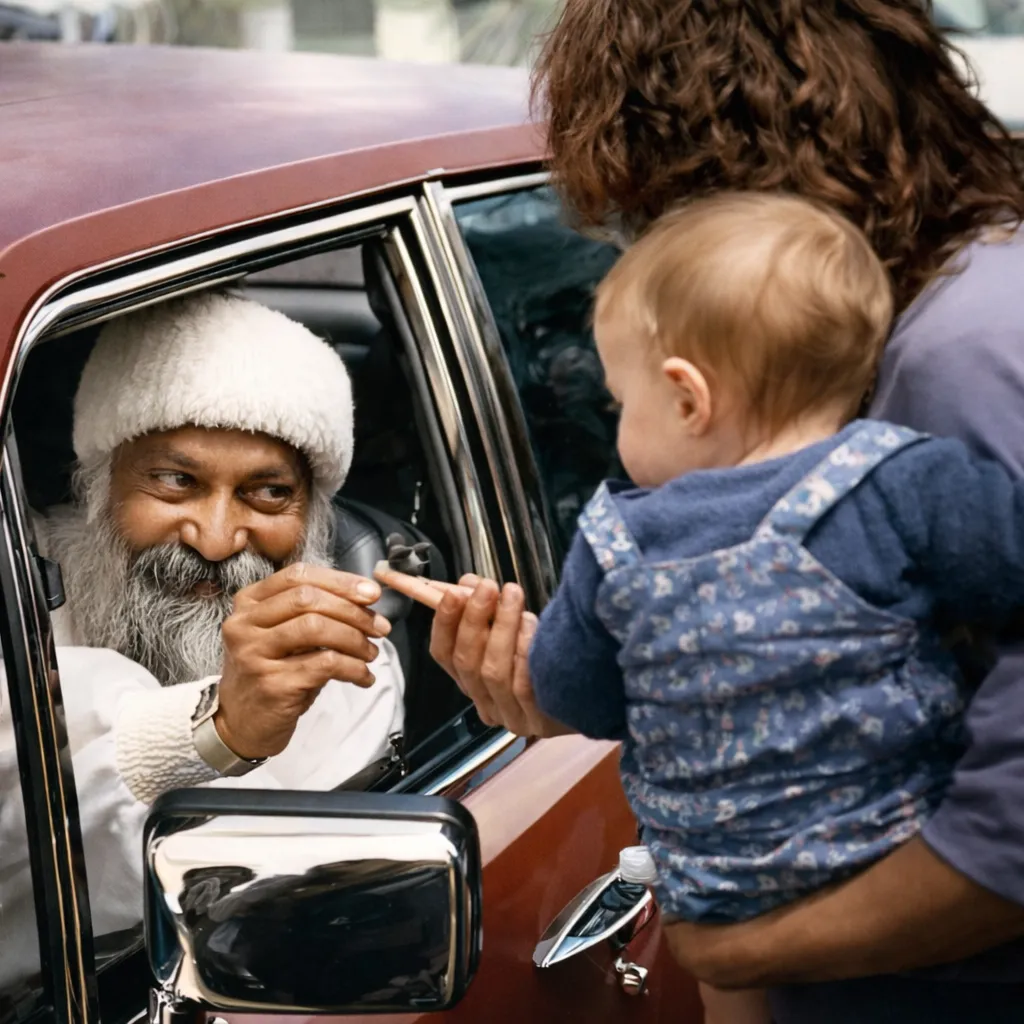
Let the old you fall away without fear, and what looked scary turns into a welcoming place where love meets you.
From the Discourses
Passages where Osho speaks to this question — each links to the complete discourse.
Osho, On the gallows lies the Beloved’s bed—by what method can one meet Him? Come, Beloved, come; tears stream from the eyes, the heart aches—Beloved, come and meet me.
“The Beloved’s bed is on the gallows”—it has always been so. But the gallows is what we see because we are uncomprehending. We have not yet learned the Beloved’s language; the Beloved’s symbols have not opened before us. We have tried to understand the Beloved through our own language. Therefore it seems: the Beloved’s bed is on the gallows. Anxiety arises. Who would not be afraid of dying? Coming to the master brings a tremor, a restlessness. A young woman came to me the evening before last. She had traveled from California. She said, “I want to return at once. First, I don’t even understand why I came; and now that I am here, I fear I may not get back alive.” She began to weep. “I have a child, a husband. Please let me go.” She has seen the gallows. But within those gallows there is also a faint…
Osho! I set out to seek the Beloved; how is union with the Beloved attained?
Yog Neelam! The Beloved is not far. Not even so far that any meeting would be needed. There has only been forgetfulness, not separation. Separation cannot be. The Beloved abides within. He is the breath of our breath, the heartbeat of our heart. Without him we have no being. Because he is, we are. As the ocean is, so the waves are. The ocean can be without waves, but the waves cannot be without the ocean. Yet a wave can fall into a delusion—the delusion that “I am separate from the ocean.” In that very delusion, forgetfulness happens. Only forgetfulness happens; separation cannot. The whole search for the Beloved is nothing but remembrance—re-remembering. That is why the saints have called this search surati. Surati means remembrance, recollection. Surati is the folk form of the word smriti. What the Buddha called smriti, by the time of Kabir and Nanak became surati—dearer,…
Osho, it seems as if a constant benediction showers from your eyes—sweet and tender. Your eyes move over the listeners, and the moment they fall on me it feels as if a spear has pierced my innermost core. My whole body trembles. Something like death happens. But why does the ultimate death not take place?
The goldsmith puts gold into the fire. If the gold had a little intelligence it would scream and writhe, saying, What are you doing—will you kill me? But how could the gold know that this is the very process of becoming pure? Passing through the fire, whatever remains is kundan, pure gold. What does not die in you even when you die—that is the soul. What is not erased in you even when you are erased—that is your true being. You will have to pass through death. If you go from me having learned anything else, you will have gone collecting trash. If you go having learned death, you have taken the key. We have called India’s supreme mystical scriptures the Upanishads. Upanishad means to be near the master; it means to sit close—just that. What happens by sitting close? By sitting near one who is gone, the courage to…
Osho, O friend, tell me the enchanting tales of the Beloved. My body is without virtue, impure; I have done no garlanding or adornment. I know nothing of the ways of love. My bosom trembles with fear. The Beloved sits enthroned within the palace; I remained entangled in household chores. Not even for a single moment did I keep His company; all the nights passed in vain. The Beloved sleeps in a lofty turret where the grief of lovers does not reach. By which path may I go to meet Him? In what manner shall I compose and write the letter? I lose myself in this bhajan. Please explain its purport.
One day it will happen that before the bhajan, you are; in the singing, you are lost; the singing ends many times, and you return again and again. Again you lose yourself, again you return. One day it will happen: you will be lost, the bhajan will end, but you will remain lost—you will not be able to return. That day the meeting happens. That day the letter is written. That day the address is found. Keep drowning. Practice drowning; keep taking the plunge. If not today, then tomorrow; if not tomorrow, then the day after—some day that auspicious moment will arrive: you will drown once, and there will be no coming up. Where you do not remain at all—there you will find that what remains is the Divine. “Though by body You are separate in every way, yet from the heart You are not far. These hands have not…
Osho! Without intending to, my eyes happened to meet yours, and suddenly spring burst into my life. What is death—how should I explain it to the world? A traveler dozed off along the way. The veil lifted from your face and the moon grew shy; your tresses scattered and dark clouds gathered. The heart no longer has its former turmoil; now the hour to dissolve in love has arrived.
Anand Mohammed! Human intentions never reach God—they cannot. A person’s intentions are only extensions of his passions and desires. Even if a person seeks God, he will not seek God for God’s sake, but for something else—for wealth, for position, for prestige. There are temples, mosques, churches, gurudwaras. So much worship, so much prayer, so much adoration—and all of it false. The intentions themselves are not pure; the mistake is at the very foundation. People are praying, but their prayers are only the forms of repressed desires—each is a demand. And where there is demand, what kind of prayer is that! Prayer is gratitude, the feeling of grace. Prayer is the “Ah!” that says: So much has been given that I was not worthy of! My vessel is small; my little pitcher has been filled from the ocean! And even if I were to want, what would I want! Even…