
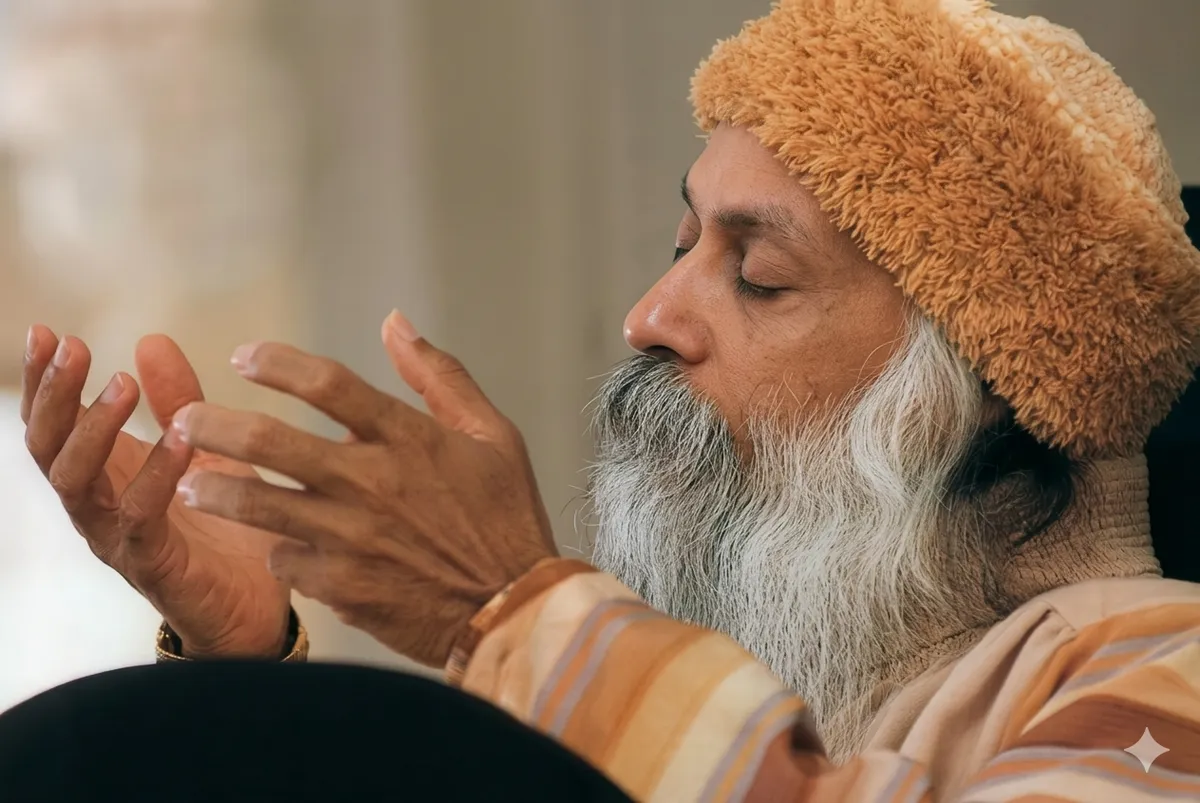
Crying and laughing look opposite, but in deep love they come from the same heart, so both can happen together and are okay.
From the Discourses
Passages where Osho speaks to this question — each links to the complete discourse.
Osho, in the pangs of separation from the Beloved, the devotee sometimes weeps and sometimes laughs. What kind of contradiction is this?
Or tell me outright that relief is not in my fate. If You must give, then give today—not on the Day of Judgment. How long is one to wait? And yet he knows too, he understands too— To complain to Him is futile, Seemab: It is you who are not yet worthy of His gracious glance. He knows this as well: What cause for complaint? What is my worthiness? I am not yet even fit for His compassion! So wearied am I by these mirage-like thoughts, My heart wishes even you would not come into thought. Exasperated, I would break this enchantment of thought— Or make me certain that it is You who dwell in my thought. Sometimes he becomes so harried by remembering and remembering, by weeping and weeping, that he says: I am so tired, so afflicted...so wearied am I by these mirage-like thoughts—by thoughts of you, by…
Osho, in the state of separation (viraha), is the devotee miserable or happy?
And there is delight in it. There is delight even in weeping! For the first time crying does not seem the opposite of joy. This is the secret that unfolds in the state of separation. For the first time one feels a harmony between tears and smiles. Tears themselves seem to smile; tears themselves seem to dance. Ordinarily we have known tears only for sorrow; the devotee comes to know the tears of joy. The pang does sting, yes—but within the pang is a sweetness, a honeyed savor. Call it a sweet pain—honey-drenched, intoxicating. The arrow of separation pierces the heart, and a stream of nectar flows. This happens together. I have tasted such rapture that even feeling it became difficult; as your pain kept dwelling in my heart, it itself became my heart. At first, life in love was impossible; now the end is such that even dying has…
Osho, you say that only those who go dancing and singing gain entry into the temple of the Divine. But the devotee-saints advise going there with an offering of pain and tears. Please, compassionately clarify this contradiction.
Pain, too, has a song, and tears have their own dance. The truth is, no song rises like the song that rises out of pain, and no dance is as alive as the dance of tears. So there is no contradiction. Go dancing and singing. In dancing and singing everything is included—pain comes, weeping comes, tears come. When I say, “Go dancing and singing,” I am saying: go filled with trust; the union will happen. The meeting is certain. There is not a grain of doubt in it. Of course there is pain. Until the union happens, there is sorrow, there is anguish. “Someone should ask my heart about your half-drawn arrow: whence this lingering sting, if it had pierced all the way through?” The arrow has struck, but it has not gone clean through. Therefore the ache is great. To attain the Divine—this fact has lodged in the heart…
Osho, why do devotees weep? What is the relationship between weeping and meditation?
If devotees did not weep, what else would they do? Why do little children cry when they are hungry? Why does the baby in the cradle cry when thirst arises? That is why devotees cry. Devotees are calling out to Existence itself. And before this vastness the devotee is as helpless as an infant—perhaps even more helpless. Do you see this immensity? What is our strength before it? Do you see this infinity? Where are we before it? Who are we? What are we? We are not even a speck. What standing does a speck have? If this speck does not weep, what else can it do? In helplessness, in darkness, wandering for lifetimes, what else can the devotee do? Had they not been threaded on the bond of sorrow, the pieces of the heart would have lain scattered. It is this cry, these tears, that bind them together— had…
Osho, a contradiction arises. As you said in Bombay about Krishna—and again here at the outset—that Krishna’s life was a transcendent and miraculous life: laughing, playful, blossoming like flowers. Whereas the lives of the others were suffering-centered. No one ever saw Jesus laughing. So if a devotee asks for suffering, stays gloomy, never laughs, then how is that transcendent vision of Krishna fulfilled? I would like to know this from you.
The devotee who asks for suffering is not a suffering-monger. A suffering-monger creates so much suffering for himself that there is no need to ask anyone for more. Does a suffering-monger go to ask someone for suffering? He already lives in so much suffering that you cannot give him any more. A devotee asks for suffering because he is already receiving plenty of joy; he wants to taste suffering too, with which he is completely unfamiliar. A devotee is never miserable, and even if he weeps, his tears are tears of bliss. Devotees have wept much, but their tears are not tears of sorrow. We make a big mistake because we ourselves have cried only in sorrow; we have never cried in bliss. So we have tied tears to sorrow as if inevitably. But tears have no necessary relation to sorrow. Tears are related to overflowing. Whenever any feeling crosses…