
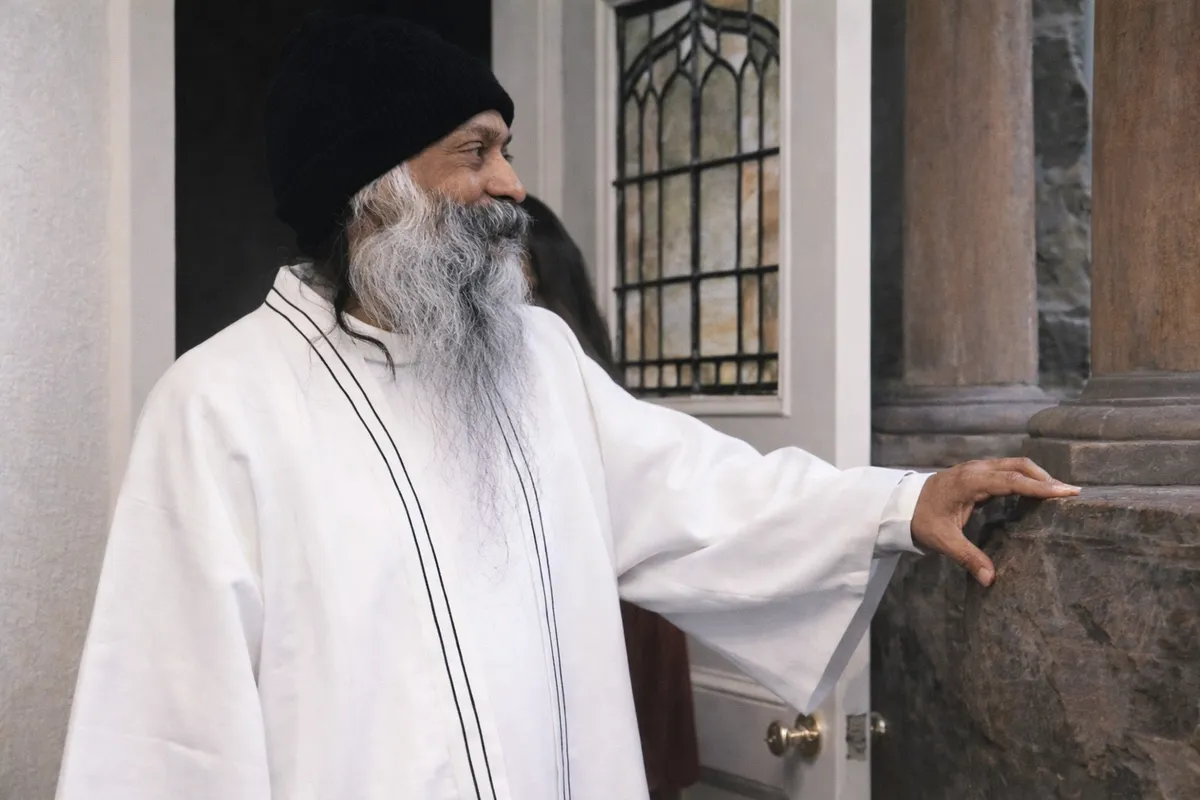
Consciousness is like a flashlight for the dark; when the sun of nirvana rises, you put the flashlight away and simply live in the light.
From the Discourses
Passages where Osho speaks to this question — each links to the complete discourse.
Osho, Gautam Buddha does not accept a soul, but he does accept consciousness, heedfulness. And perhaps consciousness is the ultimate—or does even that have a nirvana?
It will be hard to understand. Consciousness too attains nirvana. Because consciousness is needed only so long as there is unconsciousness within you. As long as there is darkness in the house, there is a need for light. And as long as there is illness within, there is a need for medicine. When the illness has gone, what will you do with the medicine? And when darkness is no more, what will you do with the light? In the morning you put out the lamp, don’t you? Once the sun has risen, what will you do with a lamp? If, after the sun has risen, you still walk around carrying a torch, people will think you are mad. A final moment comes when even consciousness is no longer needed. Such an immeasurable consciousness is spread on all sides that what question remains of your own consciousness? To carry even that…
Osho, before discussing the process of entering a conscious death, I would like to ask: what is the difference between stupor and awakening? What do we call the state of unconsciousness? In other words, in wakefulness and in unconsciousness, what is the state of the jivatma’s consciousness?
Religion is a search for attention; so, in their own way, are gambling, battle, hunting. The man who enters the forest to hunt a lion is also seeking attention; so is the yogi in a cave striving at the ajna chakra. The search may be noble or ignoble, desirable or undesirable, successful or futile—but the underlying hunger is one. Attention means: the knowing power within me becomes fully manifest—no part left potential or dormant. Whatever capacity to know I carry turns from potential into actual. In the moment a person is fully awake, in that very moment he fully is. Awakening and being happen together. Think of a seed: the tree is hidden in the seed, but only potentially. The seed can die without becoming a tree; the tree is not a necessity, only a possibility. When the tree manifests, it is the seed in its expressed form. Sleep is…
You often speak of becoming a buddha. But shankara often said that buddha only brought his disciples to cosmic consciousness, while there are still higher states of consciousness, such as unity consciousness and brahma consciousness.
PLEASE WILL YOU COMMENT ON THIS AND, IF YOU KNOW, TELL US ABOUT THE PATHS WHICH LEAD TO THESE STATES. BUDDHA has not talked about cosmic consciousness at all. He talks about ultimate no-selfness beyond which there is nothing, beyond which there cannot be anything. He talks about the total disappearance of the ego. All other states belong to the ego: "I have attained this, I have attained that, I have attained that -- cosmic consciousness and unity consciousness and Brahma consciousness...." Who is attaining these things? There must be some identity, some 'I', howsoever subtle. Shankara remains confined to the self. He goes on refining it, polishing it, but he never goes beyond the self. Buddha goes to no-self. Now no-self cannot have many states. No-self is simply no-self -- utter nothingness. How can nothingness have states? It is impossible, because two nothingnesses cannot be different. Nobody has gone…
Osho, in the Chandogya Upanishad there is a sutra: na pashyato mṛtyuṁ pashyati na rogaṁ noto duḥkhatām, sarvaṁ ha paśyaḥ paśyati sarvam āpnoti sarvaśa iti. That is, the knower does not see death, nor disease, nor sorrow; he sees all as the Self and attains everything. You are a witness—does a buddha truly see even death, disease, and sorrow as the very Self? Kindly give us direction on this sutra.
Buddha uses nirvana in exactly this sense. When the flickering lamp of ego is extinguished, the whole sky is yours. The moons and stars are yours. When you are not, everything is yours. Understand this paradox well—here lies the secret of religion, the distilled essence of the mystics and seers. The sutra of the Chandogya is profound—very profound. Let the ego dissolve; you are no more; then all is yours. When you are not, nothing is “other.” It is the “I” that creates the “you,” the division. When the line of “I” disappears, the courtyard becomes the sky. Demolish the walls you have drawn around your yard—your courtyard is the open heavens. Na pashyato mṛtyum... To the knower death is not seen—he does not know death, he does not die—because whatever could die he let die in advance. Ego could die—and what is unreal alone can die. What is, is…
Osho, Buddha has said that those steadfast ones who practice meditation continuously attain the unsurpassable ease and security called nirvana. Are there kinds of nirvana?
It is said of the Zen master Rinzai that he had eighteen hundred satori experiences before samadhi. Eighteen hundred is only symbolic; they could be eighteen thousand. However many glimpses there may be, a glimpse is only a message: “I am coming closer, closer”—but I have not yet arrived. The goal begins to be seen, and then it is lost again, because the moods of the mind keep changing. On some days meditation settles easily—the mind is buoyant, quiet, blissful. On other days it does not settle—there is a miss, and a great distance arises. So there is often a coming near and a moving far. But once the glimpses begin—once the taste comes—you cannot be led astray. One thing is now certain: what you are seeking is. It is not imagination. Whatever the births it may take, it is. Faith arises. And as soon as faith arises, satori slowly…