
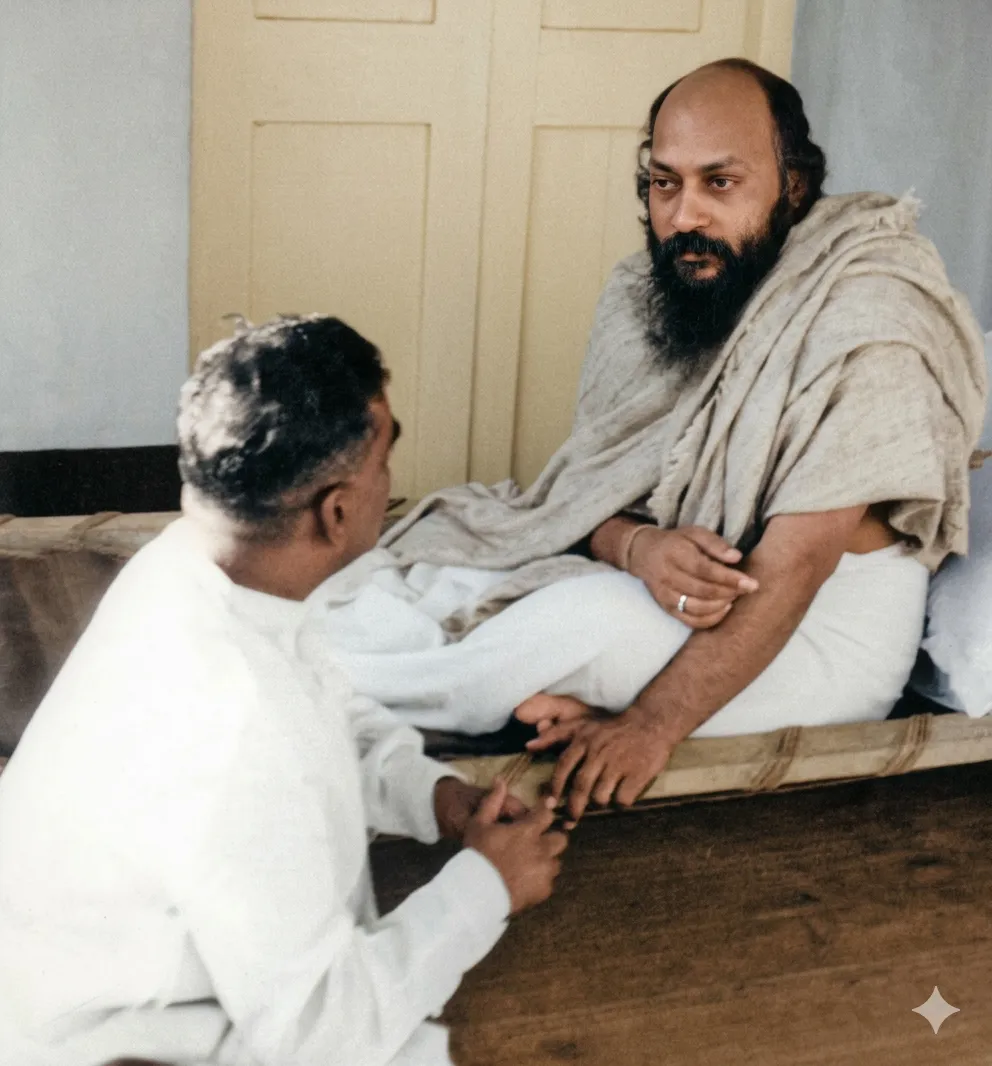
There’s no real gap between family life and being a seeker—they’re one path, with family life helping you grow into true sannyas.
From the Discourses
Passages where Osho speaks to this question — each links to the complete discourse.
Osho, the ‘and’ that has come between the sannyasin and the householder—what is it, what is it like, and how long will it last?
Arjun! The ‘and’ that has come between the sannyasin and the householder is thanks to your mahatmas. Otherwise there is no need for any ‘and’. Householding is the very ladder to sannyas. There is no need to differentiate between the two, no need to draw a boundary. Where does householding end and where does sannyas begin—no one can say exactly. Householding itself becomes sannyas. Simply understand the life of a householder rightly: the householder’s life is a school for sannyas. If the householder is the seed, sannyas is its flower. If householding is the climate, the prologue, the preparation, then sannyas is its fulfillment. But your mahatmas have declared sannyas and householding to be opposites and have created an upheaval. For centuries you’ve been taught that sannyas is the renunciation of life—of home, hearth, wife, children. Hence a panic has spread. If someone becomes a sannyasin, his family panics. The…
Osho, in the classical tradition the sannyasin turns away from māyā and sensual enjoyment and orients himself toward God-realization; yoga and bhoga are known to be mutually opposed. But in your sannyas there is no emphasis on dispassion from enjoyment. Therefore, kindly clarify your conception of sannyas!
So first thing: religion is not tradition. Religion is ever ancient and ever new. It is a paradox. It has always been—and yet each time it must be discovered anew. When the sun of religion rises, it is private, personal, not collective. It does not become society’s property or legacy. If you do not trust Buddha, Buddha has no way to make you trust. Have you thought about this? If you say, “We doubt you: you claim God-experience, but how are we to believe it?” Buddha will shrug his shoulders: “What can be done? What happened is private, personal. There is no way to spread it out on the table before you. It happened within; there is no device to bring it out. It happened so deep that it cannot be exhibited for all to see.” That is why there have been so many perfectly awakened ones, yet atheism has…
Firstly, it is a long time that sannyas has remained isolated from the world, and consequently it has been doubly harmed. A sannyasin living completely cut off from the world, living in utter isolation from the world, becomes poor, and his poverty is very deep and subtle, because the wealth of all our life's experiences lies in the world, not outside. All our experiences of pain and pleasure, attachment and detachment, hate and love, enmity and friendship, war and peace, come from the world itself. So when a man breaks away from the world, he becomes a hothouse plant, he ceases to be a flower that blooms under the sun and the open sky. By now, sannyas has become a hothouse plant. And such a sannyas cannot live any longer. Sannyas cannot be grown in hothouses. To grow and blossom, the plant of sannyas needs an open sky.
Osho, what is the first experience of samadhi like?
You will know only when it happens. It cannot be said; at most a few hints can be given. It is as if, in the dark, a lamp is suddenly lit. Or as if a dying patient, right at the edge of death, suddenly finds a medicine that works; life’s wave, life’s thrill spreads again—so it is. As if a corpse becomes alive—such is the first experience of samadhi. It is the taste of nectar. The experience of the ultimate music. But it will be only when it happens; and only then will you understand. You will not understand by my saying it. It is as with love. How can anyone explain it? To someone who has never loved, never known love, no matter how many explanations you offer—he will hear it all and still ask, “I haven’t understood; please explain a little more.” It is like explaining light to…
Osho, for the past two or three days many listeners, seeing the new sannyas and the new sannyasins around you, wish to hear about them from your own mouth. Please say something on this.
Such are man’s limits. To think that the whole of humanity is one is beyond the ordinary man’s limits. To think that all temples and all mosques belong to the same God is difficult. For the limits of the ordinary, it will be hard. But sannyas is a declaration of being extraordinary. So the second point: sannyas is an entry into religion—not into Hinduism, not into Islam, not into Christianity, not into Jainism, but into religion. What does this mean? Against Hinduism? No. Against Islam? No. Against Jainism? No. For that in Jainism which is religion, and against that which is merely Jain. For that in Hinduism which is religion, and against that which is merely Hindu. For that in Islam which is religion, and against that which is merely Islamic. Against the limited, and for the unlimited. Against the formed, and for the formless. A sannyasin belongs to no…