
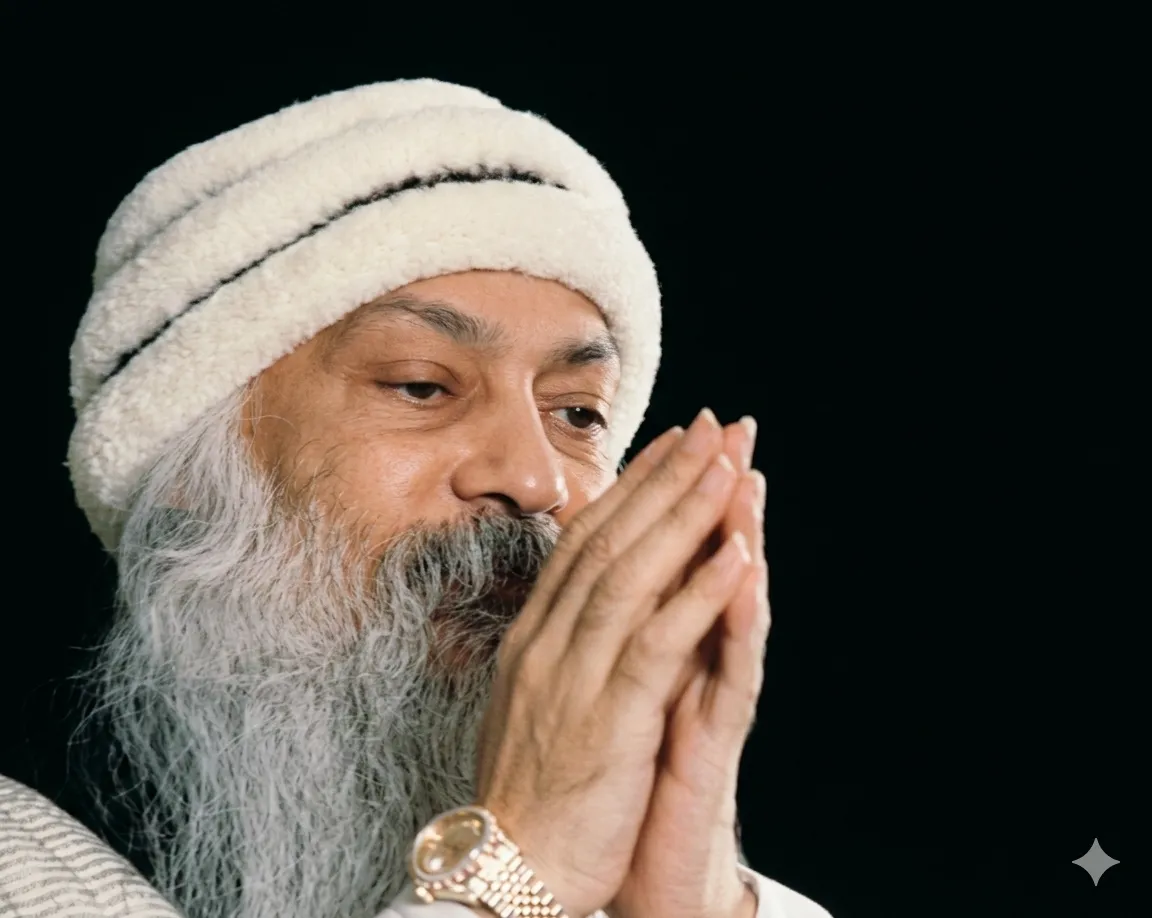
Your tears are happy-tears from your heart opening; let them flow—they show you’re joining with something bigger.
From the Discourses
Passages where Osho speaks to this question — each links to the complete discourse.
Osho, when I listen to you, every word sinks to the depths of my heart and stirs me. But when I read you, it remains a mental game. Please tell me why this happens.
It’s plain. The arithmetic is simple. When you read, only you are there; I am not. What you read is nothing but you. It becomes a game of the mind. When you listen to me, then sometimes—knowingly or unknowingly—I also slip into you. You seldom give such a chance, but now and then a lapse happens on your side. Unaware, you leave the door a little open—and I come in. So when you are hearing me, it’s a different matter. That is why truth has always been spoken, not written. It cannot be written. Even speaking it is very difficult, yet it can still be said—at least a little can be said, a little news can be given. Because in speaking, many elements are involved that are lost in writing. When you read a book, the book is dead. A book cannot create an atmosphere around you. A book has…
Osho! While listening to you I start to weep. Now, even in the celebration of active meditation, tears burst forth. What is this? In the midst of meditation a feeling arises that this body is a hindrance now; how can it be shed—the feeling keeps growing more intense. Why? Please explain out of compassion.
Akshay Vivek! Human beings have been given such wrong conditioning that they have neither ever cried to their heart’s content nor laughed to their heart’s content. They have never really lived to their heart’s content. In no aspect, in no dimension, have they ever done anything totally; everything remains half-done! So many things hang inside, suspended like Trishanku. I say meditation is a celebration, but what is happening to you happens to others as well. While celebrating, suddenly tears arise from some unknown corner! They must have been suppressed somewhere—perhaps for lifetimes. Especially in men. Because from childhood we tell boys: Don’t cry! Girls cry. You are a man; crying is not for you. This is false. It is utterly false. Nature has made the tear glands in the eyes of men and women just the same. Men’s tear glands are not smaller than women’s. So one thing is certain—nature…
Osho, why do devotees weep? What is the relationship between weeping and meditation?
If devotees did not weep, what else would they do? Why do little children cry when they are hungry? Why does the baby in the cradle cry when thirst arises? That is why devotees cry. Devotees are calling out to Existence itself. And before this vastness the devotee is as helpless as an infant—perhaps even more helpless. Do you see this immensity? What is our strength before it? Do you see this infinity? Where are we before it? Who are we? What are we? We are not even a speck. What standing does a speck have? If this speck does not weep, what else can it do? In helplessness, in darkness, wandering for lifetimes, what else can the devotee do? Had they not been threaded on the bond of sorrow, the pieces of the heart would have lain scattered. It is this cry, these tears, that bind them together— had…
Osho, the moment I arrived here, intellect turned into heart and words into silence. While listening to you, my heart sometimes begins to flow as tears. I am doubtful whether this state will remain when I return home. Kindly explain how this state can be stabilized.
First thing: a human being has nothing more sacred than tears. There is no prayer greater than tears. People have known only one form of tears—tears of sorrow. But there is another form—tears of joy. Very few have known it; very few ever come to know it. When you see someone crying, you think he must be unhappy, in pain, wounded, burning. Not necessarily. Tears flow whenever any feeling becomes so intense that you cannot contain it—any feeling. If sorrow grows too much, it overflows as tears. If happiness grows too much, it too overflows as tears. Great pain flows out and lightens the heart through tears; great bliss also flows out as tears. So first, do not tie tears inextricably to sorrow. Deep down our minds have been conditioned to think tears come because of suffering. So we hide them, we hold them back. We try hard that tears…
Osho, we have to leave tomorrow. Out of your grace, please tell us: are the tears that flow in the beloved’s separation themselves his meditation, or is meditation something else? If meditation is something else, what meditation is that?
Honor these tears! Do not hold them back! In this, women are more fortunate than men, because women have not been taught the stupidity of “don’t cry.” Men have been taught this stupidity a lot. To small boys we say, “You are a manly child; don’t cry! Don’t do girlish things!” As if crying had anything to do with girls! The right to cry belongs to men exactly as it does to women. Crying is an extraordinary alchemy. One who has not passed through it will be deprived of certain experiences; some depths of life will never be known to him; some music of life will never be heard; some songs will never arise within. One who has not known tears will not know compassion, will not know love, will not know sympathy, will not know kindness. Without tears, life becomes arid—a desert—without oases. In this desert-like life, tears are…