
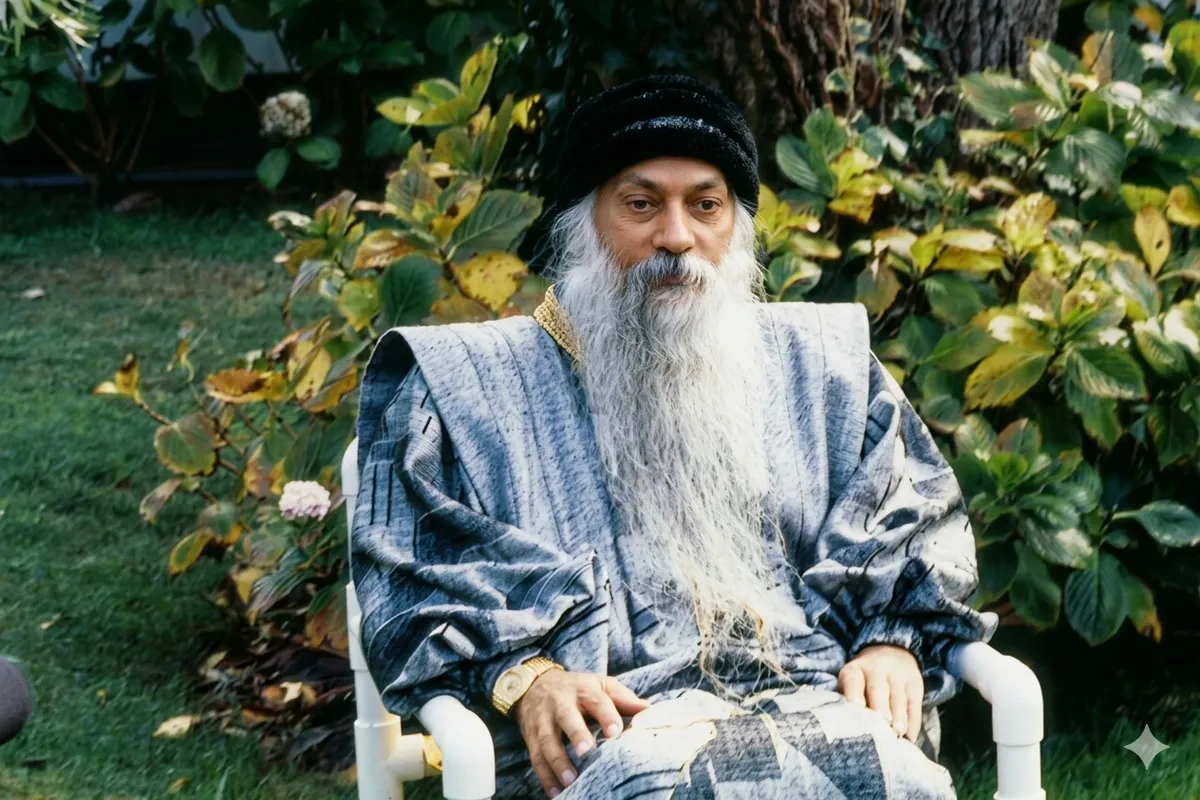
Showing gentle, consensual love in public bothers repressed people because it wakes their hidden desires, but it also helps society become warmer and less violent.
From the Discourses
Passages where Osho speaks to this question — each links to the complete discourse.
Many times when I see our friends hugging, kissing passionately, and caressing each other's bodies, I feel that it is this sight which offends indian society in general and creates great misunderstandings about you and your teachings. With this particular type of behavior, if the society is offended and great difficulties are created for the world of our master, why shouldn't we simply correct our behavior when we are in society, whether in india, america, or germany?
Siddhartha, this is what I have been talking about: the rotten mind. What is wrong in hugging a person you love, in kissing a person you love? Don't enforce your hug on anybody, that's true; then it is ugly -- and that's what the Indians go on doing. And my women sannyasins are aware of it. If you are there in the marketplace, then Indians behave really in an ugly way. They will pinch your bottoms. Now, that is ugly. They will rub their bodies against your body. That is ugly. They will look at you as if they would like to eat you. That is ugly. They will look at you as if they would like to see how you are behind your clothes. That is ugly, but that is accepted, that is perfectly good. If you love a person and you hold hands and you hug each other…
Beloved Osho, when I look around your commune and see people hugging the way they do, and feel the energy I have when I hug someone here, I wonder why this doesn't happen in the outside world. Please comment.
In a more humane society the woman will not feel offended. And deep down she does not feel offended now. Even after thousands of centuries' conditioning, her feeling of being offended is superficial. Deep down she rejoices, deep down the undercurrent of nature is there. Not to look at a woman again, not to look back, is certainly an insult. Not to look in the eyes of a man or woman for more than three seconds is humiliation. You have rejected the person, you have not been nice to the person. Hugging is closer than seeing. If seeing makes people offended, if in shaking hands people shrink their energy back.... People use the phrase "a warm welcome," but it rarely happens. It is always a cold welcome because your energy moves back. Your hand is just cold, not radiating warmth. There are dangers for the religious people: if your hand…
Osho, I have never been able to express my love. Not only ordinary worldly love—even the love I feel for you I keep hidden. I don’t know what fear has crippled me! How will this underdeveloped love become devotion?
It is humanity’s misfortune that the culture and civilization that have evolved on earth so far are anti-love. They side with war and oppose love. This is not much of a civilization; it is very primitive. It lives by war, not by love. It is hostile to love—deeply afraid of it. You can see it—thousands of obstacles are raised against the expression of love. Thousands of walls are built so that love does not happen. For centuries child marriage continued only to prevent love: before love’s tide could rise, marry them off—then the tide won’t rise and there will be no trouble. Men and women are kept apart, large distances are imposed between them. Boys and girls are not allowed to study together in school or college; and even if they are, their seating is kept separate. All kinds of barriers are erected. And every kind of fear is instilled:…
Osho, ever since contact with your disciples, your literature, and ultimately with you yourself has become available, a current of love has begun to flow in my life. Everyone and everything has begun to look good to me. But many times, when, filled with love, I want to embrace another, the other person becomes hesitant and then I withdraw. Please tell me what I should do at such times?
Yes, give him your experience. But let that experience not be an order. Hand over to him the wealth of what you have known. But give him the right to choose—whether to agree or not. If he does not agree, do not be angry. If he agrees, do not be elated. For it is through the politics of our pleasure and displeasure that we coerce children. A father tells his son, “Do as you wish.” But if the son acts against the father’s wish, the father looks unhappy; then the son wants to make the father happy: “All right!” If the son acts according to the father’s wish, the father is pleased; then the son wants to please the father: “All right!” In this way, slowly, the son’s soul is lost. That is why there is such a crowd in the world and so many soulless people. Where is the…
Question: Second question: Osho, I am afraid to ask this, yet I cannot refrain from asking. Today when you spoke about the feminine touch, every word pierced me like an arrow. Yesterday after the discourse I went to the reception and “Darshan” said to me: “I want to embrace you.” I hesitated a little, but I drank in the feeling with which she said it, and we both sank into each other’s embrace, as if time stood still. Yet even in this deep, innocent embrace, my male-feeling remained. Then I remembered that in these fifty years of life, except for my wife, I have never embraced anyone with feeling—not even my mother, daughter, or sister. Tradition would consider this an ornament, a virtue. But now it seems to me this has been my blockage.