
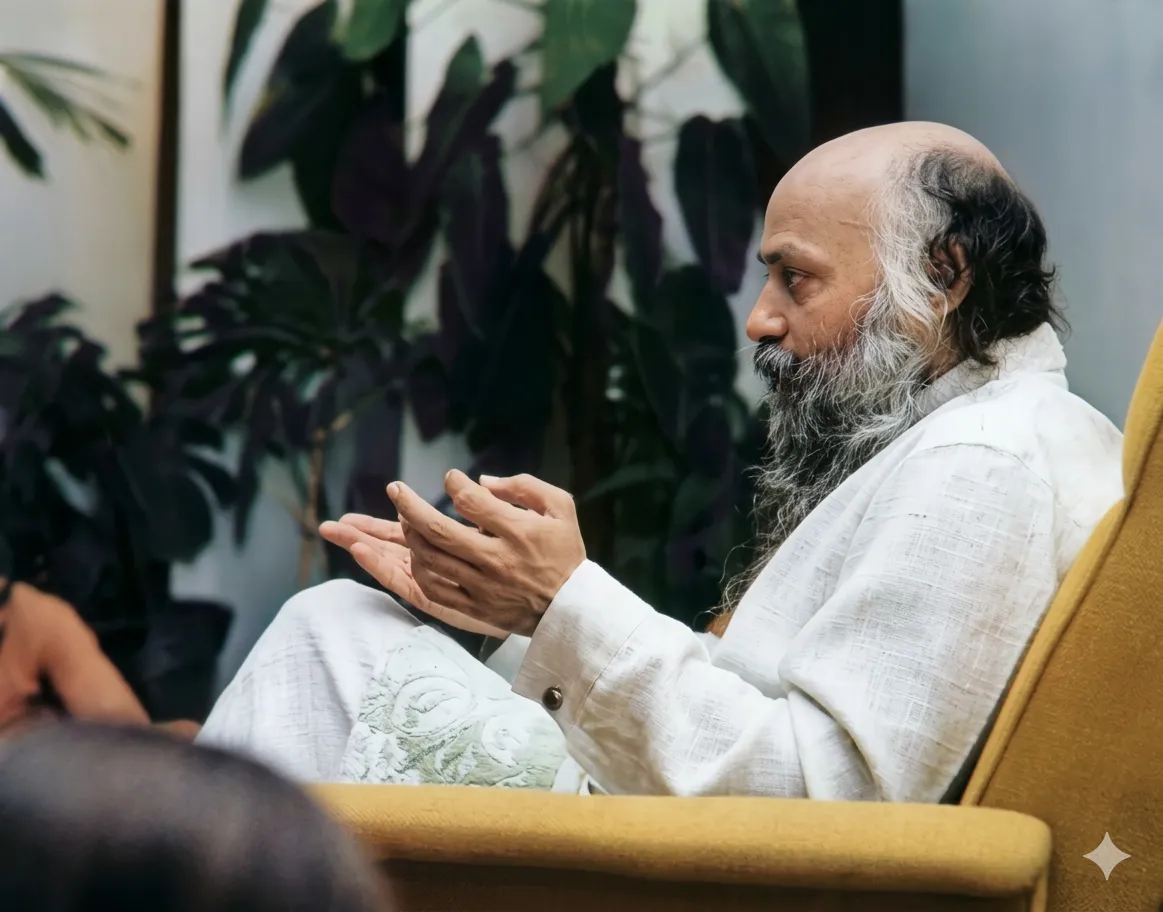
Stop searching or surrendering; be still now—nothing is missing, you already are what you seek.
From the Discourses
Passages where Osho speaks to this question — each links to the complete discourse.
You said there are only two types of people: those whose path is awareness and those whose path is surrender or bhakti. It seems to me that lao tzu has nothing to do with either of them -- is there a third type then who follow neither or both?
Yes, there are two types of people, two types of persons. Humanity is divided into two types: the male and the female, the yin and the yang, the negative and the positive, the aggressive and the passive. These two types of people both live in illusion, in a sort of dream, a kind of sleep; drunk with desire, blind with desire. The person who belongs to the male type needs some path upon which he can exercise his will; that will suit him. Finally, a day will come when by this exercising of his will, by and by, he will start understanding that he is engaging in a futile effort. But he will take a long time to understand this. He will have to fall many times, and he will again stand, and he will again make efforts, and he will again be a failure because the will cannot succeed.…
Osho, yoga is a method of upward ascent; it seeks to take energy, power, upward. And Lao Tzu’s method seems exactly the opposite—to bring energy downward, toward the navel. So a question naturally arises: between these two methods, which one is right?
A disciple of Lao Tzu, Lieh Tzu, was once asked: We have heard that the Buddha attained enlightenment sitting under a tree. And we have heard that some yogi, chanting a mantra, sitting under a tree, attained truth by his mantra. Lieh Tzu, what is your view? Lieh Tzu said: As we understand it, chanting mantras, doing practices, performing yogasanas—these are for those who cannot remain without doing. But the real point is not that Buddha arrived by practice; he arrived because he sat. The essential thing is: he sat, therefore he arrived. Some yogi kept reciting a mantra and arrived; the mantra is not the essential thing. He arrived because he sat. The mantra is a pretext—for he cannot sit empty, so he keeps reciting. Lieh Tzu is saying: whoever has arrived, has arrived because they sat and left everything. Some can sit having left everything; they will not…
Osho, you said... then you will find that the devotee is God. The question arises: if one devotee prefers to be God and another wants to remain only a devotee, then which of the two is superior?
The one who wants to be God will not be able to be. And the one who wants to remain a devotee will become God. The question of superior or inferior does not arise, because only one of the two will happen. The one who does not want to be will be. The one who wants to be will be deprived. That very wanting is of the ego. But the matter is a little delicate. Sometimes humility too belongs to the ego. Beware that your humility may not be of the ego. Perhaps you are saying, “No, I don’t want to be,” because you know that those who refuse are the ones who attain. Then you are clever. Then your humility is adulterous. Your humility is not pure, not sacred, not virginal—it is like a prostitute. The one who wants to be God, whose ego says, “I must become God,”…
Osho, please tell us: are not all of Lao Tzu’s teachings the teachings of a defeated, beaten man? At their root, isn’t there a negative attitude, a kind of escapism? Won’t this policy of tathata—of acceptance—end up encouraging exploitative systems? And finally, can we not call these teachings mere theoretical idealism? They are not practical, nor do they show any way to be free of doing or to be de-hypnotized.
No. If we understand life rightly, Lao Tzu is not running away from life; he is only stepping away from stupidity—from the fire, from the disease. He is going deeper into life. And we, thinking we are advancing in life, go on advancing into sheer stupidity and are deprived of life. What is the final criterion? Compare Lao Tzu’s face with ours. Lao Tzu, untroubled even while dying; we, anxious even while living. Lao Tzu joyously embraces death; we have never embraced life with joy. Lao Tzu laughs even in illness; we keep weeping even in health. What is the measure? Put thorns in Lao Tzu’s hands and he is grateful; put a flower in our hands and no gratitude arises. By what path shall we recognize? What standard? Lao Tzu is no escapist. And if he is, then everyone should be an escapist—then escapism is religion. Because by escaping…
A friend has asked: Osho, you said about a wayward son that one should let him pass through his experiences, and he will learn on his own. But even after experiencing, he still prefers the same thing—someone is asking about his wayward son—no matter how much suffering he has to endure, even if death itself should come, still he does the same. After stumbling again and again, he repeats it. What can be done? How to reform him?
You will not be able to reform him. If life cannot reform him, if even death cannot reform him, what will you be able to do? If what you say is true—that again and again, even after suffering, he does the same thing; even if death comes, he will still do the same thing, and he does not change—then take your hands off. You will not be able to reform him. You cannot be stronger than death. And one who does not learn from suffering—what will he learn from you? Do not call him a wayward son. You have found yourself a Jadabharata. Because those whom suffering does not reform, whom even death does not reform—these are great, arrived masters; they are in the ultimate state. Do not even try to reform such a one. And why are you so eager to reform another? It is enough to reform yourself.…