
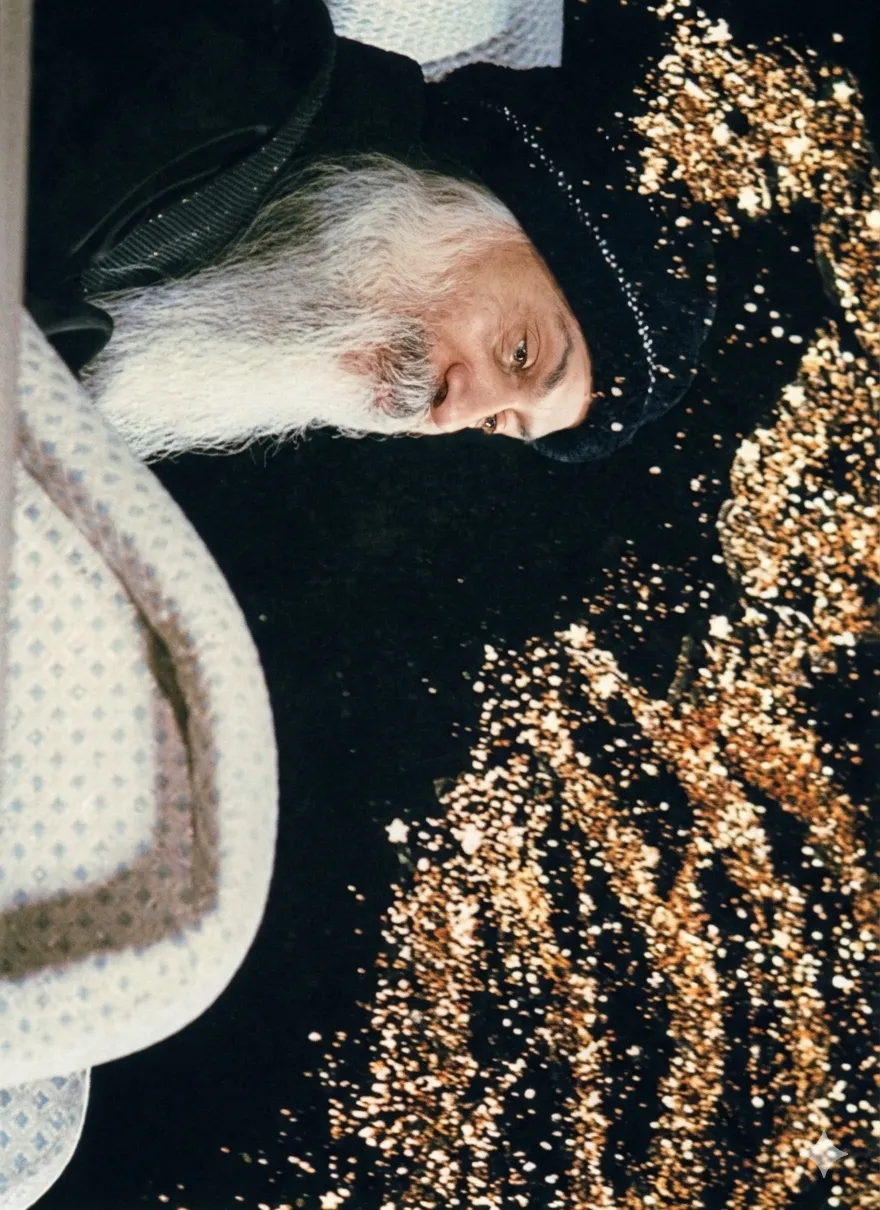
You just know inside, not because anyone tells you; after searching and getting tired, you settle into yourself and it’s obvious.
From the Discourses
Passages where Osho speaks to this question — each links to the complete discourse.
Osho, should one just keep watching it? Keep feeling it? What thought should be there at that time? What feeling should be there at that time?
So you can prevent meditation from happening—and you are preventing it—but you cannot make it happen. Our whole problem is very reversed. The reality is that when someone asks me, Meditation is not happening, he is asking the question upside down. In fact, he is striving with all his life’s breath to make sure that meditation does not happen. He has spoiled lifetimes to see that meditation does not happen. And for meditation he has erected a thousand kinds of barriers so that it cannot happen. You are fully arranged so that you do not become a witness. And then when you hear from someone that there is great bliss in witnessing, you think, All right, let me also become a witness. So you try to become a witness too. And all your arrangements to prevent witnessing continue as before; nothing in them changes. Within that very setup you also…
Osho, what is the first experience of samadhi like?
You will know only when it happens. It cannot be said; at most a few hints can be given. It is as if, in the dark, a lamp is suddenly lit. Or as if a dying patient, right at the edge of death, suddenly finds a medicine that works; life’s wave, life’s thrill spreads again—so it is. As if a corpse becomes alive—such is the first experience of samadhi. It is the taste of nectar. The experience of the ultimate music. But it will be only when it happens; and only then will you understand. You will not understand by my saying it. It is as with love. How can anyone explain it? To someone who has never loved, never known love, no matter how many explanations you offer—he will hear it all and still ask, “I haven’t understood; please explain a little more.” It is like explaining light to…
Osho, what happened in a split second—the “I” is gone, the mind is gone! My veil says, listen, O breeze, the monsoon has come this time, beloved. Again and again, thank you, Osho!
Hansa, in this world everything else takes time to happen, but meditation is timeless. It doesn’t even take a moment. The gap between two moments—that is the realm of meditation. When meditation happens, it happens in such a way that not even a moment is needed. Meditation is not a process in time. Meditation has no steps. Meditation is revolution, not evolution. And why is it so? Because the whole arrangement of the mind is fundamentally an arrangement of time. Mind means: past and future—with a tiny present squeezed in between. The mind lives in the past, in what has already happened; it keeps digging there, searching there, rummaging through memories. Or it lives in their reflections, the echoes projected into the future: what happened yesterday should happen again tomorrow—it was sweet, it was delightful; or what happened yesterday was very bitter—let it never happen again. The mind wants to…
Osho, while listening to yesterday’s discourse I felt I was not on this earth, but a particle of light in the free and boundless sky. Even after the discourse a sense of lightness and emptiness continued; I kept wanting to roam in that same sky. I do not know knowledge, action, or devotion; but when I am alone I feel like sinking into this state. Yet sometimes a thought also arises: perhaps this is my madness; perhaps it’s just another play of my ego! Kindly guide me.
It is the fear of losing control. The ego can live very well with sorrow, because in sorrow it does not lose control. Cry as much as you like in sorrow, yet you remain your own master. Control is lost in joy; boundaries break in joy. In sorrow no boundary ever breaks. In hell, too, boundaries do not break. You can be in hell and remain inwardly strong. Boundaries break in heaven. There control is lost. Where control is lost, the ego is lost. Where control is lost, the grip of intellect is lost, the net of logic is lost. That is what is happening. Do not be afraid. The moment to cross is near. But without the head turning, no one has ever crossed. I seek a tune That is not on the lips— It quivers in the veins, Burning like lava— So that I may melt. I seek…
Osho, what is meditation?
No special posture is needed, no special time is needed. There are people who think there are special times. No, not for meditation; any time is the right time -- you just have to be relaxed and playful. And if it does not happen it does not matter; don't feel sad.... Because I am not telling you that it will happen today, or tomorrow, or within three months or six months. I am not giving you any expectation because that will become a tension in your mind. It can happen any day, it may not happen: it all depends on how playful you are. Just start playing -- in the bathtub, when you are not doing anything, why not play? Sitting under your shower, you are not doing anything; the shower is doing its work. You are simply standing there; for those few moments just be playful. Walking on the…