
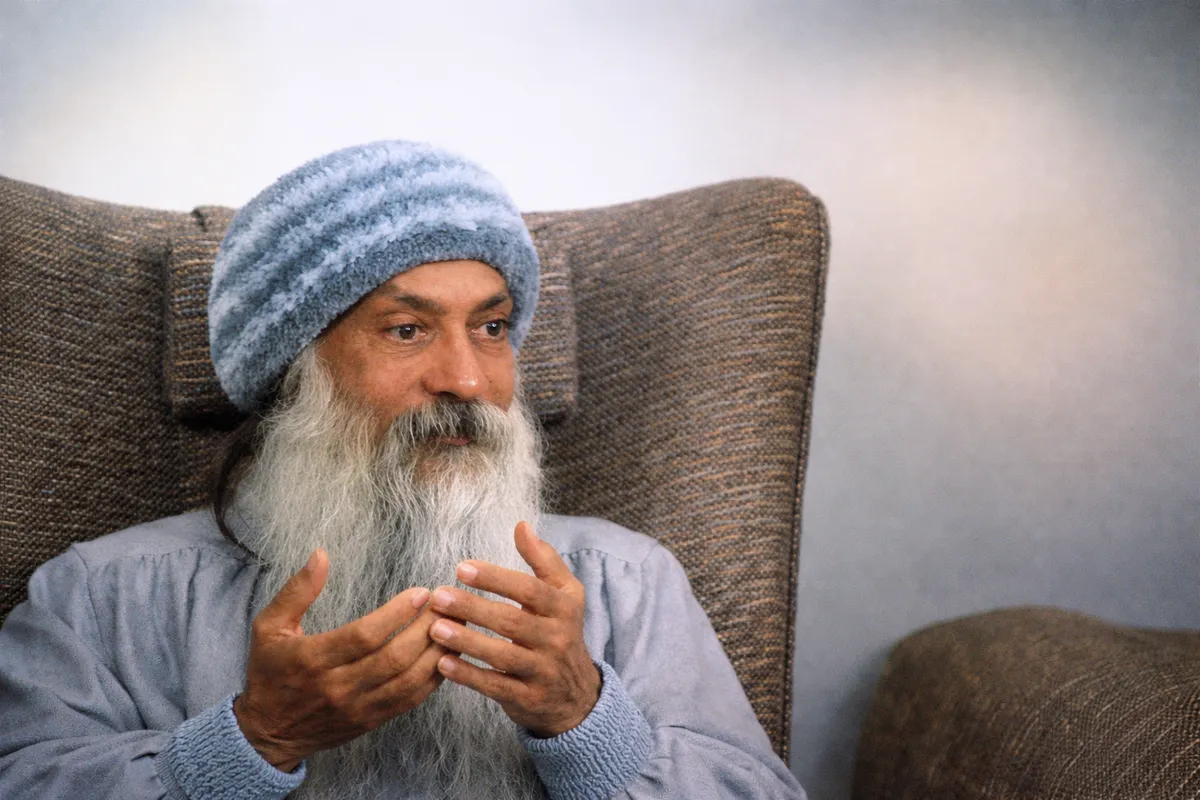
According to Osho, the mind is only a thought-wave that penetrates all walls, enters the ‘bottle’ of objects and desires, and gets attached there. Because you identify with the mind, its attachments become your own, creating the illusion that ‘you’ are trapped. As radio waves need a receiver, identification amplifies subtle thoughts into a loud, convincing prison—though your being was never inside.
Your mind grabs onto things and you think that’s you, so you feel stuck, even though who you really are was never trapped.
From the Discourses
Passages where Osho speaks to this question — each links to the complete discourse.
Beloved Osho, if we have always been out of the bottle, how did our minds ever get control and fool us that we were in?
In fact in no other language does anything like the koan exists. It is not a puzzle, it is not something that you can solve. Puzzles exist in every language; this is a totally different thing. If it were a puzzle then there would be some way to bring the goose out without breaking the bottle, but it is not a puzzle. It is made absolutely clear to the disciple that the bottle cannot be broken and the goose cannot be killed. You cannot kill it and take it out in parts -- and still the goose has to be out. It is a meditation for the disciple to meditate on, day in, day out. It takes months. Even though he knows the answer, that does not mean that he can go to the master and say, "The goose is out." He will get a good hit on his head…
13. Devi, imagine the sanskrit letters in these honey-filled foci of awareness, first as letters, then more subtly as sounds, then as most subtle feeling. Then, leaving them aside, be free.
14. BATHE IN THE CENTER OF SOUND, AS IN THE CONTINUOUS SOUND OF A WATERFALL. OR, BY PUTTING THE FINGERS IN THE EARS, HEAR THE SOUND OF SOUNDS. For example, in any language the word `mother' is somehow related with `ma'. It may be `mater', it may be `Mutter', it may be `mata', it may be `ma', -- anything -- but somewhere it is related with the sound "ma" in all the languages, more or less. The child can utter "ma" most easily. The first sound which the child can utter is "ma." Then the whole structure is based on this "ma." A child utters "ma" because it is the first sound which is easy for the child to utter. This is the case anywhere, in any part of the world, in any time. Just because of the structure of the throat and the body, "ma" is the easiest sound…
4. Suppose you are gradually being deprived of strength or of knowledge. At the instant of deprivation, transcend.
5. DEVOTION FREES. But either way one goes on worrying about the future. Buddha said, "There is no heaven and no afterlife." And he said, "There is no soul, and your death will be total and complete; nothing will survive." People thought he was an atheist. He was not, he was just trying to create a situation in which you can forget the tomorrow and can remain in this very moment, here and now. Then meditation follows very easily. So if you are thinking of death -- not the death which will come, or is to come later -- fall down on the ground and lie dead. Relax and feel, "I am dying, I am dying, I am dying." And not only think it, feel it in every limb of the body, in every fib of the body. Let death creep in. It is one of the most beautiful meditations.…
As the fletcher whittles and makes straight his arrows, so the master directs his straying thoughts.
LIKE A FISH OUT OF WATER, STRANDED ON THE SHORE, THOUGHTS THRASH AND QUIVER. FOR HOW CAN THEY SHAKE OFF DESIRE? THEY TREMBLE, THEY ARE UNSTEADY, THEY WANDER AT THEIR WILL. IT IS GOOD TO CONTROL THEM. AND TO MASTER THEM BRINGS HAPPINESS. BUT HOW SUBTLE THEY ARE, HOW ELUSIVE! THE TASK IS TO QUIETEN THEM, AND BY RULING THEM TO FIND HAPPINESS. WITH SINGLEMINDEDNESS THE MASTER QUELLS HIS THOUGHTS. Ram was only wearing one single cloth, he had just wrapped a blanket around himself. He threw the blanket -- rather than answering he created a situation. That's how great mystics work. He threw the blanket, he was utterly naked, and he ran away. All the people ran with him! Not only those who were surrounding him but others also who were standing here and there or who had come for a morning walk, and people who were sitting on…
Question: CHITTAM MANTRAH PRAYATNAHA SADHAKASH GURUH UPAYAH SHARIRAM HAVIH GYANAMANNAM VIDYASANGHARA TADUTTHASWAPNADARSHANAM. THE MIND IS THE MANTRA, EFFORT IS THE SEEKER. THE GURU IS THE MEANS. THE BODY IS THE OFFERING. KNOWLEDGE IS FOOD. WHEN KNOWLEDGE IS DESTROYED, THE DREAM IS SEEN. THE MIND IS THE MANTRA. During the French Revolution the inmates of a prison rebelled. There were two thousand prisoners and only twenty guards on hand to put them down. In fact, the prisoners could have gained their freedom at any time. What can the twenty guards do? The prisoners never rebelled, but of course, prisoners are never friends with each other. They don't unite. They don't have the simplicity which can bring there together. They are inimical to each other. So twenty guards were enough. On this occasion however they united and rebelled. The head jailer was very perturbed what to do?