
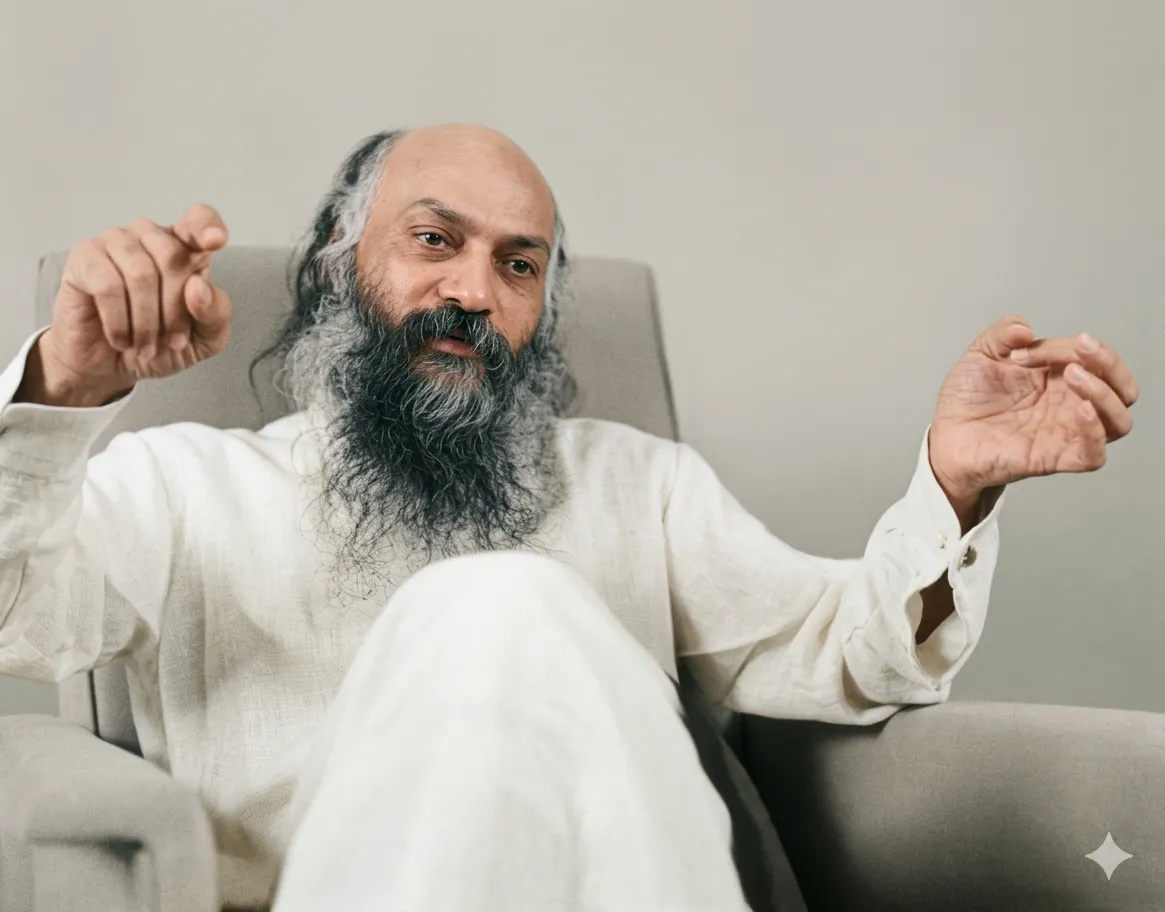
You might dance like Meera or grow quiet like Mahavira—let your heart bloom in its own way without forcing it.
From the Discourses
Passages where Osho speaks to this question — each links to the complete discourse.
Osho, you are my indwelling one. Will songs of love like Meera’s and Chaitanya’s burst forth in my heart? Will I be able to dance in mad ecstasy like them?
When I begged alms from the deity of silence, I received honey-brimming chalices of sound—resounding verse! He whose halo is lord of day and night— whenever I beheld him, my eyes closed of themselves. When the trident-bearer dances, mad with ecstasy, flowers of virtue, restraint, and sadhana shower down. Beads of sweat—science; the dust of his feet—the dignity of knowledge; servant, yogi, ascetic—each longs for him. Opposites reconciled—such are his two feet; their shade is a maya beyond even supreme knowing. Softer than clay is his tender heart; adamantine the cosmos, golden the radiance of his body. The two strings of breath are attraction and repulsion; in sleep he dreams the creation of a hundred universes; on motionless eyelids the play of worlds sports, in keen wakefulness roars the dread dissolution. Beg alms from such a god of silence, and you receive honey-brimming chalices of sound—resounding verse! He whose halo…
Osho, as the depth of meditation grows, it feels as if countless songs are surging to burst forth in my very life-breath! What should I do?
A Christian priest was preparing his sermon. The next day was Sunday, and a big religious festival was approaching; he was busy composing his sermon. His little son sat nearby, watching. Small children have a wisdom that even the old have lost. The dust of a whole lifetime settles so thick that wisdom is lost. Small children have a certain freshness, a vision, a guileless innocence. The little boy said, “Father, a question is arising in my mind. You always say—and last Sunday in church you also said—that the words I speak are not mine; they are God’s.” The father said, “Certainly. I repeat only His words.” Then the boy said, “In that case a question arises: why are you making so many cuts and edits in the sermon you are writing? If these words are His, who are you to edit them? And if you are editing them, how…
Osho! I set out to seek the Beloved; how is union with the Beloved attained?
Yog Neelam! The Beloved is not far. Not even so far that any meeting would be needed. There has only been forgetfulness, not separation. Separation cannot be. The Beloved abides within. He is the breath of our breath, the heartbeat of our heart. Without him we have no being. Because he is, we are. As the ocean is, so the waves are. The ocean can be without waves, but the waves cannot be without the ocean. Yet a wave can fall into a delusion—the delusion that “I am separate from the ocean.” In that very delusion, forgetfulness happens. Only forgetfulness happens; separation cannot. The whole search for the Beloved is nothing but remembrance—re-remembering. That is why the saints have called this search surati. Surati means remembrance, recollection. Surati is the folk form of the word smriti. What the Buddha called smriti, by the time of Kabir and Nanak became surati—dearer,…
Osho, I am dancing here. I, who never danced. Far from dancing—I had never even thought I would dance. I am astonished at myself. I ask: what has happened to me?
Love has happened to you; religion has happened to you. You have begun to come toward your home. You have turned back. You have set out toward your source. The Ganges has started flowing back toward Gangotri. The current has reversed. Your first steps have begun to fall in the direction from which you came. And when the first steps fall that way, dance is born. The farther you go from the divine, the more dance is lost; gloom, frustration, melancholy spread through life. When you are very miserable, understand that you are very far from the divine. The rishis have described the divine as sat-chit-ananda—being, consciousness, bliss. Saraha says, Tilopa says: it is mahāsukha, the great bliss. That means the more you are in sorrow, the farther you are from it. The proportion of your sorrow is the proportion of your distance. The measure of your sorrow is the…
Osho, every day as I listen, I bathe in tears, the heart throbs—whether you speak on devotion or on meditation. When you take me into the depths, it is like a sacred immersion in the Ganges and the Yamuna. Seeing you in form and formless, I am filled with bliss, I feel blessed. Love and meditation then are not two. Through both there is a glimpse of the One. I feel graced. Countless pranams!
My silent night has been made eloquent by the sweet anklets of Your steps. In the rhythm of those anklets my breaths have recognized their own rhythm; in the sound of those anklets my life-breaths have known their own song. Every pore keeps time, to the jingling of those bells. With this restless, ringing anklet today bind my voice. My silent night is made vocal by the sweet anklets of Your feet. What I am saying to you is no doctrine; it is simply a music. There is a music that puts you to sleep—a mother sings a lullaby and the child sleeps. And there is another kind of music that awakens—you hear the alarm clock and sleep breaks. What I am saying to you is not a doctrine. It is only a music, a single note—if you can hear it, you begin to awaken. If you hold to that…