
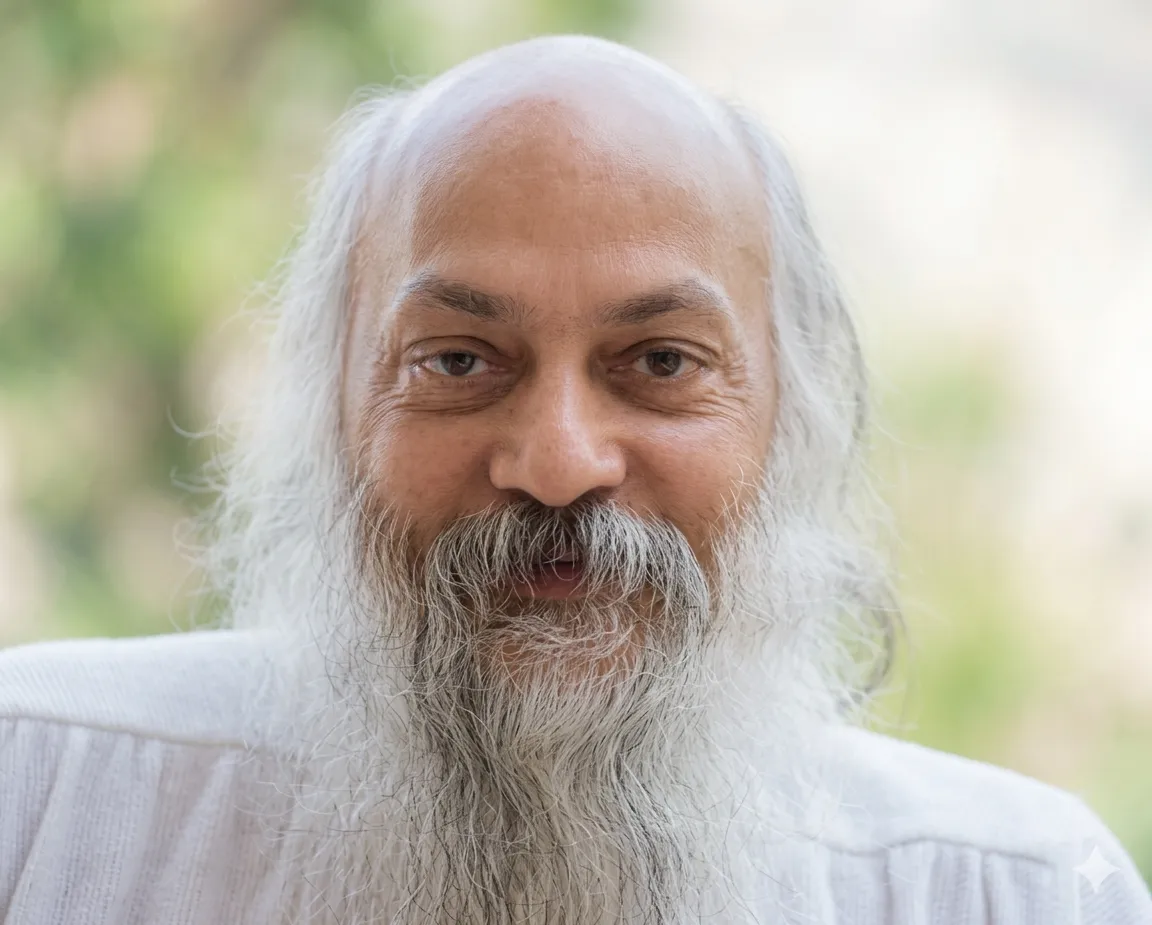
If you have to say “I love you,” it may mean the feeling isn’t shining by itself; true love is felt without words.
From the Discourses
Passages where Osho speaks to this question — each links to the complete discourse.
You said in an interview that when somebody says `I love you' to the other, the love is already gone. Why?
I said it because when you are in love there is no need to say it. It shows itself -- from your eyes, from your every gesture. And moreover, for the first time you understand that you are experiencing something which cannot be put into words. You can say, "I love you," but you will suddenly see that the feeling that you are calling love is so vast, and the word `love' is so small, it does not do justice to it. Hence, when people are in love, they understand in their silence the feeling of each other. Lovers may sit for hours in the full-moon night, by the sea, not even speaking a single word, just holding hands, as if they are not two -- with whom to talk, and what is there to talk about? In silence the love is so great, overpowering, that any word is going…
Osho, it is surprising that only when you speak do we get a slight glimpse of your peak through words. Why is that?
No one understands silence. If someone loves you and does not say so, you will not be able to grasp that he loves you. If in no way does he express it—through gesture, through the eyes, through words—these are all “words”—if he remains silent, you will never recognize that someone loves you. It has to be said; it has to be expressed. And then a very amusing thing happens. Even if there is no love, if someone is skilled in expressing, you will feel that there is love. Many times, the one who is skilled in expression becomes the lover. It is not necessary that there be love—because you do not understand love; you only understand words. Husbands and wives begin to feel depressed—how long can one keep saying the same words? Then they no longer carry any flavor. But as soon as words are lost, the relationship is lost.…
Beloved Osho, nearly eight years ago, during farewell darshan, I was called forward, and you asked me the question, "anything to say to me?" I nodded and felt something strong I wanted to say but I could not express a word. You said, "I have heard you." today I found out what I wanted to say: I love you.
Anand Govind, the most difficult thing is to hear yourself. Your mind is so full of others, there is so much noise, so much traffic of thoughts and feelings and emotions, that the still, small voice of your heart is drowned in it. It took eight years for you to hear it. Still it is early. There are people who have not heard it even for eighty years; and most people die without hearing their own heart, without hearing that still, small voice. I remember the moment when I asked you, "Have you anything to say to me?" because I felt in your eyes the stirring of your heart. But you could not hear it. You were certainly aware that there was something you wanted to say -- but what it was, was very vague, nebulous. Now it has become a condensed phenomenon, and your mind has also become more…
Love is ineffable. Yet those who wish to understand love have no other instrument than words; so one must speak even of love. The void is not defined, it abides only in the eye. Aeons, years, and seasons— how can they be bound in a fleeting moment? All remain unnamed; none is ever truly called. Expression remains incomplete— life’s infant lisps and stammers! All speech is a kind of stammering. Even a Buddha’s words lisp like a child’s. A small child is full of feeling and wants to say something—but there are no words. Suppose he has learned a few words, just a little; still they are too few. He wants to say great things, but he knows only one word: “Ma!” “Ma!” With that one word he must say everything. Hungry—“Ma!” Thirsty—“Ma!” In the sun—“Ma!” In the cold—“Ma!” One word for everything.
The master foso hoyen said: 'they say that buddha uttered five thousand and forty-eight truths during his lifetime. They include the truth of emptiness and the truth of being. They include the truth of sudden enlightenment and the truth of gradual enlightenment. Are not all these yea-sayings?
'BUT ON THE OTHER HAND, YOKA, IN THE "SONG OF ENLIGHTENMENT" SAYS THERE ARE NO BEINGS AND NO BUDDHAS -- SAGES ARE SEA-BUBBLES, AND GREAT MINDS ARE ONLY FLICKERINGS OF LIGHTNING. ARE NOT ALL THESE NAY-SAYINGS? 'OH MY DISCIPLES, IF YOU SAY YEA, YOU DENY YOKA, AND IF YOU SAY NAY, YOU CONTRADICT BUDDHA. IF BUDDHA WERE HERE WITH YOU, HOW WOULD HE SOLVE THIS PROBLEM? 'IF WE KNEW WHERE TO STAND WE WOULD QUESTION BUDDHA EVERY MORNING AND GREET HIM EVERY NIGHT. BUT AS WE DON'T KNOW WHERE TO STAND I WILL LET YOU INTO A SECRET: WHEN I SAY THIS IS SO, PERHAPS IT IS NOT A YEA-SAYING. WHEN I SAY THIS IS NOT SO, PERHAPS IT IS NOT A NAY-SAYING. 'TURN TO THE EAST AND SEE THE HOLY WESTERN LAND, FACE SOUTH TO SEE THE NORTHERN STAR.' But if a man is stupid and he becomes silent,…