
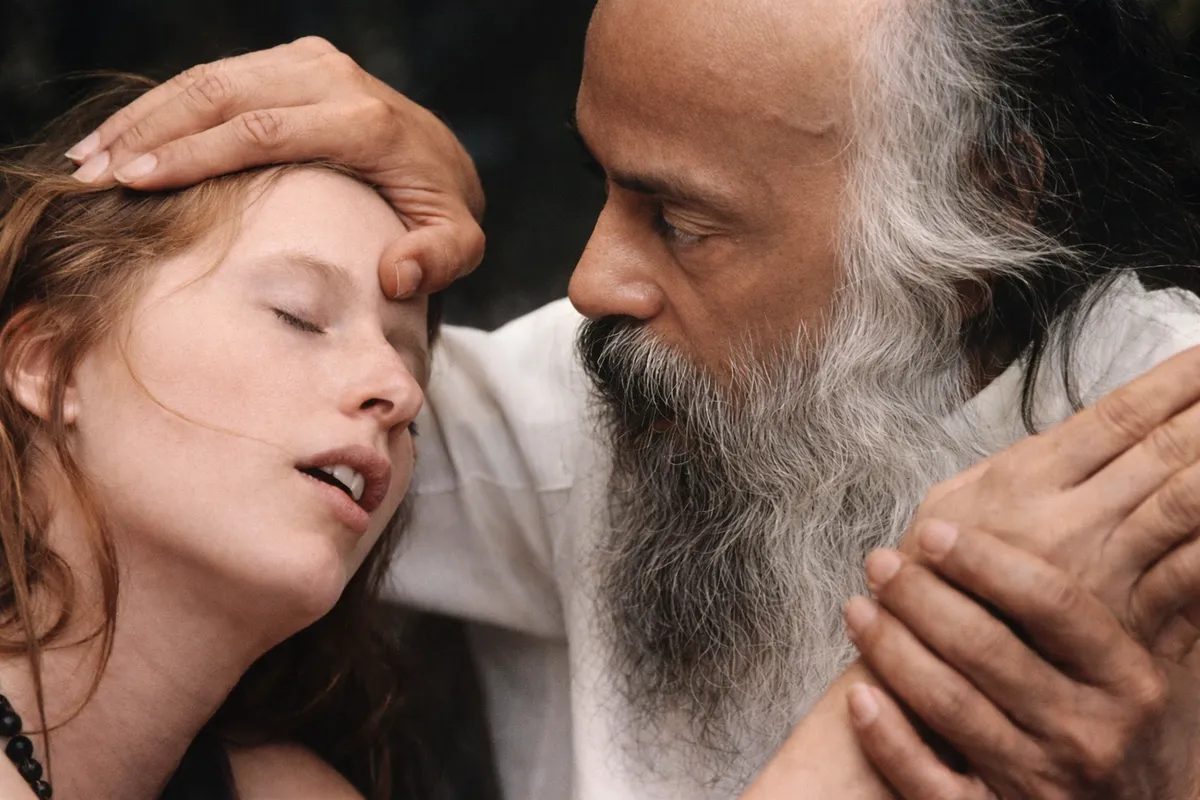
Names are like a ladder to the sky: helpful to climb, but the sky itself has no label, so you must let the ladder go to be in it.
From the Discourses
Passages where Osho speaks to this question — each links to the complete discourse.
Osho, it is said that whatever can be named cannot be the eternal and changeless truth. But the names given to the Ultimate are provisional, and through the practice of name-remembrance people have also attained the Nameless. Please explain why one cannot begin with a changing name and arrive at the changeless Nameless?
No! I say Lao Tzu is absolutely right, precisely right. And still, when I speak on Chaitanya, I will say Chaitanya is absolutely right. One can arrive by the stairs too. But do not raise that now. Bringing it in will not make Lao Tzu any easier to understand. Forget it—forget it completely. If you sit to understand Lao Tzu, then understand the leap in its entirety. Otherwise our mind behaves this way: when I sit to explain the leap, you bring up the stairs; when I sit to explain the stairs, you bring up the leap. You miss. It is the mind’s dishonesty. When I say, “Do kirtan,” you say, “What will kirtan do?” And when I say, “Throw everything away; burn the names and all that,” you say, “But you were saying it will happen through kirtan.” You did neither that nor this. You keep seeking a way…
Question: bhagwan sri: you said yesterday that whatever can be named, is not the eternal, the permanent, truth. All names given to the supreme truth are only meant to serve a purpose. But many have reached the 'name-less' by the sadhana of nam-sumiran (repetition of name). Please explain why you say that with the help of the changing name, one cannot reach the changeless.
Bhagwan Sri: Lao Tzu prefers the method of the jump. He is not in favour of going step by step. Actually a step is also a jump -- a small jump. When you climb the steps you are actually taking small jumps. You have divided the jump into twenty parts; whereas there are others, who jump all the twenty steps at one time. You can also say, this man has made one big step equal to twenty small ones -- that is if you do not like to call it a jump. So one man takes one step to cross the same distance whereas another takes twenty steps to do so. We can also say, this man takes twenty jumps. Now this depends on each individual and the amount of courage he has. Now Lao Tzu's method is the Jump. He says: "Why should we catch hold of that which…
Question: THE ABSOLUTE TAO THE TAO THAT CAN BE TRODDEN IS NOT THE ENDURING AND UNCHANGING TAO. THE NAME THAT CAN BE NAMED IS NOT THE ENDURING AND UNCHANGING NAME. The second part of the statement is: The name that can be memorised cannot be the enduring and the unchanging Tao. The name which can be named, that can be recollected, that can be expressed in words, cannot be the authentic name. It cannot be the enduring, everlasting name which cannot be conquered by Time. Understand this further: We give a name to every thing. It is convenient for human transactions, it is easier to establish relationships and describe things. If we do not use names, things become complicated and difficult. All movements are impossible without attributing names in this world.
To console your mind I talk about the new name and I make it appear as if it is tremendously significant. In that greed you drop the old. Once the old is dropped, I am going to tell you sooner or later that the new is as useless as the old. Use it -- it is needed. It is arbitrary... it is just a label on you. It does not say anything about you -- it cannot say anything about you; it has nothing to do with you. You are vast... you are immense! The name is just a small thing.... But then you will be able to understand. So sometimes I have to lie -- I have to tell lies. But that's what buddhas have been doing down the centuries.
Osho, what is the definition of God?
Words are very small. If you say God is light, then what of darkness? The scriptures have said that God is light. Suppose we accept this as a definition—then what about darkness? Where will darkness go? Darkness is too; in fact it is far more than light. Light sometimes is and sometimes is not; darkness is always, eternal. Where will you place darkness? If you say God is light, darkness is left out. If you say God is darkness, then light is left out. If you say God is both darkness and light, a contradiction arises: they cannot be together. Try to have both darkness and light in the same room. If you bring in light, darkness disappears; if you preserve darkness, you cannot have light. Then how can both be together? That becomes an impossibility. So you cannot say “both” either. Then the fourth device is to say: it…