
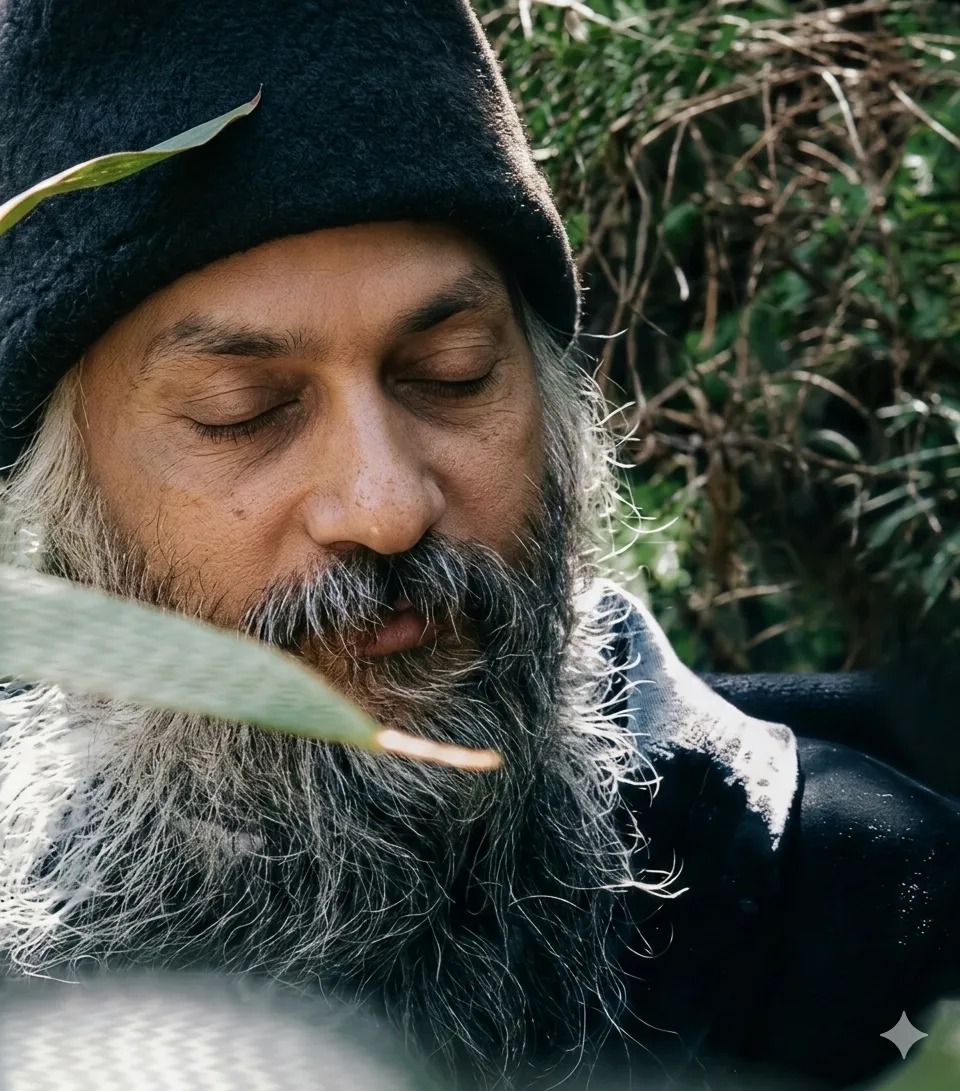
The mind keeps chattering with endless questions and can’t hear answers; if you wait quietly with trust, answers arrive on their own.
From the Discourses
Passages where Osho speaks to this question — each links to the complete discourse.
Beloved Osho, I often wanted to ask you some questions, but after waiting for a while, I always found my questions answered by you. And at the same time I found out that all those questions were just silly questions, coming from my mind without any connection to my heart. My heart only wants to cry, and my mind only wants to know, despite any answer. Could you please comment on how to deal with a continuous questioning mind that is not interested in any answer anyway? Or am I just a greek donkey?
In their cemetery they have a big well. There are steel rods on top of the well. The dead body is put on those steel rods, and between the steel rods there are gaps. All around, there are big, ancient trees and thousands of vultures are sitting there, waiting for some poor Parsee to die -- the vultures need food every day; Parsees supply the food. The dead body of the Parsee is put on those rods on top of the well and the vultures eat whatever is edible. And whatever is not edible -- bones, et cetera -- goes on falling through the gaps between the rods into the well. On the surface it looks very strange -- "What are you doing?" -- but the Parsees have their rationale. In this world everybody has some reasonable grounds for every superstition. They say, "Because we have been eating everything, now…
Osho, the questions we ask you all arise out of unconsciousness. And your replies come from total awareness. How can the two ever meet? And if they cannot meet, then asking itself seems wrong. Then what do you mean when you tell us to ask?
What is the difference between resonance and string? The string is gross, the resonance is subtle. The string can be grasped; the resonance cannot be grasped. Catch hold of the string and you remain on the surface. Catch the string and you will be bound—the string becomes a chain. Resonance enters your very life-breath. And resonance sets aquiver the resonance already asleep within you. Resonance is liberation. Do not take my strings, my words. Do not be concerned with what I say; be absorbed in what I am. Take the aura, not the form! If you take the form, you are bound. Take a form and you enter a prison. Take the aura! The halo that surrounds a lamp cannot be clutched in a fist, cannot be locked in a safe. But if you look at it with full eyes, your eyes will begin to shine. If you drink in…
Beloved Osho, it is such a joy seeking out a question -- it comes word by word and surprises me as it appears on the paper. Being here with you has been more moment-to-moment and less plan-filled than any other time in my life. The question is: where do these questions come from? How does seeking them out empty our minds and cleanse our beings? I love you beyond my understanding. Thank you again and again.
But centuries have passed, and people are discussing and inquiring and questioning, and all questions concerned with such things are absolutely futile. "How many hands does God have?" Now, is this a question that really means anything to you? -- whether he has two hands or four hands or one thousand hands? What does it matter to you? But there are people who believe that God has one thousand hands, because to take care of this big world, two hands are not enough. But who says to you that one thousand hands will be enough? The world is still big. If two hands are too few, one thousand hands are also too few. And just think of a god who has one thousand hands.... I think two hands can do things in a better way than a person who has one thousand hands. He is bound to get confused. And…
Beloved Osho, after all, what can we ask? Yet you have made us ask questions!
In Japan there is a tradition: whenever someone comes to a Zen master, he brings his sitting mat with him. He unrolls the mat, sits on it, and asks his question. Then he has to leave his mat there, and each day, whenever he has a question to ask, he comes and sits on his mat and asks the question. This sometimes continues for years together. Then a day comes when he becomes tired of this asking and being answered, and he realizes that all this is just nonsense. He rolls up his mat, puts it under his arm, and leaves. The day he rolls up his mat, the master says, "Have you rolled up your mat? Good! My blessings to you!" Rolling up the mat is symbolic of getting tired of asking questions and getting answers to them, of asking and listening. Now he stops both, and from that…
Beloved Osho, On what day will the chariot set out? When will you, striking me with light, take me across? On what day will you come bearing flaming arrows, draw a line upon my heart and pass on? On what day shall I take your fire upon my head and throw open my very life before your arrows? Asked by Anand Maitreya!
When the Divine comes, it feels—He came unasked. And when He goes, it feels—everything is looted. All is looted! You become poorer than before. Because earlier you had no experience, so you did not know—you could not compare—what treasure is. Once light has entered the eye and then darkness grows dense again, the darkness will seem deeper than before. You will weep much, writhe much. All is looted. The robbers have taken everything. So there is one kind of separation that a man feels before knowing God. It is not very deep. It cannot be very deep. If you have not seen the Beloved, have not known His beauty, not even had a glimpse, you can weep, but how deep can that weeping be? With no experience, what will you weep for? For whom are you weeping? Are you even sure He is? That He ever was? Or is it…