
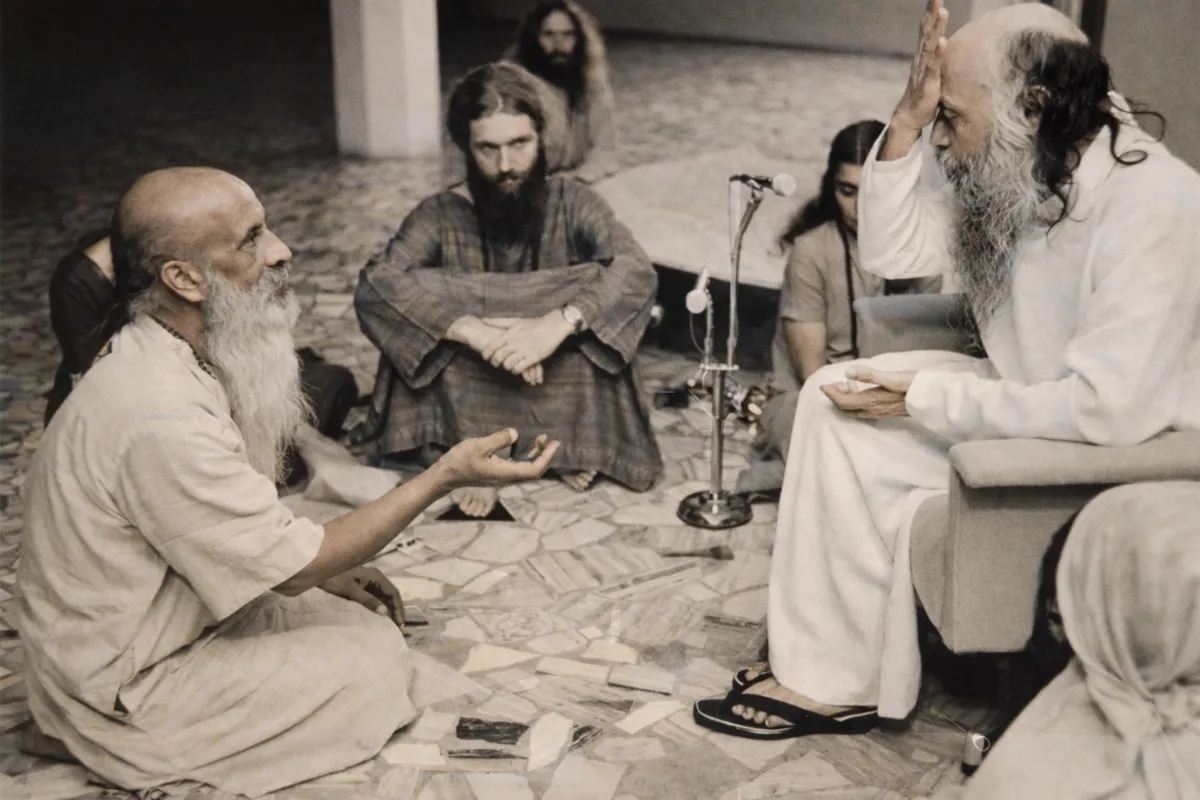
Truth can’t be put into words; when the mind is quiet you sense that the world and Brahman are the same reality—one visible, one invisible.
From the Discourses
Passages where Osho speaks to this question — each links to the complete discourse.
Osho, while refuting Adi Guru Shankaracharya’s aphorism “the world is illusory, Brahman alone is true,” you said the world is true and Brahman is true. But the definition of truth is: that which is not perishable. Since the world is perishable, how can it be true? It must be illusory. Brahman is imperishable, therefore true. I request you to define truth and shed light on this aspect.
Call a rose “rose,” or give it another name—there are thousands of languages, so the rose has thousands of names. Does the rose care? Call it beautiful or ugly—does it change the rose? Fashions change daily. A hundred years ago, who would imagine you would place a cactus in your drawing room, that a cactus would be called beautiful? Tell a villager today that a cactus is beautiful—he will stare: “What nonsense!” He plants cactus as a fence to keep animals and thieves out. He cannot imagine putting it in his house. He’ll say, “Am I mad?” Roses were beautiful—but now to insist “the rose is beautiful” sounds old-fashioned. The modern, cultivated people keep cactus. New poetry sings of cacti; new painters paint them. The rose has become passé. Nobility is out; the cactus is the proletariat. This is the age of socialism. To praise roses—aren’t you ashamed? Kings are…
When the self as consciousness, which is truth, knowledge, infinity, and bliss, devoid of all its attributes, shines like pure gold freed from all its forms such as a bangle and a crown, it is called twam or thou.the brahman is truth, infinity and knowledge. That which is indestructible is truth. And that which does not perish even after the destruction of space, time, et cetera, is called the avinashi, the imperishable.
There is a dialogue, a deep dialogue between my existence and existence itself, a constant dialogue, a continuity every moment: the incoming breath, the outgoing breath. I am constantly linked with the universe, with existence. If we take two points, between these two points the dialogue continues. One point is "I," and the other point -- the total -- is "thou." A non-religious mind, a material mind, will say that the dialogue is not between "I" and "thou," the dialogue is between "I" and "that," because the world is just a thing; it is not a person. And really, if the world is just a thing and it is not a person, then there can be no dialogue, there can be no intimacy. But if the whole world is just a thing, then myself -- I myself cannot be a person; this "I" is also a thing. This is what…
Beloved Osho,sometimes while just sitting, the question comes up in the mind: what is truth? But by the time I come here I realize that I am not capable to ask. But may I ask what happens in those moments when the question arises so strongly that had you been nearby I would have asked it. Or if you had not replied, I would have caught hold of your beard or collar and asked, "what is truth, Osho?"
When you fall in love with a woman there is some truth -- if you have fallen absolutely unaware, if you have not 'done' it in any way, if you have not acted, managed, if you have not even thought about it. Suddenly you see a woman, you look into her eyes, she looks into your eyes, and something clicks. You are not the doer of it, you are simply possessed by it, you simply fall into it. It has nothing to do with you. Your ego is not involved, at least not in the very, very beginning, when love is virgin. In that moment there is truth, but there is no interpretation. That's why love remains indefinable. Soon the mind comes in, starts managing things, takes possession of you. You start thinking about the girl as your girlfriend, you start thinking of how to get married, you start thinking…
Beloved Osho, is there any definition of the ultimate experience other than satyam-shivam-sundram -- "truth, godliness and beauty"?
But in the first definition the word sundram, beauty, gives a sense that your eyes are capable of seeing it; perhaps your hands can feel it, perhaps your ears can hear the beautiful music in it. The word 'beauty' functions almost as a bridge. In the second definition there is no bridge, but a quantum leap. You simply jump from the mind to no-mind. Only no-mind can be aware of truth; only no-mind can be filled with consciousness; only no-mind can be showered with thousands of flowers of bliss. Nothing relates to your ordinary world. In this way it is purer. Both have their own pros and cons, and I want you to be aware of them. But remember: don't choose the definition. First choose the experience, then the definition will come on its own accord. If you choose the definition first, it may not fit your individuality and the…
Osho, the nature of Truth is Sat-Chit-Ananda. Swami Vivekananda has said this too. That cannot be Truth in which there is not Sat, Chit, and Ananda!
Truth cannot be defined. What you quoted is a definition of our longing, not of Truth. Our longing is that Truth be like that—Sat-Chit-Ananda: being, consciousness, and bliss. This is the human wish: that being not be suffering—otherwise we are finished. If the world is suffering, and Truth too is suffering, and even liberation is suffering, then where shall we go? So we want a moksha where there is no sorrow at all; a moksha where there is no ignorance at all, only knowledge; a moksha where there is no darkness at all, only light. This Sat-Chit-Ananda is not a definition of Truth; it is our aspiration. And our aspirations are very pleasing to us. Therefore, we love the scripture in which this is written, and if Vivekananda says it, he becomes a great master for us. The root reason is simply that our desires feel gratified. If a guru…