
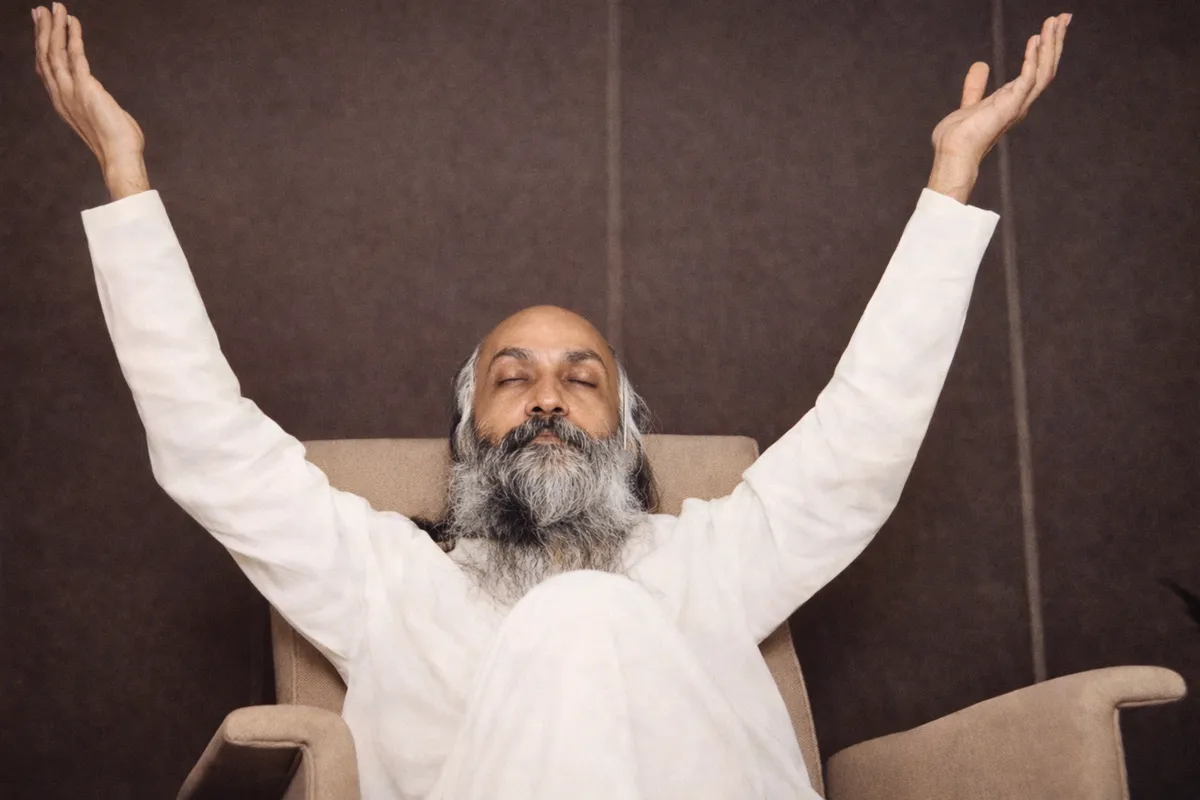
When your mind clicks with the teacher in trust, your question pulls its own answer through him, like talking to yourself in two mirrors.
From the Discourses
Passages where Osho speaks to this question — each links to the complete discourse.
Osho, whatever you say seems to be right from the point of view of what you are saying at that moment. But it may be contradictory. You draw the listeners in one direction confirming a particular point, and at the same time you go via the back door to the opposite point. It is a spiral -- the listener hardly realizes what may be happening. Is this not fooling the listener -- unless he realizes that the real answer lies beyond your spoken words?
One sannyasin has done well. He has called my path VIA CONFUSIVA -- that's right. That's perfectly right. It is neither VIA NEGATIVA nor VIA POSITIVE -- it is VIA CONFUSIVA. If you can be so much confused that you drop ALL belief, out of that confusion will come clarity. When do you feel confused? When exactly? Whenever one of your beliefs is attacked -- you become suspicious: Now what to believe in? Whenever a doubt arises... but how is a doubt possible if there is no belief? The man of no-belief cannot doubt either. There is nothing to doubt. 13y destroying your belief I am destroying the very pos-sibility of doubt. Can you see the point? Doubt is a shadow of belief. It looks like the opposite -- it is not. Only believers can doubt. If you believe in God, doubt can arise. But if you don't believe in…
Osho, how does the energy of thought transform into feeling?
Therefore I am not teaching you religious thoughts. I am initiating you into no-thought. Generally, what goes on in temples and mosques is just this: people full of worldly thoughts are stuffed instead with spiritual thoughts—nothing more. But what difference does it make? You have given the disease a pious, pretty name; what changes? So long as you want to be anything, so long as you harbor the ambition to become something in the future, so long as you are eager for tomorrow, you will remain unquiet. The stream of thought will keep flowing. And as long as the stream of thought flows, you will remain cut off from God. I am telling you that religious thoughts are just as great an obstacle between you and God as worldly thoughts. Thought is the barrier; no-thought is union. Gorakh has said: See the Unseen, ponder what is seen, seat the Invisible…
Osho, the other day while listening to your discourse, a strange kind of vibration arose in the heart and along the auditory nerves; since then even ordinary sounds set off odd ripples and waves of bliss. Please tell me: is there something in the voice of enlightened ones that produces a special effect? Also, in your presence there is a particular, delightful fragrance; at times it is felt in the ashram and sometimes during meditation as well. In this regard, please say whether certain moments in time have their own special fragrance too.
I speak with the same purpose with which a musician plays the vina. He does not play to explain anything. Remember me as a vina player. My speaking is my vina. What I am saying to you—less am I speaking, more am I singing. If you understand its purpose, that is enough: listening to this instrument—as one sometimes, listening to a vina, falls into a trance—one begins to sway; something within begins to vibrate; something like a stone inside begins to melt and flow. For a moment a window, an opening, is there—sky is glimpsed. Like a flash of lightning—the darkness is gone—even if only for a moment; but then you know that light is, and you also know there is a path. It was revealed for a moment in the lightning’s flare, but revealed it was. Now no one can tell you there is no path; no one can…
Beloved Osho, the master speaks, and the disciples listen. What is it that happens, and remains unsaid?
Yoga Chinmaya, the master speaks, the disciple listens -- yet there is much which the master does not speak, and the disciple listens. In fact, that is the whole secret of disciplehood. If you only listen to that which is said, you are a student. You listen to the words, you miss the wordless. The moment you start listening to the wordless, you are initiated into disciplehood. The master is speaking. Naturally he has to use words, but he is also leaving gaps in between. He is also using wordlessness. He is saying something, and he is also meaning something which cannot be said -- but it can be heard. If the disciple is silent, he will hear the words and he will also hear the wordlessness; he will hear what is being said, and he will hear also what is not being said and yet is transferred. You are…
Osho, at this time and in this place, what does God make happen between you and us? What is the difference between you and us, and what is the connection?
I had long heard the sound of footsteps, but never met you face-to-face. In bewilderment the golden morning turned to dusky evening. The restlessness of each of my moments bowed down of its own accord. I had long heard the echo, but not the source of the sound. I had long heard the footfall, but never met you face-to-face. You too have heard the footfall; otherwise you would not have come here. You too have heard the echo; otherwise what would have brought you here? That very echo has brought you. But a direct meeting is not happening. I am standing facing him; you are standing with your back to him—this alone is the distance. It is not a great distance. About-turn—that is the distance. In the military they manage it. Turn around! “What is the difference between you and us?” Turn around! “And what is the connection?” From my…