
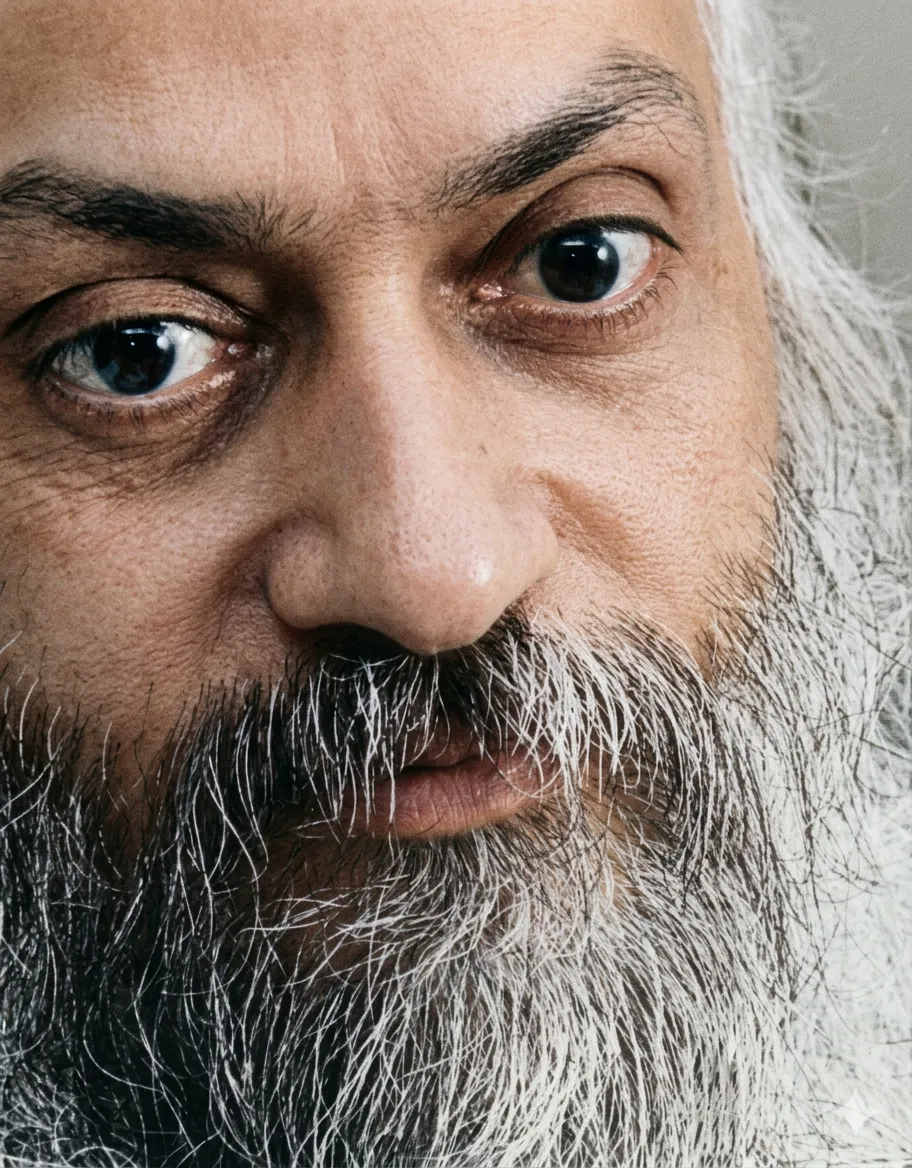
Stop forcing yourself, relax into trust, and life will carry you where you need to go—like a river to the ocean.
From the Discourses
Passages where Osho speaks to this question — each links to the complete discourse.
Beloved Osho, my surrender is goal-oriented. I'm surrendering in order to win freedom, so it is not real surrender at all. I'm watching it, but the problem is: it is always 'I' who is watching. Therefore every realization out of that watching is a reinforcement of the ego. I feel tricked by my ego.
The ego is always goal-oriented. It is always greedy, it is always grabbing. It is always searching for more and more and more; it lives in the more. If you have money it wants to have more money; if you have a house it wants to have a bigger house; if you have a woman it wants to have a beautiful woman, but it always wants more. The ego is constantly hungry. It lives in the future and in the past. In the past it lives as a hoarder -- "I have this and this and this." It gets a great satisfaction: "I have got something" -- power, prestige, money. It gives a kind of reality to it. It gives the notion that, "When I have these things, I must be there." And it lives in the future with the idea of more. It lives as memory and as desire.…
Osho, tell us of some lure that would set us moving toward God—some temptation that would engage our mind in God-realization.
Difficult today, difficult tomorrow; the day after, not so difficult—if you persist and don’t jump up, “Oh, a bad thought—get rid of it!” The witness has nothing to do with good or bad. Thorns have the same worth as flowers. We label; the witness does not. Soon, an amazing thing begins: now and then a gap appears—an interval. A thought comes, then the next does not; a space remains. In that empty space, the first glimpses begin. In that emptiness, even you are not—there is only emptiness. That is the door. Keep at it, and thoughts lessen; spaces grow. It’s like a road where a person passes, then for an hour no one—emptiness. A thought appears on the screen, then none for a long while; the screen is blank. From that blankness, your first contacts with God begin—because in that moment you are present. Thought can take you to past…
Osho, you said, “You are free—now, here, in this very moment”; but how do I get free of this “I”?
This is the marvelous principle of destiny, of fate: everything is happening by itself. The wrong people took it in the wrong sense—that was their mistake. Properly understood, fate means only this: if you understand the principle of destiny rightly, you become a witness, and there is nothing to do. But people did not become witnesses through fate; they became inert, indolent. There is a difference between a non-doer (akarta) and an idler (akarmanya). The idler is lazy, sluggish, dead. The non-doer is overflowing with energy—he simply does not say, “I am doing.” The Divine is doing. I am only seeing. This play is happening; I am watching. Man is very dishonest; he uses even the most beautiful truths in ugly ways. Fate is a very beautiful truth. It means only this: everything is happening; nothing is happening by your doing. All is ordained. What has to be, will be.…
You say, Osho, don’t try to be something, to become, to attempt “becoming”—just be, just being. Please explain in detail how this is to be attained.
The very moment you ask how to practice it, you miss the understanding. Because “to practice” already means the effort to become something has begun. When I say, remain as you are, just as you are, the question of practice does not arise. Practice means you have started trying to be what you are not. So you have not understood. Any practice implies discontent; there is no fulfillment in being as you are. The mind says, let something more happen. A little money—let’s gather more. A little knowledge—accumulate more. A little renunciation—become a great renunciate. A slight taste of meditation—let’s manufacture the taste of samadhi. It is all the same; there is no difference. The issue is neither money nor meditation; the issue is the demand for “more.” So whether you ask for wealth you remain worldly, and even if you ask for meditation you remain worldly. Wherever there is…
Question: OSHO, EXACTLY HOW DO YOU NOT DO IT? I said, "This feeling is not from the awareness that you are, because your consciousness has remained the same. This sense of a new birth is coming from your ego; your ego is tremendously gratified, strengthened. That is your 'gain.' But according to those who know that is your loss." What is gain to the ego is loss to the soul. What is a blessing to the ego is a curse to the soul. What seems to be of tremendous importance to the ego is just sheer stupidity to the innermost core of your being. The logic of the ego is that it is never interested in the simple things, because if you say, "I can breathe!" that is not going to bring crowds to welcome you, to say, "Teertha, you are great! Your name will remain immortal because you breathe.