
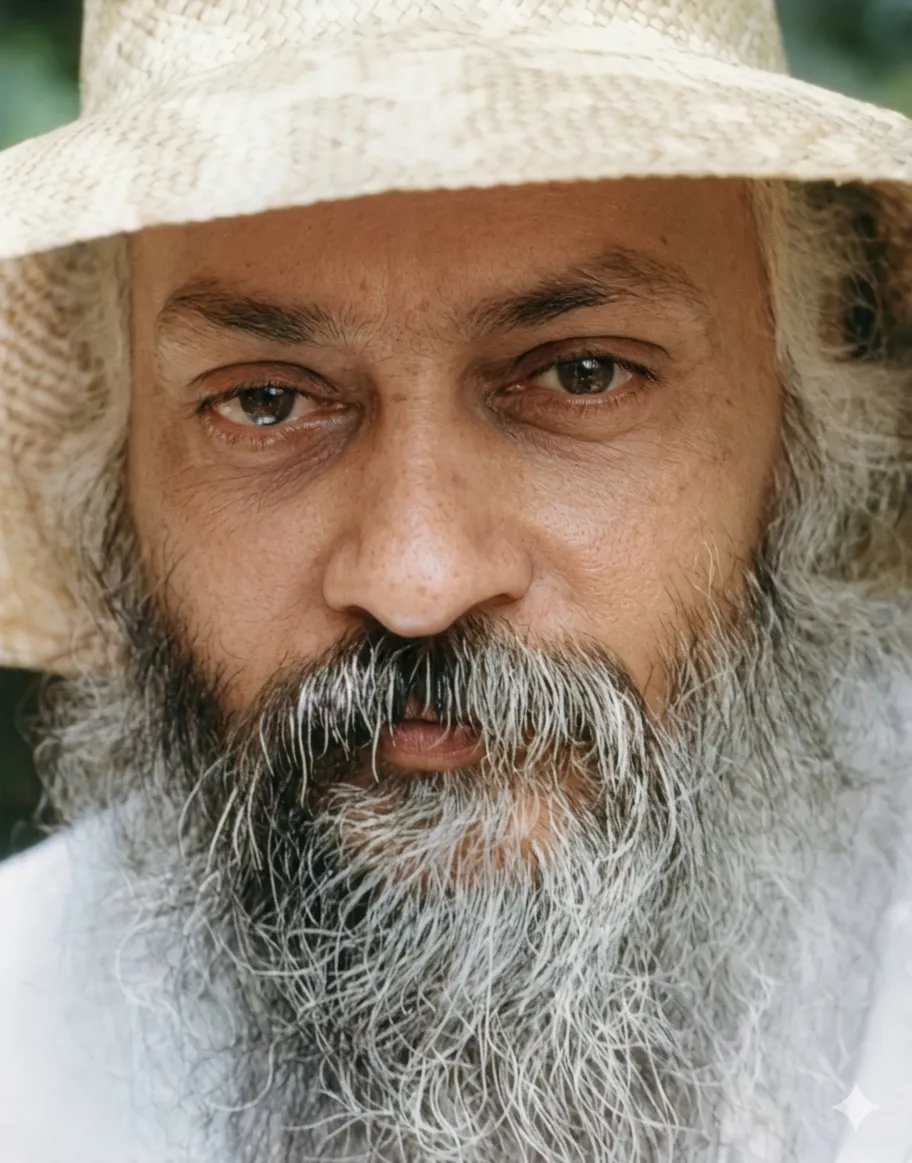
According to Osho, the stopping of inner talk is not something to label as enlightenment; if you can still ask, the mind is back. Enlightenment is not an experience or a goal but your innate nature recognized when distraction ends. In silence you do not declare it; you simply are, resting in your source. Be still, wake up, remember.
When thoughts go quiet, don’t name it—just rest, because the peace is your true self already.
From the Discourses
Passages where Osho speaks to this question — each links to the complete discourse.
When the internal talking stops, is this enlightenment?
Parivesh, when the internal talking stops, who cares? Who is there to care? Who is there to raise the question 'Is this enlightenment'? If you can still ask the question, then it is internal talking continuing. If you can still see that this is enlightenment, then nothing has happened; then the mind is back from the back door. It has jumped upon your enlightenment too, and it has destroyed it. Enlightenment is not an experience, that's why nothing can be said about it. Enlightenment is not one of the series of experiences that you have lived through. Enlightenment is not something that happens to you like a content in the mind. When the mind is not there you don't say 'This is enlightenment', you don't feel it as an experience; rather, on the contrary, you see it as your nature. It has always been so -- just because of that…
Question: BELOVED OSHO, HOW DO YOU EXPERIENCE YOUR ENLIGHTENMENT? But in this whole changing, riverlike being... who are you? Only the stupid will speak out; the wise will remain silent. One who knows not will say, "I am this; I am a man, I am a woman, I am young, I am Hindu, I am a Christian..." Only the stupid will speak out. The wise will become absolutely silent. He is also answering -- his silence is the answer. Buddha calls this silence "right remembrance"... sammasati. You are saying, "I go on remembering all kinds of things you have said, and my own insights..." Agyeya, I had no idea that you also have insights! But... okay. Remembering all kinds of things that I have said, and what you have imagined as your intuitions... just try to find a single intuition that is yours, and you will be surprised.
Just as the mute is incapable of relating outwardly, you have become incapable of relating inwardly—because there you keep talking. There you need to be mute. There, be totally quiet; because there is no “other” there. With whom are you conversing? To whom are you talking inside? You raise questions and answer them yourself—this is a symptom of insanity. What is the difference between a madman and you? The madman talks loudly to himself; you do it softly—that’s all. Some day you too may begin to do it loudly; then you will be called mad. Right now you are sitting on your madness as if suppressing it; it can erupt any moment. It is an abscess; the pus can burst any time. Why does inner talk go on? What is the reason? Habit. Your whole life you have only been taught to speak.
Question: BELOVED OSHO, WHAT IS THE LANGUAGE OF ENLIGHTENMENT? Milarepa, there is no language of enlightenment. There cannot be by the very nature of the phenomenon. Enlightenment happens beyond mind and language is part of the mind. Enlightenment is experienced in utter silence. If you want to call silence a language, then of course enlightenment has a language which consists of silence, which consists of blissfulness, which consists of ecstasy, which consists of innocence. But this is not the ordinary meaning of language. The ordinary meaning is that words have to be used as a vehicle to convey. Silence cannot be conveyed by words; neither can ecstasy or love or blissfulness. In fact, enlightenment can be seen, can be understood, can be felt, but cannot be heard and cannot be spoken.
How is it that people who are not enlightened can talk with such apparent inside knowledge and so convincingly about the whole business?
Precisely because of that. Not knowing, they don't hesitate; not knowing, they have nothing to say really, so they can go on spinning; not knowing, they can use language more perfectly. If you know, language is always a barrier; rather than a help it is a hindrance. When you know, you have to be constantly aware because whatsoever you are saying is not that which you know -- there is great distance between the two. Sometimes that which you say goes directly opposite to that which you know. A blind man can talk very easily about light, there is no problem. He has no experience to put into words. Words are empty, so he can go on throwing them out. Of course, he can talk only to another blind man -- no man with eyes will be deceived. People who are not enlightened can go on talking to people who…