
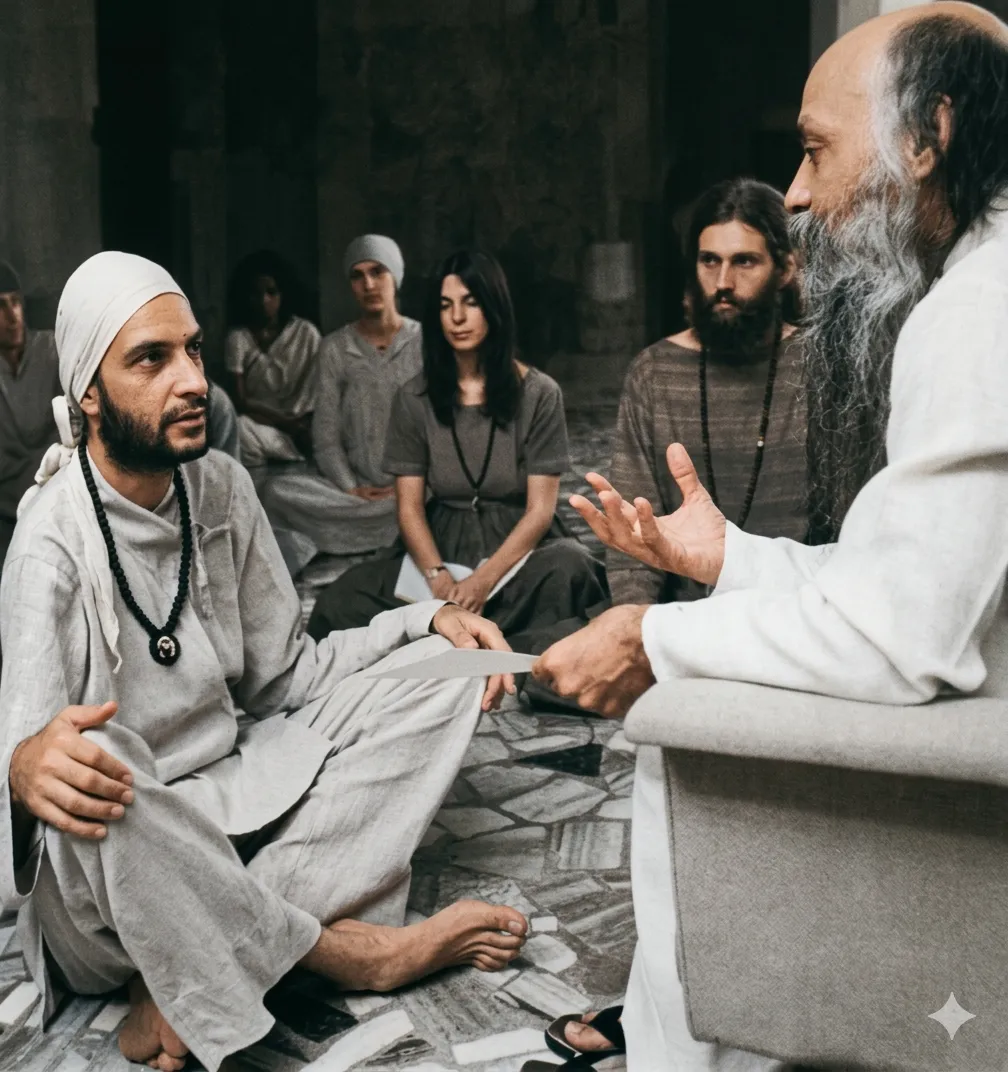
He doesn’t offer one road; he helps each person use whatever works, staying open so truth can meet you through many doors.
From the Discourses
Passages where Osho speaks to this question — each links to the complete discourse.
How would you describe your particular path to enlightenment in relationship to other traditional paths such as the various kinds of yoga, sufism, buddhism, zen, christianity, etcetera?
I HAVE NO particular path. I don't belong to any path whatsoever, and therefore all paths belong to me. Each path is perfect in itself, but each path can help only a very minor part of humanity. Each path exists for a particular type. It is complete in itself. Nothing is to be added to it -- nothing is to be deducted from it. As it is, it is perfect. But it can help only a particular type. Humanity is vast; one path cannot carry the whole of humanity. All paths are needed. In fact, as the human mind changes, more new paths have to be evolved. With the mind changing, many old paths have become by and by useless, or can be used only by a very few individuals. I use all paths. Whenever I see a seeker, I start looking into him -- what type he is and…
Osho, the twenty-one-day ritual you have hinted at—was that practice or elemental realization in any way traditional? Because from your mode of expression it continually seems that you surely represent some teacher’s or Tirthankara’s method. Within this I also want to dare to ask: do you want to add a link to some established spiritual lineage, or, like Buddha, are you attempting to cut a new path through the mountains?
Nor is the issue one of tolerance. It is a matter of sky-like spaciousness, not tolerance. Not mere forbearance. Not that a Hindu “puts up with” a Muslim or a Christian “puts up with” a Jain. Forbearance already holds violence within it. I do not say the Quran and the Gita say the same thing. The Quran says something quite different; it has its own individual voice—that is its greatness. If it only repeated what the Gita says, it would be worth two pennies. The Bible says something else again, which neither the Gita nor the Quran says. Each has its own voice. Mahavira does not say what Buddha says; they say very different things. And yet from these differing statements one ultimately arrives at the same place. My emphasis is on the oneness of the destination, not on the oneness of the paths. My emphasis is that in the…
Osho, you have said that there are many mutually opposite paths that lead to the One Divine. In the past it used to be that seekers of a single path would gather around one master: yogis separate, devotees separate, tantrikas separate, meditators separate. That made it easy for everyone to walk their own path. But with you, in your ashram, there is a whole fair of opposing paths—yogis and bhaktas, tantrikas and Sufis, karma-yogis and meditators—all together. How is this so? It also creates obstacles. Kindly say something about this.
It is true. In the past it was like that. A master would be the advocate of one narrow path. That had its benefits, and its harms. The benefit was that no dilemma arose in your mind. The same thing—the same thing, the same thing—you heard. The same thing—the same thing, the same thing—you did. Doubt did not arise. You quietly held your path and walked. But there was a danger: narrowness set in. Sectarianism set in—the feeling that only I am right and everyone else is wrong; only this path is right and all others are wrong. So there was a benefit, and there was a harm. And the harm proved greater than the benefit. The benefit reached very few; the harm reached millions. The whole world became sectarian. The whole world became dogmatic: we are right and everyone else is wrong. Ask a Jain—he says, our guru is…
Beloved Osho, I took sannyas from swami shivanand of rishikesh after reading his book brahmacharya and other books of his.
AFTER SOME YEARS, I WAS ATTRACTED TO SRI RAMANA MAHARSHI AND THEREAFTER TO SRI AUROBINDO DUE TO HIS INTEGRAL APPROACH TO THE DIVINE. FROM 1959 ONWARDS I WAS DOING MEDITATION ON THE LINES INDICATED BY SRI AUROBINDO AND THE MOTHER. THEREAFTER J. KRISHNAMURTI'S APPROACH ATTRACTED ME, NOW YOURS. I ENJOY AND FEEL HAPPY WHENEVER I READ SRI AUROBINDO'S WORKS, SINCE HE EMPHASIZES LIVING A FULL LIFE AND REALIZATION OF INTEGRAL DIVINE AND GIVES MUCH EMPHASIS TO PHYSICAL TRANSFORMATION. YOU ALSO EMPHASIZE NOT TO NEGATE LIFE BUT TO LIVE FULLY, AND HAVE GIVEN A NEW MEANING TO SANNYAS. HENCE I AM HERE TO EMBRACE THIS ALSO. I WONDER WHETHER I AM ON THE RIGHT PATH OR DRIFTING? WHAT IS THIS MULTIFARIOUS ATTRACTION IN ME? COULD YOU HELP ME WITH A RIGHT PATH IF I AM DRIFTING? But the questioner seems to be too much in the head: then he became interested…
Osho, does the ritual of twenty-one days which you indicated you were doing in your previous birth belong to any particular tradition of meditation and self-experience? Because from your speeches, it appears that you are definitely representing the methods of some great teacher or teerthanker. In view of this, may I also dare to ask whether you wish to connect a spiritual link to some traditional chain, or like buddha are you attempting to cut a new path on some mountain?
The overall perspective which I have before me is this: that I would like to help every person to move according to his capacity, his stage of evolution, his culture -- according to what has already been assimilated in his blood. Then it will be much easier for him to achieve. Therefore, I have neither any religion of my own, nor any path of my own, because now one exclusive path or religion will not work for the future, and a religious sect means a path. Nowadays, such a religion is required which doesn't insist on a particular path, which can become the crossroads for all the paths, which can say that all paths belong to it and which can ask everyone to follow the path of his liking. Such a religion would emphasize that you will reach the same place from wherever you walk, that all roads lead to…