
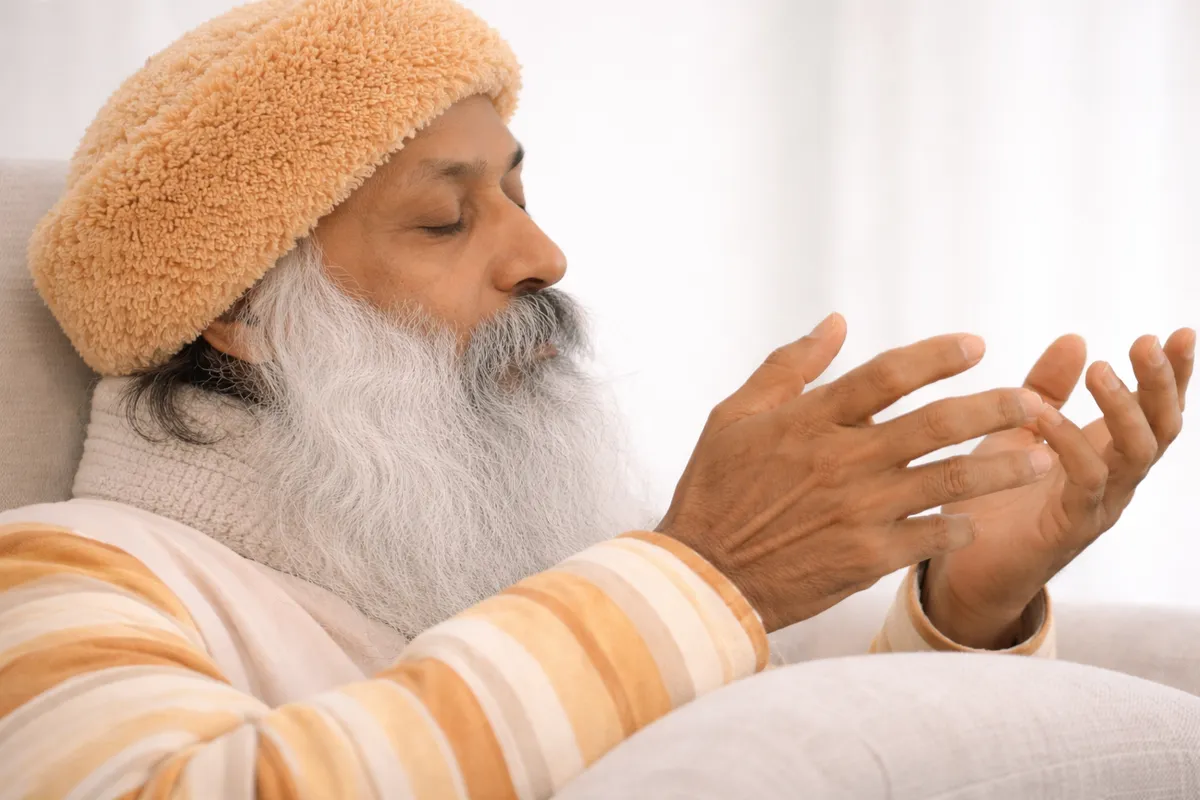
You realize you were unaware the same way you know you were asleep—only after you wake up and see what happened.
From the Discourses
Passages where Osho speaks to this question — each links to the complete discourse.
Osho, but this seems a bit paradoxical. In unconsciousness there is no awareness—how did he come to know that?
It is always known afterward, always afterward—after the event has passed. Suppose you became angry. While you are in anger you have no awareness at all. But when the anger is gone, you look back and say, “Ah, what have I done! I would never have done that if I had been aware.” It’s a matter of a second, isn’t it? It’s not as if months have passed. Just a second!
Osho, please say something about this news item: the indian express of 18th august reports that the rajneesh film won't reflect the real image of india. The union information minister, l.k. Advani said in the parliament, 'foreign television and film units have been refused permission to document the activities of the rajneesh ashram, as it is felt that a film on the activities of the ashram would not reflect favourably on india's image abroad.'
If this country is going to be destroyed one day, the reason will be these people who are in power today. India cannot have one language. And if it can have one language, that language has to be neutral; either it will be English or Esperanto, but not Hindi, not Gujarati, not Marathi, not Bengali, not Tamil. It will have to be a neutral language. English is neutral; it is nobody's mother tongue in India. And English is international too, so it is perfectly good. I support a two-language formula: English as the national language, because it is also international and as the second language, the mother tongue. Each child should be taught two languages. Forget all about Hindi, and forget all about creating one monolith in this country of variety, of multiplicity. And they are trying to do the same thing with religion too, in the same way. They…
Osho, I have had lots of exhilarating moments of what seemed to me to be real consciousness, but then as soon as I have felt conscious I begin to feel unconscious, and it seems more and more to me that being conscious is a state one has to just experience and not recognize. Have you anything to say on this?
THE STATE of real awareness is not exhilarating. It has no excitement in it, it is absolutely peaceful. It is neither hot nor cold. You live in a world of coldness, dullness, hence your mind is constantly seeking for something exciting, exhilarating, elevating. You live always in dark valleys so you hanker for peaks, sunlit peaks. That is your desire, but that is not the nature of consciousness itself. Consciousness is exactly in the middle. It is neither low nor high, it is neither a valley nor a peak, it is neither cold nor hot. Buddha has called it MAJJHIM NIKAYA -- the middle way. It is exactly in the middle, and it is in the middle that transcendence happens. It is neither positive nor negative, neither good nor bad, NETI NETI, neither this nor that. You have come to such a delicate point where everything is balanced. You are…
A friend has asked: Osho, you said about a wayward son that one should let him pass through his experiences, and he will learn on his own. But even after experiencing, he still prefers the same thing—someone is asking about his wayward son—no matter how much suffering he has to endure, even if death itself should come, still he does the same. After stumbling again and again, he repeats it. What can be done? How to reform him?
You will not be able to reform him. If life cannot reform him, if even death cannot reform him, what will you be able to do? If what you say is true—that again and again, even after suffering, he does the same thing; even if death comes, he will still do the same thing, and he does not change—then take your hands off. You will not be able to reform him. You cannot be stronger than death. And one who does not learn from suffering—what will he learn from you? Do not call him a wayward son. You have found yourself a Jadabharata. Because those whom suffering does not reform, whom even death does not reform—these are great, arrived masters; they are in the ultimate state. Do not even try to reform such a one. And why are you so eager to reform another? It is enough to reform yourself.…
Question: BELOVED MASTER, WHAT IS UNCONSCIOUSNESS? I have heard: Mulla Nasruddin got so drunk that there was a fight with another drunkard, and he had wounds and scratches all over his face. He came home in the middle of the night, looked into the mirror and thought, "Now, tomorrow morning is going to be difficult!" How is he going to hide these wounds and these scratches? His wife is bound to know and she will say, "You got drunk again and you have been fighting again!" How to hide it? A great idea occurred to him. He searched in the medicine chest, found some ointment. He put it on his wounds and scratches, was very happy, pleased with himself that by morning things would not be so bad... and went to sleep.