
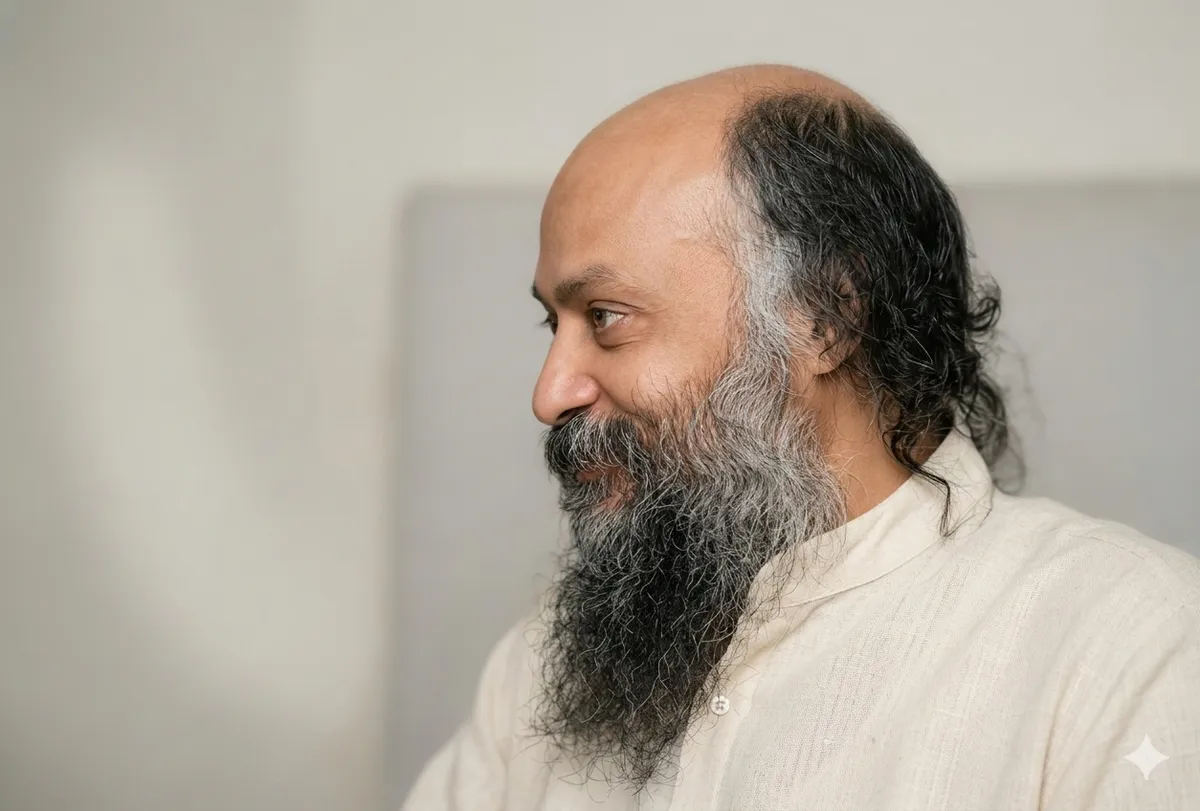
According to Osho, you have been 'in love' only insofar as you became love itself. Love addressed to someone destroys itself. Real love is like breathing - an overflowing quality of your being, radiating to all, even when alone. Do not ask, 'Do I love this person?' Ask, 'Am I love?' Life always offers this blossoming, even in the last breath.
Love is not just for one person; it is something you are that shines on everyone and everything, like breathing or sunlight.
From the Discourses
Passages where Osho speaks to this question — each links to the complete discourse.
Do you love me?
No! Never! Because I don't do anything. ]f you feel my love, it is not because I love you; it is because I AM love. So you can feel it, but I have nothing to do with it. It is just like when a flower opens and the fragrance spreads. Not that the flower is doing anything to spread it, not that there is any effort on the flower's part to spread it, not that because you were passing by the side, the flower threw its fragrance towards you, no. Even if nobody was passing the fragrance would be floating around the empty path. It would fill the empty path It is not directed; there is no effort. It simply is; the flower has bloomed. Nothing to do. When the flower blooms, fragrance spreads. When you attain to your innermost being, love spreads. Love is the fragrance. What YOU call…
Osho, what is the definition of God?
Words are very small. If you say God is light, then what of darkness? The scriptures have said that God is light. Suppose we accept this as a definition—then what about darkness? Where will darkness go? Darkness is too; in fact it is far more than light. Light sometimes is and sometimes is not; darkness is always, eternal. Where will you place darkness? If you say God is light, darkness is left out. If you say God is darkness, then light is left out. If you say God is both darkness and light, a contradiction arises: they cannot be together. Try to have both darkness and light in the same room. If you bring in light, darkness disappears; if you preserve darkness, you cannot have light. Then how can both be together? That becomes an impossibility. So you cannot say “both” either. Then the fourth device is to say: it…
Osho, your answer about the heart which was approximately yogi reminded me of the following interchange: wife: "darling, since we married, do you love me more, or less?" husband: "more or less."
To ask about love in terms of more or less is stupid, because love can neither be more nor less. Either it is or it is not. It is not a quantity; it is a quality. It cannot be measured; it is immeasurable. You cannot say more, you cannot say less. The question is irrelevant, but lovers go on asking because they don't know what love is. Whatsoever they know must be something else. It cannot be love because love is not quantitative. How can you love more? How can you love less? Either you love or you don't love. Love surrounds you, fills you totally, or disappears completely and is not there... not even a trace is left behind. Love is a totality. You cannot divide it; division is not possible. Love is indivisible. If you have not come across such love which is indivisible then be alert. Then…
Question: Second question: Osho, is love life itself? Is it aliveness? These are now scientific findings; not poetry or stories. Many laboratories in the world have reached decisive conclusions: love increases life. The rose you love will produce larger flowers—of course it will, because you have given it dignity. The life of the plant is thrilled; it wants to delight you because you delighted it. You gave to it; it wants to return. What more can it do but blossom into a larger flower? Under the love of true Masters, disciples have attained the Divine—sometimes without any doing at all. And at other times, after doing much, if the Master’s loving shade is not there, nothing happens. That is why surrender has such value. Surrender simply means: do not be a wall to the stream of love flowing from the Master’s life—be a door.
OSHO: Love is the most intoxicating phenomenon. It is the wine that wells up within. It is not something chemical that comes from the outside, it is not even part of the body, not part of the mind either. It is the dance of the heart in tune with the whole. Love is your heart in deep harmony with the heart of the universe. Then there is great intoxication. And yet the intoxication does not make you unconscious; on the contrary it makes you more conscious than ever. That's the paradox of love: on one hand one is intoxicated, on the other hand one has never been so aware before. It is an intoxication that makes you wake up. HER SIX-YEAR-OLD DAUGHTER: PREM GARIMA, GLORY OF LOVE. NENE BECOMES MA PREM KUNDAN OSHO: It is by passing through the fire of love that one becomes one's real self.