
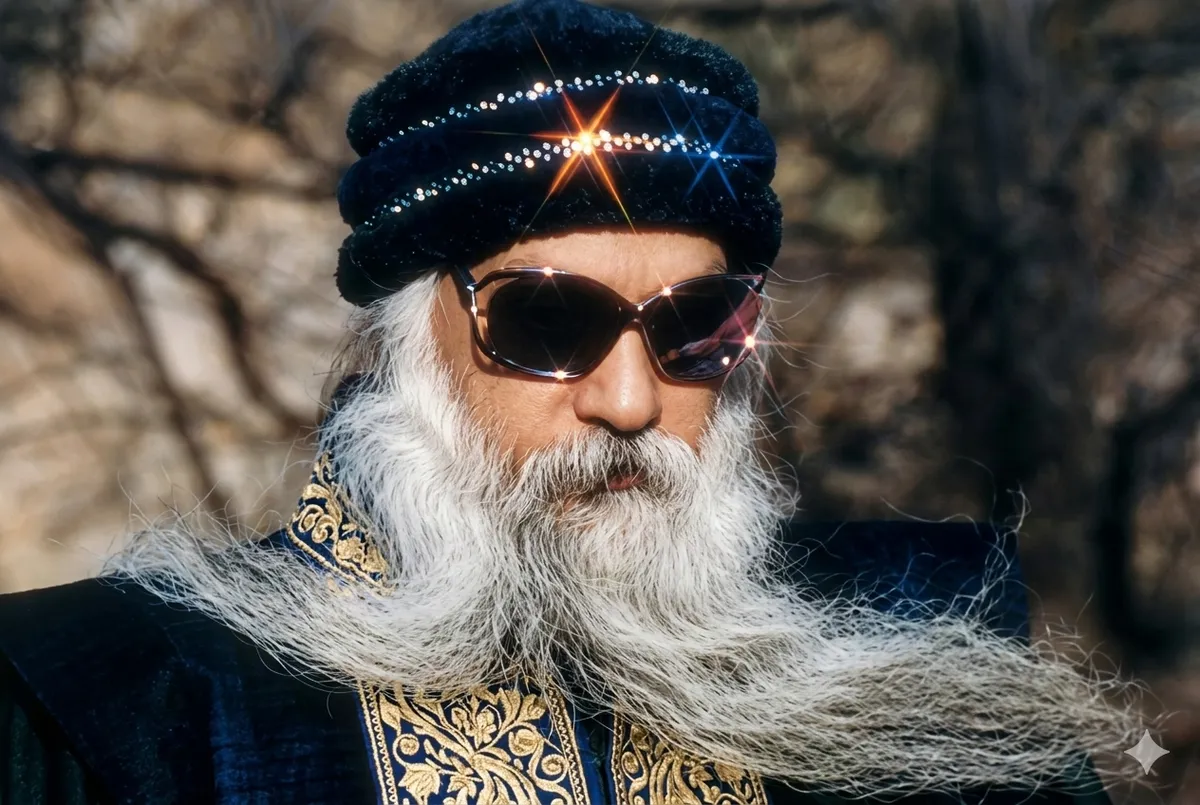
Experiences are like changing weather, but real Truth is the unchanging sky—the quiet watcher behind all changes.
From the Discourses
Passages where Osho speaks to this question — each links to the complete discourse.
There is a knife, a blade. Boys play with it; we warn them, "Hey, you'll get hurt." When they do get hurt, from their experience we too understand that if you fool around with a knife you get cut. So that counts as truth, doesn't it? From their experience I have learned that this is what happens when you play with a knife.
That is not Truth; it is only a fact. A fact, not Truth. It is merely a fact that if a knife strikes you, you are wounded. That is a fact. When a knife and a hand collide, pain begins—that is a fact. In some situations, the collision of knife and hand can also remove pain. If there is a boil, cutting with a knife can relieve the pain—that is another fact. The meaning of Truth… let me tell you an incident; it will make it clear. In the last world war, in France, a prisoner was injured in his leg. The pain was so intense that they kept him unconscious. At night they operated and amputated the entire leg. In the morning, when he regained consciousness, he started saying again, “My big toe is hurting terribly.” There was no toe. The doctors were very puzzled: how can there be…
When the self as consciousness, which is truth, knowledge, infinity, and bliss, devoid of all its attributes, shines like pure gold freed from all its forms such as a bangle and a crown, it is called twam or thou.the brahman is truth, infinity and knowledge. That which is indestructible is truth. And that which does not perish even after the destruction of space, time, et cetera, is called the avinashi, the imperishable.
There is a dialogue, a deep dialogue between my existence and existence itself, a constant dialogue, a continuity every moment: the incoming breath, the outgoing breath. I am constantly linked with the universe, with existence. If we take two points, between these two points the dialogue continues. One point is "I," and the other point -- the total -- is "thou." A non-religious mind, a material mind, will say that the dialogue is not between "I" and "thou," the dialogue is between "I" and "that," because the world is just a thing; it is not a person. And really, if the world is just a thing and it is not a person, then there can be no dialogue, there can be no intimacy. But if the whole world is just a thing, then myself -- I myself cannot be a person; this "I" is also a thing. This is what…
Real truth is what is experienced as such
The very first foundations of a life of spiritual endeavour are love of oneself and spiritual harmony. Surely you will be confounded to hear this, because you have been often advised to suppress something within you. But I say that there is nothing within you that needs suppression or extirpation. There are certain drives within every man that need to be harnessed, not extirpated; certain forces that must needs be awakened and loved, not suppressed. They should be controlled and directed along the proper course. But those who consider them hostile can never be successful in transforming them. A man of understanding can transform even poison into nectar, but one who has no understanding whatever is sure to turn his nectar into poison. I call understanding nectar and deficiency in it poison. We see that putrefying things, things that emit foul smell, are used as fertilizers. Just now some one…
In accepted knowledge, the knower and the known are separate, the seer and the seen are distinct, but in the realization of the self they are not separate. There, the knower, the known and knowledge are all one. And so here, words become quite useless. They are not meant to be used in this context. To use them like this is to stretch them beyond their capacity, beyond their potentiality. No wonder they become crippled and lifeless in this tug-of-war. And although they give an indication of the body, of the outer form of truth, they cannot touch the heart of truth. The truth will be known only when words are not present. How can words express the truth? That which is attained in a state of thoughtlessness cannot be held earthbound by thought. Is there a way to tie down the sky?
Question: BELOVED OSHO, WHAT IS THE CRITERION OF THE TRUTH? Sahabsadev Hasan, truth is not an experience of the mind; hence no logic can prove it or disprove it. No argument can convince you about it or unconvince you about it. Truth is an experience beyond mind, so there is no objective criterion possible. That's why science never talks about it, because science can only talk about things which can be objectively proved. Truth is a subjective experience, just like love. What is the criterion of love? Can you prove when you fall in love? Can you prove that really you have fallen in love? Is there a way to prove it? Is there any argument, any logic that will support you -- any eyewitnesses? All that you can say is, "I know for certain that my heart is beating differently" -- but that is something inner to you.