
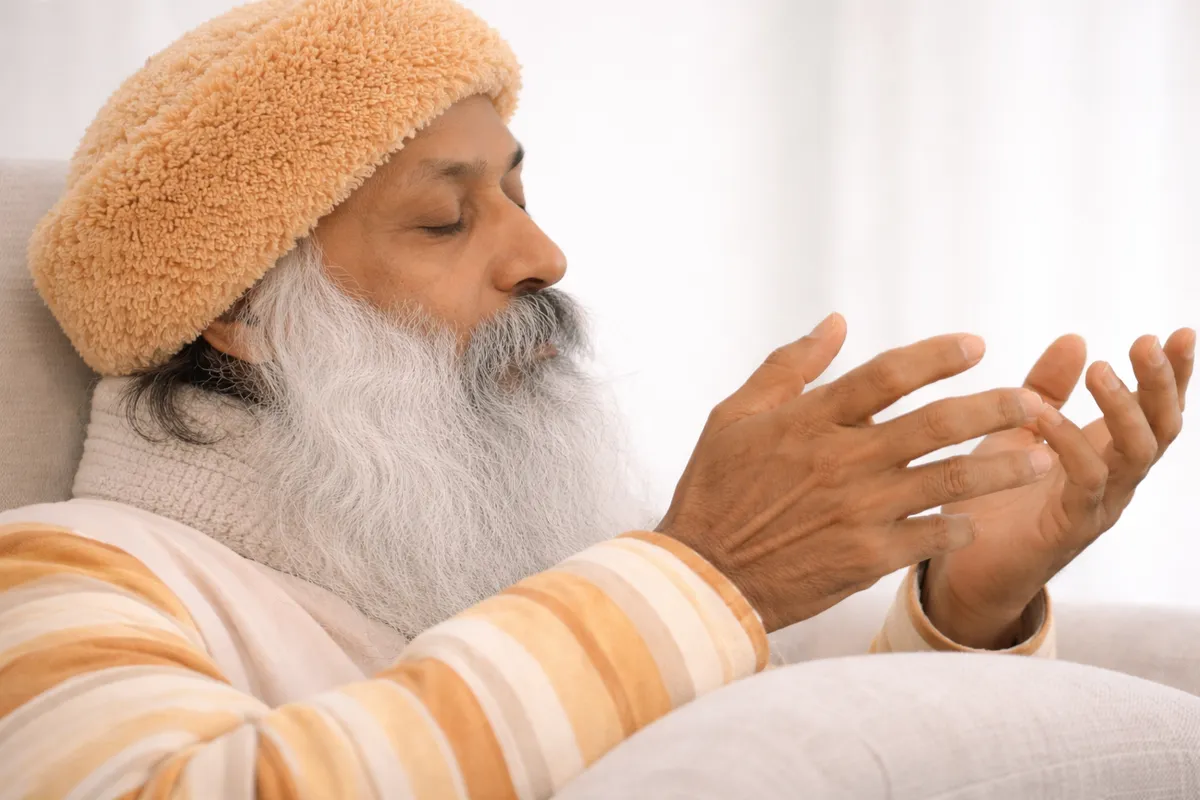
Being bald doesn’t make you enlightened; wisdom comes from inside, not your hair.
From the Discourses
Passages where Osho speaks to this question — each links to the complete discourse.
Are all enlightened masters bald?
AND NOW I cannot avoid it any more, because in the effort to become bald he has shaved his head. There exists no relationship, so don't try to be bald. Bald people are very clever, they create rumors about themselves. One rumor they have created all around the world is that they are potentially more sexual than anybody else. Of course bald people are not so sexually attractive; they have to create rumors around themselves. All over the world in all countries the rumor exists that bald people are more sexual, more potential sexually than anybody else. This is a trick. But now to create another rumor that bald people are the only ones who become enlightened will be too much!
Beloved Osho, last night, I noticed your beard. It is really a magnificent thing; it reminds me of a lion's mane. Does a beard like yours come with enlightenment? Or do you have to be born with it?
When you look in, those mirrors go on reflecting each other. So instead of three, you see a line of hundreds, as far as you can see. The first mirror reflects the second mirror, then that mirror reflects the other mirror, and this goes on and on. So as far as you can see and strangely, you can see exactly twenty-four tirthankaras -- a great artistic device ... But if the temple is very poor, then you will find only one statue of Mahavira. But one thing is -- it is striking too that Jainas have not been able to explain it -- all the statues look similar, exactly similar. The only difference is a small symbol underneath their legs -- a line represents Mahavira. Even the priests cannot say which is Mahavira. First he has to look. You may not understand how he manages to tell that this is…
Beloved Osho, when wakuan saw a picture of the bearded bodhidharma, he complained: why hasn't that fellow got a beard? Beloved Osho, why don't you have a beard?
It is true. When you meet a Zen master on the road...and you always meet a master on the road because the master is always moving. You never meet him anywhere else. Remember, you always meet a master on the road, because he is always moving. He is a river, never static, never standing. If you cannot move with him, you will miss him. He is always on his feet. You always meet him on the road. What can you talk to him about? And you cannot be silent either, because to be silent is almost impossible for you. You cannot talk, because the master belongs to a different world. You cannot be silent, because the world you belong to is never silent. Your mind goes on chattering. Your mind is a constant chatterbox. Consistent, inconsistent -- thoughts go on and on and on, and there is no end to…
Hair carries a sexual allure. Hence a man may shave his head; women almost never agree to shave theirs. And a shaven-headed woman looks quite like a man; she does not look like a woman. Much of a woman’s beauty is hidden in her hair. So Mahavira says: having become a shraman, one may shave the head—because he has no purpose left in attracting another. Now it is a matter of convenience. And for a shraman hair can be troublesome. Mahavira says: if hair is to be kept, one must be dependent—someone must cut it. Unnecessary dependence increases. Or carry implements—razor, knife—to keep it clean. If not cleaned, filth accumulates. If hair is allowed to grow, its hygiene must be cared for; otherwise lice collect, and other dirt. All this is painful. So Mahavira says: one who has become a shraman may well shave his head.
Why do sannyasins have to change their names and wear a mala? The spiritual jet-set talks about all these 'enlightened masters': 'Osho is more enlightened than oscar', 'oscar is more enlightened....' how can we tell what it means?
First: there is no reason why sannyasins are in orange and wear a mala except that I am eccentric about it. I am a little in love with the orange and I am in love with myself, hence the mala. This is the truth, if you understand. If you need some rationalisation you can ask my disciples. And the second question: '"Osho is more enlightened than Oscar". "Oscar is more enlightened...." How can we tell what it means?' Enlightenment is never more or less: either one is enlightened or one is not. It is not a question of more or less. How can you be more enlightened and less enlightened? This is absurd. Enlightenment is not a relative concept: either one has arrived or one has not arrived. How can you partially arrive? You have come back home. Can you say 'I have partially come back home -- only one…