
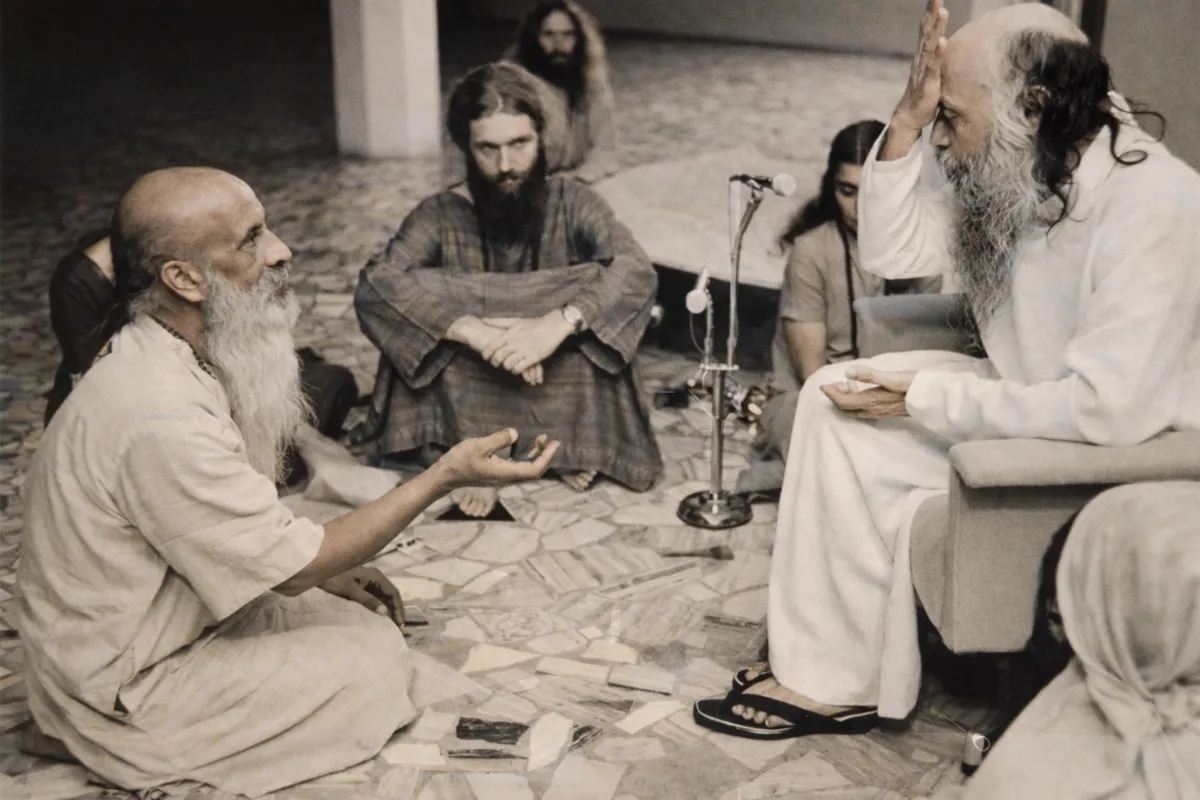
Because Osho wants residents to stop hiding in many techniques and instead make their everyday work and listening a continuous meditation.
From the Discourses
Passages where Osho speaks to this question — each links to the complete discourse.
Why are the ashramite sannyasins not allowed to participate in all the meditations? Why are they told to participate in only one meditation every day?
It is because of you, ladies and gentlemen. It is because of your laziness. I go on talking about non-doing and my text becomes your pretext. Non-doing has nothing to do with laziness. In fact, a lazy person can never move into non-doing. A lazy person is almost suicidal. He is closed; his energy is not flowing. A non-doer is a flowing person: alive. A non-doer does not mean that he does not do anything. He does many things, many more than ordinary doers, but he is still not a doer. All that he does is a happening. He is instrumental: as if the divine possesses him and functions through him. He never thinks, "I am doing it." At the most he thinks, "I am allowing it," A non-doer will do many things and will not be tired because there will be no tension. A non-doer will do many things…
No, take the challenge to stay with the every-day activity. Vipassana should not become a style of life. These are just techniques to be learned and immediately forgotten, so only the quality is carried with you. The flavour, the fragrance, not the flower, has to be carried into day-to-day activity. so by and by you don't know what is meditation and what is ordinary activity -- they become one. Learn the technique -- and for learning, of course, one needs to be in a particular place. Once you have known the technique, then unlearn it. Then just move into ordinary life -- eat, drink, sleep. Just be ordinary, and carry the sense of silence that has come to you. Again and again remember it, again and again remind yourself. Again and again move into that feeling and catch hold of it in ordinary life.
The said, "We were living but we went on postponing that you are here any day. But now you are not there. Although we were not your sannyasins, although we were not even acquainted with you, your presence has become something that we cannot live there any more in the house. We have left, we have come to live here in Poona as your sannyasins." In Oregon, hundreds of Indians came who had never come to Poona and amongst these hundreds of Indians were people who were so poor that they could have never dreamt of travelling so far to America. It was beyond their conception. They sold their houses, they sold their land, risking their whole life because what they will do when they are back, but they said, "Whatever... but at least -- we are old -- and one time we want to see Bhagwan.
First, they have created a great hurry in people -- that's why the West is in so much of a hurry. The roots go deep into the religions that have dominated the western mind. If there is only one life, only this life and then you will be in the grave, who knows for how long... who knows when the last Judgement Day will come? For almost an eternity you will be in the grave, so make as much as you can make of your small life -- it is not much. If you are going to live sixty years, twenty years will be wasted in sleep. Of the remaining forty years, for twenty years you will be working as a clerk or as a teacher or as a D.T. collector or as an engineer. There are thousands of kinds of stupid professions in which one can waste one's life.
A friend has asked, Osho, why do you place so much emphasis on meditation or sadhana? Reading spiritual and philosophical texts, or listening to sages like Krishnamurti or yourself and then reflecting—Is the understanding that arises from these not sufficient for transformation? Isn’t that itself sadhana? Then what is the point of sitting for meditation? If meditation means witnessing, there is full opportunity for it all day, in every activity. So why meditate separately? Why sit apart?
So the day Krishnamurti’s mind dropped, whatever the last state of that mind was—its final mood of opposition to gurus and methods—remained with that mind. Whenever Krishnamurti uses the mind to speak to you, that same mind—which was retired from service forty years ago—has to be brought into use. There is no other mind with him. Naturally he uses that mind. Therefore, even what he does not want to say, what he ought not say, gets said. It comes along with that mind. Imagine you have an old car that you have put away. You no longer use it; you walk. But for forty years the car has been standing in your house. Sometimes you need to go fast and walking won’t do; you bring out your old car—and with rattles and bangs that keep the whole neighborhood awake, you drive off. Almost like this is the mind. The day…