
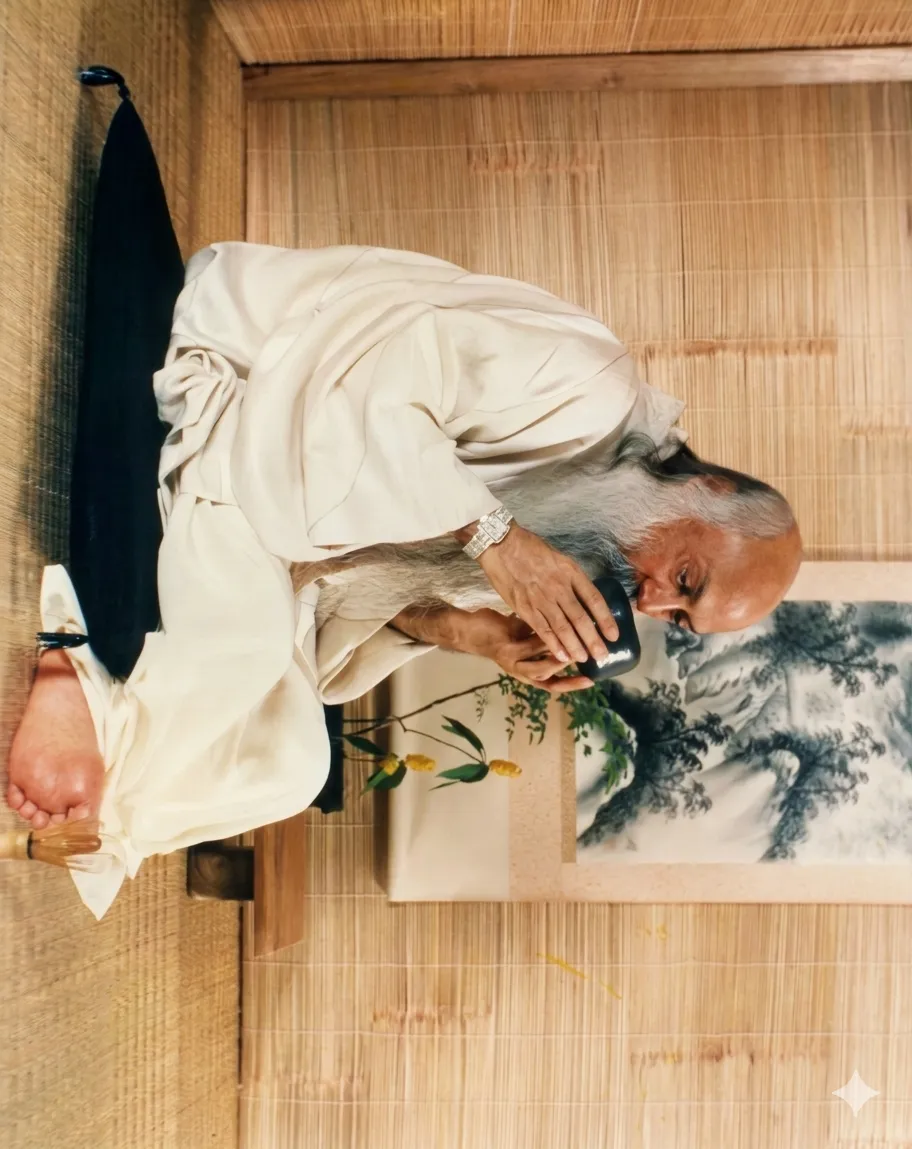
It’s when a talk turns into music and quiet that lift you up inside, beyond thinking.
From the Discourses
Passages where Osho speaks to this question — each links to the complete discourse.
Beloved Osho, in last night's discourse, listening to you, I went into a state where your words became sounds, your voice became music, and in the gaps between your words, it felt as if I found myself rising up into the sky. At first I thought I was going to fall asleep, but it turned out not to be like this. Would you please help me in understanding this?
Out of this experience scientists may think that life is centered in the heart, that if the heart stops you are dead. It is not true. There have been experiments proving certainly that the heart can be stopped and the person does not die. After ten minutes he comes back, and the heart starts again. According to the spiritual science, life is just two inches below the navel. The child was joined by the navel to the mother. And the navel was nursing the source inside, two inches below... It has been cut from the mother's life, but it is still joined with the universe from the same place. It is not in the heart, it is just two inches below the navel. And because of this, in Japan a certain thing developed: hara-kiri. Hara-kiri is a special kind of suicide. Hara is the name of the center below the…
Osho, when we begin to ask a question we feel an infinite distance; and when you begin to speak, through your way we don’t know where we are carried. While listening, sometimes joy bursts forth, sometimes tears well up. Sometimes this happens, sometimes that. Sometimes you shake us like a storm; sometimes you shower like a cloud. What is this?
Krishnamurti continuously emphasizes right listening—samyak shravana. But even right listening can be dangerous. It has its use, because the first glimpses are received from there. Then do not make those glimpses the basis of your life. Try to find those glimpses in different situations, so there can be freedom from the guru. So sometimes by a tree, sometimes by a river, sometimes standing in the middle of the marketplace, listen to the sounds and become silent. There too the same other realm will instantly open. When you ask, when you want to ask, you become restless inside. Questions agitate you and make the mind aggressive. A question too is a kind of deep violence. But when you listen, the mind becomes quiet; the tension settles, the waves dissolve. In that listening, there is a glimpse of the other world. Certainly, at times I shake you like a storm, and at…
Osho, the other day while listening to your discourse, a strange kind of vibration arose in the heart and along the auditory nerves; since then even ordinary sounds set off odd ripples and waves of bliss. Please tell me: is there something in the voice of enlightened ones that produces a special effect? Also, in your presence there is a particular, delightful fragrance; at times it is felt in the ashram and sometimes during meditation as well. In this regard, please say whether certain moments in time have their own special fragrance too.
I speak with the same purpose with which a musician plays the vina. He does not play to explain anything. Remember me as a vina player. My speaking is my vina. What I am saying to you—less am I speaking, more am I singing. If you understand its purpose, that is enough: listening to this instrument—as one sometimes, listening to a vina, falls into a trance—one begins to sway; something within begins to vibrate; something like a stone inside begins to melt and flow. For a moment a window, an opening, is there—sky is glimpsed. Like a flash of lightning—the darkness is gone—even if only for a moment; but then you know that light is, and you also know there is a path. It was revealed for a moment in the lightning’s flare, but revealed it was. Now no one can tell you there is no path; no one can…
Beloved Osho, the master speaks, and the disciples listen. What is it that happens, and remains unsaid?
Yoga Chinmaya, the master speaks, the disciple listens -- yet there is much which the master does not speak, and the disciple listens. In fact, that is the whole secret of disciplehood. If you only listen to that which is said, you are a student. You listen to the words, you miss the wordless. The moment you start listening to the wordless, you are initiated into disciplehood. The master is speaking. Naturally he has to use words, but he is also leaving gaps in between. He is also using wordlessness. He is saying something, and he is also meaning something which cannot be said -- but it can be heard. If the disciple is silent, he will hear the words and he will also hear the wordlessness; he will hear what is being said, and he will hear also what is not being said and yet is transferred. You are…
Osho, when I read your discourses I am filled with wonder. But when I listen to them, only sound keeps reverberating. In the end, only emptiness remains, and a soft, delicate bliss. Is this your taste, Osho?
Certainly. I am not saying anything to convince your intellect. My effort here is not to placate your mind. Sometimes I speak on devotion—then the effort is that your heart be stirred. Sometimes I speak on knowledge—then the effort is that you transcend both heart and intellect and become a witness. But I never speak for the intellect. The intellect is like an itch: the more you scratch… While scratching it feels pleasant; afterward a great soreness comes. I am not speaking for your intellect, not for your head. Either I speak for the heart, or I speak for that which is beyond both—beyond heart and intellect. Either for the witness, or for your feeling. Either for your love, or for the awakening of truth within you. And the greatest benefit will be for those who listen by putting the intellect aside. Heard through the intellect, nothing much is heard.…