
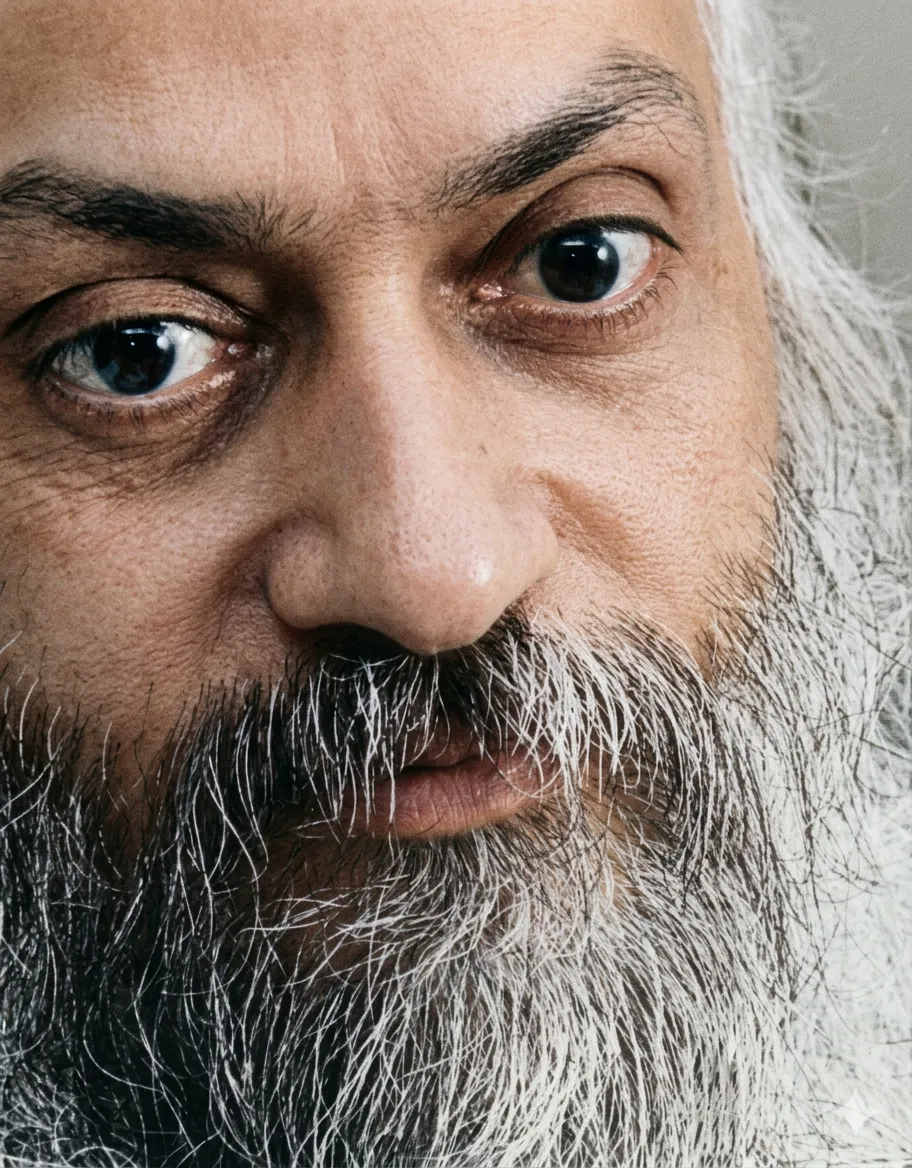
From the moment you’re born your body slowly wears out, but the real you is the quiet awareness behind it—found by calming the mind.
From the Discourses
Passages where Osho speaks to this question — each links to the complete discourse.
You said that this life we live is not life at all, but a long drawn-out process of dying. What do you mean to convey by this?
It is quite true that what we call life is not life. If it really were life how could it end in death? Life and death are two contradictory things so how then can death be the fulfillment of life? Death is the end of birth, not of life. And because death comes at the end don't think it only starts at the end. It is present in birth itself. It starts the very day one is born. After birth we die every moment. When this process of dying has been completed we call it death. What was in birth as a seed appears at the end in its fully-ripened form. Therefore nothing after death is for sure, but death is for certain. It is certain because it arrives with birth itself. Birth is just another name for death; it is the seed of death. Let this be carefully understood.…
Someone asked Osho's views on death and dying.
There is nothing as sure as death. Where there is life, there is bound to be death. He who bears not this fact in mind, wastes life, whereas he who knows this truth, obtains that which is immortal. I do not feel depressed at anybody's death, because there is no need to feel anything about it. However, it is a matter of sorrow, no doubt, if I see a life wasted. We have not to grieve after a dead body, but over a wasted life. You know, King Janak was called 'videh', i.e., without or beyond the body. Once, a young minister of his asked him, 'Your Excellency! How can you be considered without a body, when you do have a physical body? The king smiled but said nothing. After a few days, however, the king invited the minister for lunch. Such an invitation from the king himself was a…
Osho, what is the essence of Gorakhnath’s teaching?
Very small, concise— Laugh, play, live in color. Do not keep company with lust and anger. Laugh, play, sing songs. Keep your heart-mind steady and firm. This is my teaching too: Laugh, play, live in color. Live in color! In delight, in merriment, in joy. So much has the Divine given—dance, hum, sing! A song of gratitude should rise from your heart; that is prayer. Laugh, play, live in color. Laugh. If you cannot laugh, understand that you can never be religious. Your so‑called sadhus and saints have forgotten how to laugh. They simply cannot; to laugh is a sin, a transgression. That’s why you can’t stay long with them. You go, quickly touch their feet, bow, and leave. If you stay a full day, you’ll see the difficulty—your own laughter will be snatched away. People become grave around sadhus and saints. They stiffen up—dry, solemn, ultra‑serious! Laughter will feel…
Osho, in the Dwarka camp you said that meditation and samadhi are a voluntary, conscious entry into the state of death, through which the illusion of death dissolves. Then the question arises: to whom does the illusion of death occur? Does it occur to the body or to consciousness? Since the body is only an instrument, it cannot have delusive awareness; and there is no reason for consciousness to be deluded. Then what is the cause and basis of this event of delusion?
They sent word. She came very annoyed. “It’s his same old habit,” she said. “He’s grown old but hasn’t dropped it. Even at death he will create mischief.” She came with a stick, banged it on the ground and said, “Stop this devilry! If you must die, die properly!” The man laughed, came down, and said, “I was only playing a little—wanted to see what they would do. Now I will die properly, conventionally.” Then he lay down and died. His sister left, saying, “Fine, now finish the rites. There is a right way for everything; do things properly.” Our illusion about death is a social delusion. It can be broken. There are methods and arrangements to break it. And even if no one else breaks it for you, anyone who has done a little meditation will break it himself at the time of death. No outside help is needed.…
Osho, I have two questions. The first is this: meditation, awareness—these states seem to remain only so long as the body and mind are healthy. When the body and mind become dull or weak, all this seems to disappear. And before death most people do become dull—both in body and in mind. So just before dying a person loses so much control over himself that none of these methods seem to work. Which would mean that in the end even a meditator or one who tries to be aware will end up just like someone who has done none of this.
No. A few things need to be understood. In the beginning, when you start moving toward meditation, then the conditions of body and mind do influence it—because from where you start, you are nothing more than body and mind. It’s like I begin to walk out of this room: I take one step, but I’m still inside; I take two steps, I’m still inside. So the smell of the room—its fragrance or stink, its air—still affects me. But I am walking toward the door, where the room ends and I can go beyond. Once I step outside, the room’s fragrance or stink has no meaning; it no longer affects me. In the primary journey, as you move into meditation, you are still passing through the room of body and mind. So it will affect you—very much so. If the mind becomes a little dull, the body unwell, meditation will get…