
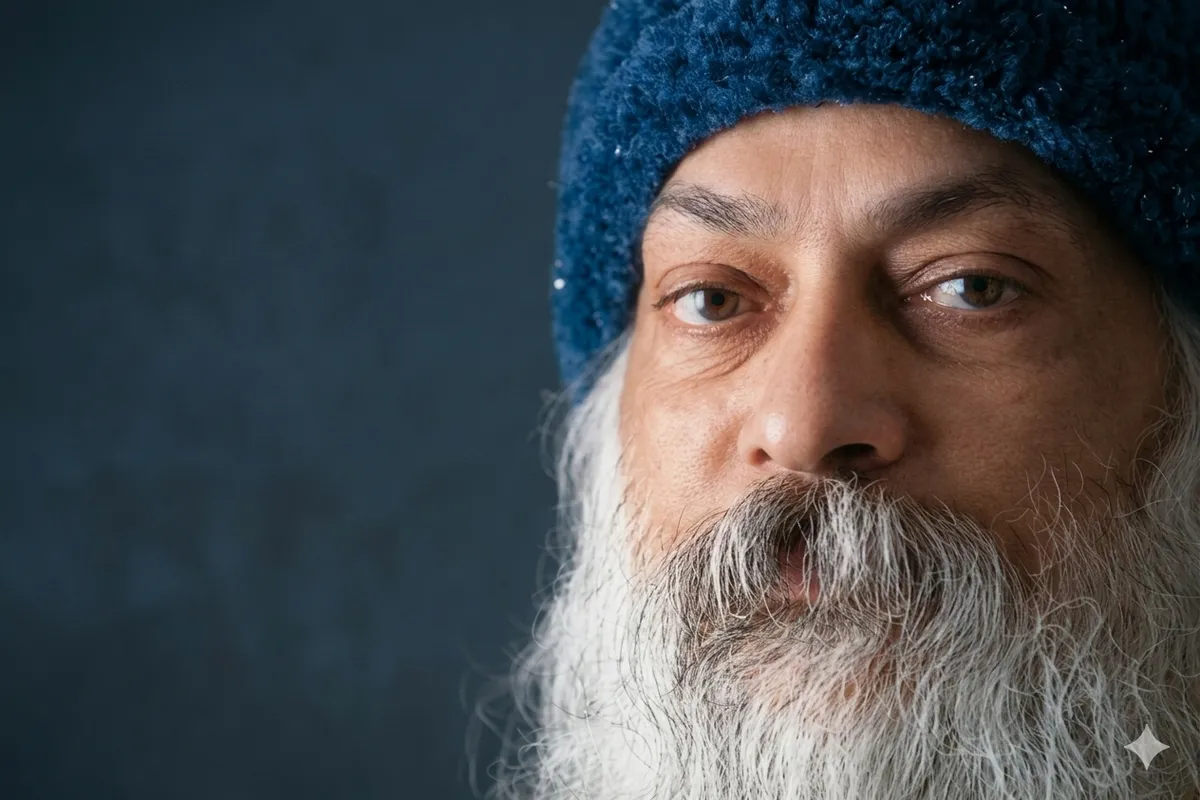
According to Osho, an enlightened man is pure emptiness—characterless, unarmored, beyond all dualities and social labels. He lives moment to moment, flowing without fixed rules, acting from consciousness rather than conscience. His behavior is spontaneous, innocent, and present; he responds with awareness (a gap before action) instead of automatic reaction. Unconditioned by fear, greed, reward, or punishment, he cannot be categorized—he simply is.
He has no fixed rules or labels; he stays aware in the now and lets wise actions arise naturally instead of reacting.
From the Discourses
Passages where Osho speaks to this question — each links to the complete discourse.
What constitutes the behaviour of an enlightened man?
An enlightened man is all emptiness. What constitutes an emptiness? It has no 'constitutes' in it; hence it is empty. A man who is enlightened has no character. Let me repeat it: an enlightened man has no character at all. He lives from moment to moment. He has no character to follow; he has no structure around him. A character is a structure, a character is an armour. An enlightened man has no character. Let me say he is characterless. But try to understand me -- because he has no structured consciousness. He HAS consciousness but the structure has been dropped. He's neither Hindu nor Mohammedan nor Christian. He is neither good nor bad, neither moral nor immoral, neither this nor that. He simply is. All duality has disappeared. You cannot evaluate him; you cannot categorize him; you cannot put him into any pigeon-holes of your logic. He exists like…
And then he renounced the world. Rather than becoming a wrestler, he became a meditator. And when he became enlightened, he dropped the cloths. He had only one cloth that he used to cover his body. And after his enlightenment, as he was coming down the hill, a beggar asked him something, because it is too cold and he has nothing. And Mahavira looked at himself, he has only one shawl, so he made two pieces out of one shawl and gave half to the beggar, and half he kept himself. It was not enough to cover the body now. And as he was just descending from the hill into the valley, a rose bush caught hold in its thorns, the one piece of the shawl. He looked back and he laughed, and he said, "This is too much.
When one becomes empty of all thoughts, empty of all plannings, empty of all desires, what transformation will happen in one's outer life and one's inner life? How will he behave? How will he see things? How will he live in the world? Please say.
IT depends, it depends on the individual. There cannot be any dogmatic statement about it because each individual is so unique. When Basho becomes enlightened he starts singing poetry, poems; Buddha has never done that. When Krishna becomes enlightened he starts dancing, singing; Mahavir has never done that. When Mahavir becomes enlightened he keeps silence for many years, remains absolutely silent, not a ripple is allowed; Meera has not done that. When she becomes enlightened, she dances from village to village, she sings the glory of God. It is very difficult to make a dogmatic statement. There have been people who renounced life when they became enlightened and went to the Himalayas, moved as far away from the society as possible. There have been people who became enlightened and came back to the world, even if they had been in the Himalayas, and started living with people again. There have…
Question: OUR BELOVED MASTER, ENGO SAID: THE ENLIGHTENED MAN ENJOYS PERFECT FREEDOM IN ACTIVE LIFE. HE IS LIKE A DRAGON SUPPORTED BY DEEP WATERS, OR LIKE A TIGER THAT COMMANDS ITS MOUNTAIN RETREAT. THE MAN WHO IS NOT ENLIGHTENED DRIFTS ABOUT IN THE AFFAIRS OF THE WORLD. HE IS LIKE A RAM THAT GETS ITS HORNS CAUGHT IN A FENCE, OR LIKE A MAN WHO WAITS FOR A HARE TO RUN AGAINST A TREE STUMP AND STUN ITSELF. THE ENLIGHTENED MAN'S WORDS ARE SOMETIMES LIKE A LION CROUCHED TO SPRING, SOMETIMES LIKE THE DIAMOND KING'S TREASURE SWORD. SOMETIMES THEIR EFFECT IS TO SHUT THE MOUTHS OF THE WORLD-FAMED ONES, SOMETIMES IT IS AS IF THEY SIMPLY FOLLOW THE WAVES COMING ONE AFTER ANOTHER. WHEN THE ENLIGHTENED MAN MEETS OTHERS WHO ARE ENLIGHTENED, THEN FRIEND MEETS FRIEND. HE VALUES THEM, AND THEY ENCOURAGE EACH OTHER.
Osho, what is the most significant thing about enlightenment?
People want definite answers to believe in: this way or that. Either be a Catholic or be a communist, but be clear. People want clarity because they are so confused, and this man brings all these seven categories; now their confusion is worse, they are even more confounded. First you were at least aware that you were confused. Now you will not be aware to which category you belong: yes, no, yes -- no both, neither yes nor no, or indescribable. Mahavira could not create a world religion for the simple reason that perhaps he had the deepest penetration into reality. If you ask about his enlightenment, he will answer in seven sentences. You will not be able to come to any conclusion -- and I feel this is something tremendously valuable. Why this urge to come to a conclusion? If existence is a continuum, an ongoing process -- never…