
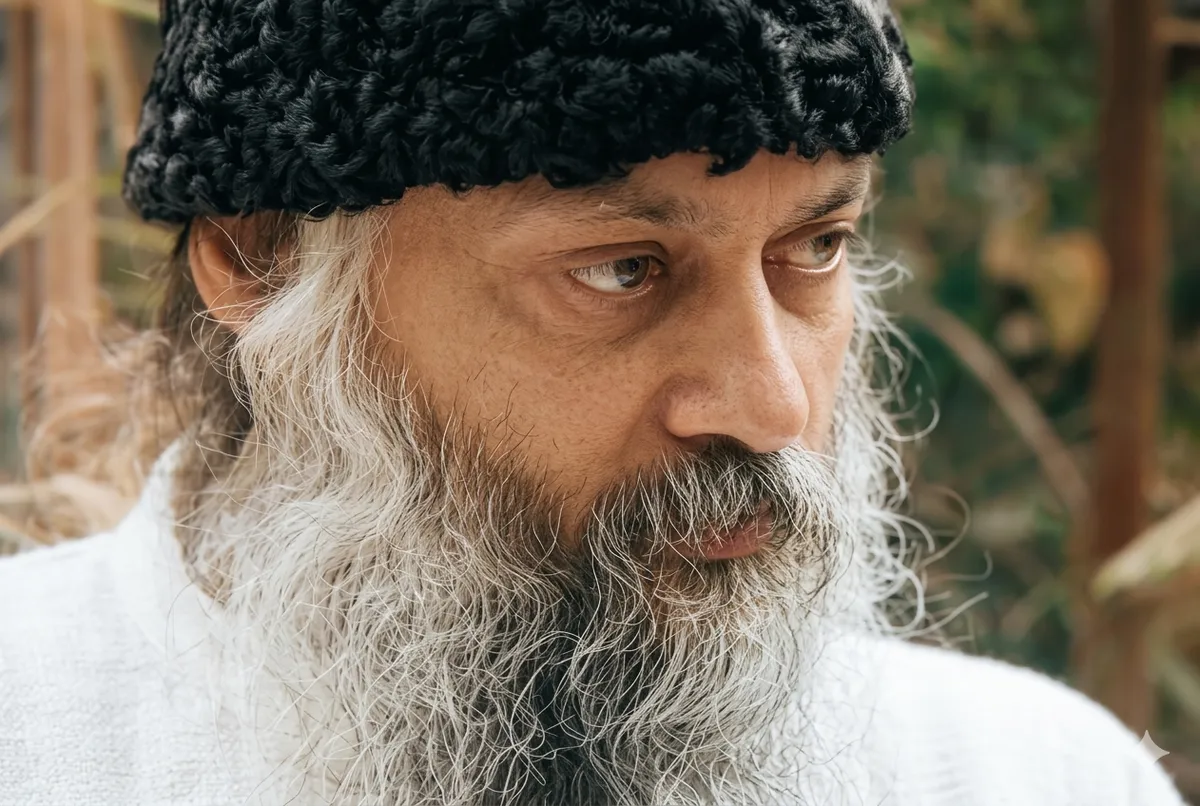
Meeting an enlightened person is like looking in a special mirror that shows who you really are inside, beyond your mask.
From the Discourses
Passages where Osho speaks to this question — each links to the complete discourse.
Beloved Osho, when I took sannyas and I first met you, it was like meeting again with an ancient beloved, as if I had known you for a long time. Is it so, or is every meeting with an enlightened being so much a reminder of one's own inner self that it feels as if one has met before?
Purna, the experience of remembering as if you have been with me before in the past lives has two dimensions -- one, which you mention in your question itself. Each meeting with an enlightened person is meeting with a mirror. You see yourself as in reality you are -- not the mask but the original face, not the personality but your universal being. The meeting with the enlightened person creates a resonance, a certain vibration that reaches to the very depths of your being. Because you don't know your self, it seems you have met this enlightened being before -- because you don't know your own enlightenment. It is your self nature. This is one dimension. But there is another dimension also. You have lived many lives, and it is impossible that you have not come across the awakened, the enlightened, the illuminated beings -- perhaps many times. You have…
Osho, when I listen to you it feels as if I’ve heard you before. When I look at you it feels as if I’ve seen you before. Yet this is my very first time here. It’s the first time I’ve heard you, the first time I’ve seen you. What is happening to me?
Eyes closed, keep advancing—such is the law of the love-mad; Do not bow your head, keep fighting—such is the law of the brave; There is motion in the breath, motion in the heart—here progress alone is the rule; Become motion, and in motion dissolve—such is the law of the motioned ones! I am a challenge—a call! I shake you. I question you. Eyes closed, keep advancing—such is the law of the love-mad; Do not bow your head, keep fighting—such is the law of the brave; There is motion in the breath, motion in the heart—here progress alone is the rule; Become motion, and in motion dissolve—such is the law of the motioned ones! You missed before—do not miss this time. Yes, fear comes. Satsang brings fear. Ah—to see and hear That which truly Is here; Love, in a single instant, effaces its own devotees! Love annihilates. Love burns. But the…
Osho, kindly explain—what is the way to recognize enlightened ones?
If you go near an enlightened one, you will recognize. How could it be otherwise! It may be that a blind man cannot see the sun, but when the morning sun spreads its rays, he feels its touch. He experiences its warmth, its heat. He comes to know that night has gone. Birds have begun to sing, the morning hymn has begun. He knows that a moment ago all was silent, asleep, dead; now life has revived, a hum is there. The sun may not be seen, but its warmth is felt. Even the blind senses the sun. He knows when night has passed and day has come. Granted you do not yet have the inner eye—but if you go near an enlightened one, that gust from the Malaya will touch you. You will bathe in it. You will be freshened. That piece of moonlight will shower upon you. You…
Osho, forgive me; I want to ask something that has been on my mind for a long time. Why is it that all the great masters who are alive—including you—never come together?
Kabir’s disciples asked, “Why were you silent? Your speech has such power—give a little taste of it to Farid too! You shower it on us every day.” Kabir said, “Farid has already received it. What I shower on you, Farid has already received. Where I am, there is Farid. We both stand in the same place. Seeing each other, we were amazed. We are not two; we are one. So what is there to say? To whom to say it? If a man sits alone and talks, would you not call him mad? Someone sitting alone, talking to himself—raising the questions and giving the answers—that is what you call madness. So,” said Kabir, “did you want to make me mad? We were not two.” Therefore there is no need for saints to meet. Saints are not separate that they should have to meet. A Janata Party is formed by non-saints,…
Osho, if another man who has already realized his own self comes to you, can you recognize him simply by looking at him? I would like to meet you if you permit me.
It is a very paradoxical phenomenon. To realize who you are is to realize that you are not! If you want to be, never try to realize, because in the very process of realization the ego disappears. And the self is only another name for the ego. There is nothing like self-realization. Yes, there is realization, but the realization always makes you absolutely clear that the self had never existed in the first place and it is not there; it has never been there. And for whom are you looking for recognition? As I see it, to me everybody is a no-self, whether he knows it or not. Yes, if he knows that there is no self I will immediately see that he knows. His humbleness, his simplicity, his spontaneity, his no-nonsense will be enough. His eyes will be absolutely empty because only in emptiness is there clarity. He will…