
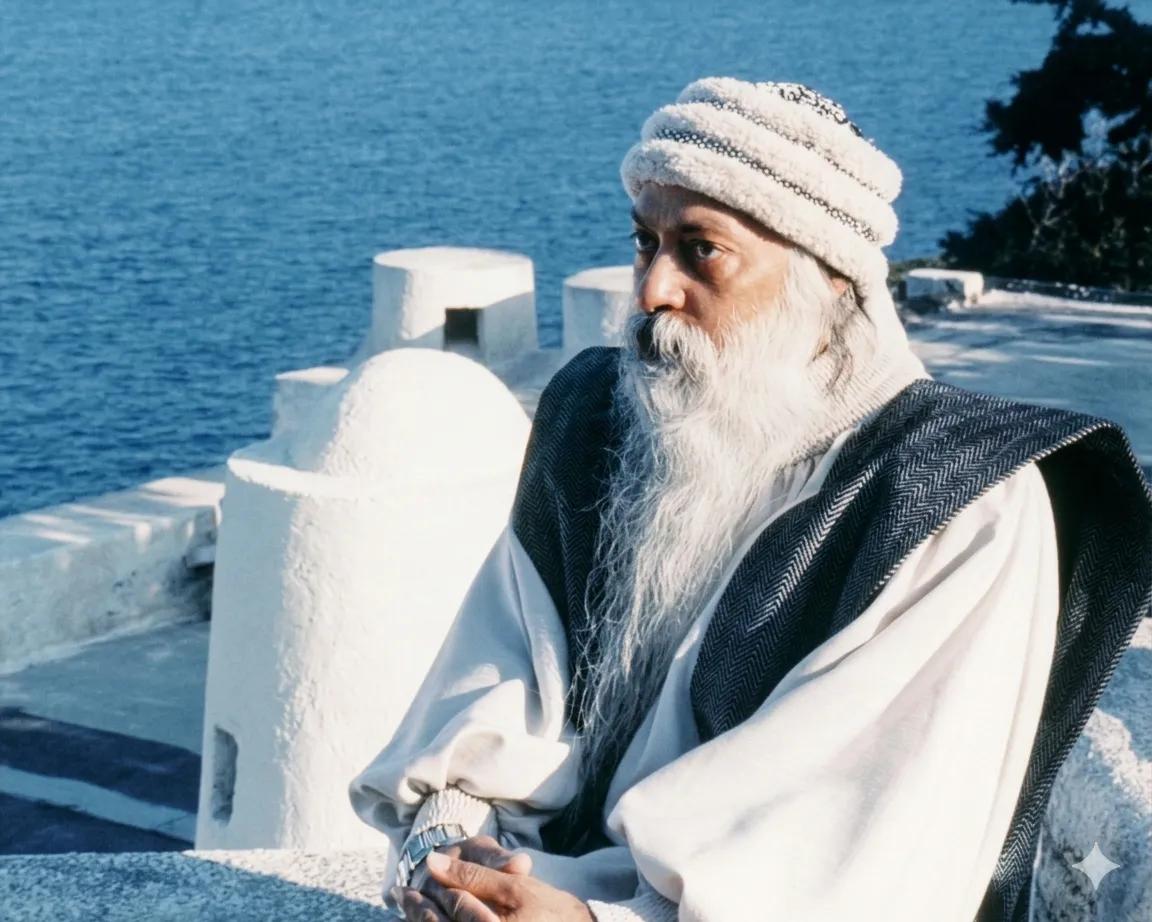
According to Osho, continuing meditation does not make 'it'—more questions or intellectual answers—come; it dissolves all questions. In true meditation, only one thing remains: silence, the single answer to everything. If you want questions, stop meditating; if you want the Answer, keep meditating. Meditation itself is the answer, not a doorway to more inquiry.
Keep meditating—the noisy questions fade, and the quiet you feel inside is the one real answer.
From the Discourses
Passages where Osho speaks to this question — each links to the complete discourse.
India’s entire grasp, its whole approach to truth, is not to obtain answers from without, but to open a door within. When that door opens, it is not that particular answers are obtained—rather, the questions drop. Getting answers to questions is one thing; the dropping of the questions is a matter of an altogether different dimension. The important thing is not the obtaining of answers; the important thing is the dropping of questions. The long yogic experiments of our land have yielded certain conclusions. One conclusion among them is this: questions are the offspring of our unquiet mind. If the mind becomes quiet, the question does not arise. All questions are born of our disturbed, agitated mind. Concerning God, concerning birth, concerning death—all questions are merely the progeny of an unquiet mind. Let the mind grow quiet, and they are dissolved. To become questionless is to become available to knowledge.
He has also asked: Osho, why is there this search at all? What is the need for it?
Ask that when you meet the divine, because only the divine can answer it. “Why is this at all?”—ask God when you meet him. Yet, so far, those who have met could not ask, because the moment they meet, they forget to ask. So the friend who has raised it—write it down very firmly so you don’t forget. But the danger remains: up to now, no one has managed to ask. The instant he is found, everything is found, and the very urge to question disappears. I have heard: on the seashore a great fair was held. Many people went. Two dolls made of salt went there too. People began to argue: How deep is the ocean? The salt dolls got worked up. “We’ll jump in right now and find out.” One jumped. The people on the shore waited and watched. He didn’t return, didn’t return. Much unease arose. The…
Question: First question: Osho, why should I meditate? Divakar Bharti! In life there are some things that are not means but ends. And there are many things that are means, not ends. One may ask, “Why should I earn money?” One cannot ask, “Why should I meditate?” Because money is a means—the “why” can be answered. Ramakrishna tells this story again and again: two dolls of salt, seeing the crowd, had come to the fair. They heard the debate. They said: Wait! We’ll go and find out. How else will it be settled? Sitting on the bank, how will you measure the ocean’s depth? We’ll go, we’ll take a plunge, and we’ll be right back! The two salt dolls plunged in. The people waited—and waited. The fair ran for months—then it dispersed—people went home. The dolls did not return. They could not return.
A friend has asked: Osho, monks, renunciates, yogis have attained meditation by sitting in caves for years. And you say that meditation is possible even in forty minutes. Is meditation really that simple?
After the three stages, the last ten minutes are only waiting. We can do nothing more. A man can only leave himself open for the divine. Can we drag “Him” in? How? Can we grasp “Him” in our fist? At most we can send an invitation and wait. The sun rises outside the door; we can leave our door open and say, “Come in”—we cannot bring the sun in. If the door is open, the sun comes. Note a strange fact. We cannot bring the sun in—but we can keep it out. Close the door. Not only that; we carry a small pair of doors in our pocket—our eyelids. The door may be open, but if we close our eyes, what can the sun do? Close these tiny shutters and the sun is helpless. Negativity we have in abundance. Negatively, we can block the divine; positively, we cannot compel it.…
Osho, even after shaktipat, will one still have to make an effort at intense breathing and asking ‘Who am I?’, or does it start happening spontaneously?
When it starts happening naturally, there is no question. Then there is no question; no question at all. Then even the question is out of place. Once it begins to happen, there’s nothing to talk about. But until it has happened, many times the mind feels like believing, “Now drop it—now it’s done! Why keep asking again and again? It’s been so many days we’ve been asking!” As long as the mind says, “Drop it—what’s the use now?”, keep going; because the mind is still there. The day you suddenly find there is no question of doing anything—even if you wanted to, you couldn’t—because you can ask ‘Who am I?’ only so long as you don’t know. The day you know, how will you ask? That would be an absurdity: how could you keep asking once it is known? I ask, “Where is the door? Where is the door?” Now…