
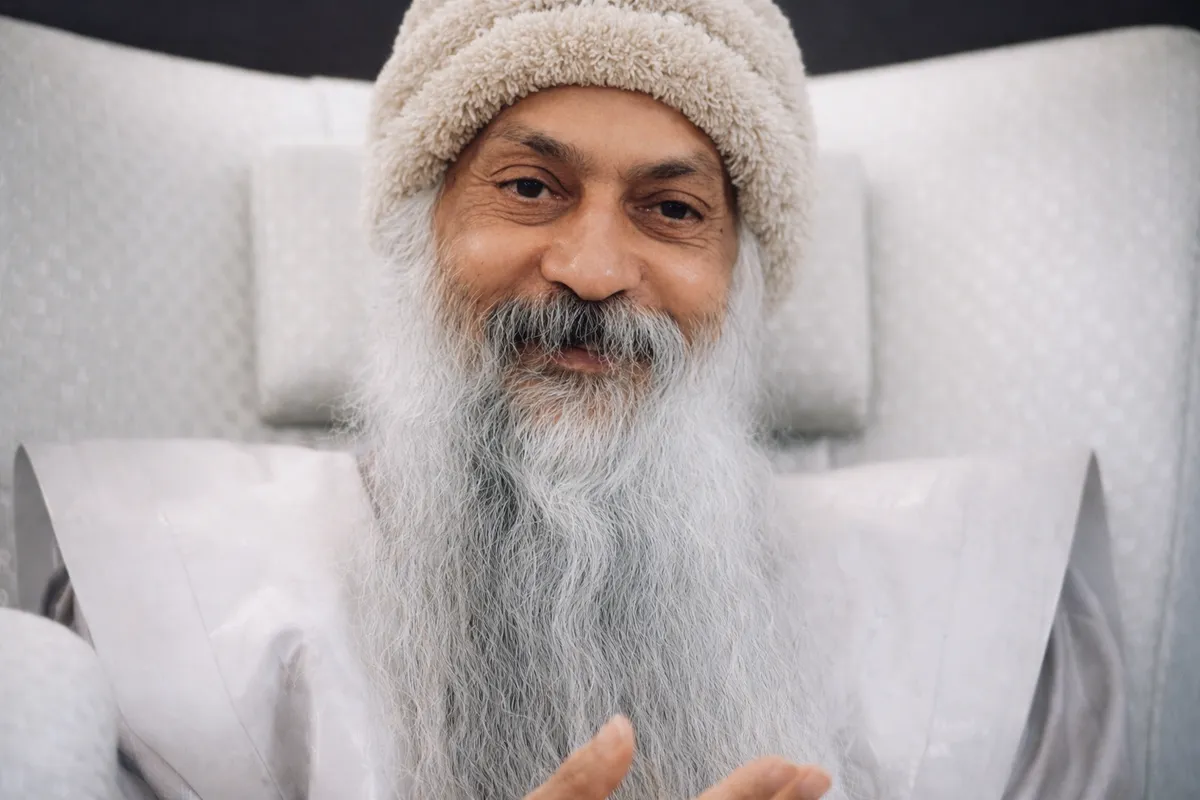
According to Osho, set a minimum of ten minutes—more is fine; just don’t do less. Within a few days you’ll feel the timing. For roughly three months, complete all four stages each session. Keep practicing; don’t drop any stage by choice. When maturity arrives, stages two and three will disappear on their own—you’ll breathe briefly, then move straight into the fourth.
Do at least 10 minutes, more is okay; for about three months do all four stages every time, then let the middle stages fade naturally.
From the Discourses
Passages where Osho speaks to this question — each links to the complete discourse.
Another friend has asked: Osho, how would ten minutes each sound?
It’s not necessary that it be exactly ten minutes. If it becomes twelve minutes, no harm; if fifteen, no harm. Just keep this estimate: it should not be less than ten minutes. In two to four days you’ll get the feel for it—just make sure it isn’t less than ten minutes. However much more it becomes, there’s no harm. Then for three months you will need to complete all four stages. As soon as your process is complete—someone’s may be in three weeks, someone’s even in three days, but generally it will take three months to fully enter the process—then the second and third stages will drop away on their own. You will breathe for a minute or two and directly enter the fourth stage. They will no longer be necessary. Therefore, for three months you must certainly make the effort. And don’t stop it from your side. When any…
A friend has asked: In the fourth stage, ten minutes feel far too short.
Whoever truly enters meditation will find them far too short. Whoever does not will find them far too long. Both kinds of people are here. One who does not enter will feel, “Who knows how these ten minutes became so long!” One who does enter will feel, “It just began, and it is already over.” Because time contracts with our joy. Time is not something real. Time depends on our experience; it is conditional. The more happiness there is, the shorter time becomes. The more suffering there is, the longer time becomes. The hands of the clock keep moving as they do, but there are the hands of the heart as well, and with joy and sorrow their speed changes. When you are happy, a moment flies like the wind. When you are unhappy, even a moment sits like a stone and won’t budge. So for those to whom meditation…
SECOND STAGE Now we have to enter the second stage. Continue deep breathing, and let go of the body. Leave the body to do what it wishes to do. Let go of it. Let it take whatever asanas or postures it wants to take; let it form whatever mudras or gestures it likes. Leave it free to move and shake and whirl as it likes. If it wants to weep let it. Let go of the body completely. Continue deep breathing and let go of the body. Let the body fall down if it wants to fall down. And let it rise again if it wants to rise. And if it wants to dance allow it wholly. Let go of the body absolutely. Let it do whatever it wants to do. Leave it free. Don't impede it even in the least. Cooperate with the body. If it spins, let it.
Let us understand two or three things about meditation, and then we will experiment with meditation. First, it is essential to understand that meditation has a very deep relationship with the breath. Ordinarily you will have noticed: in anger the breath moves in one way, in peace it moves in another. If lust seizes the mind, the rhythm of the breath changes at once. And sometimes, when the breath is moving very quietly—slow, deep—the mind experiences a most wondrous kind of bliss. All the conditions of the mind are deeply related to the breath. Therefore for the first ten minutes we will do a small experiment with the breath. In these ten minutes breathe deeply—as deeply as you can—without strain and without force, with no discomfort or trouble; and exhale just as deeply. If there is too much carbon dioxide collected in the lungs, the quieting of chitta becomes difficult.
Within three, four minutes you will feel that the body has relaxed; the breathing has come into a rhythm. Then with each outgoing breath, simply say, 'Osho' inside; not very loudly -- just a whisper, but inside so that you can hear it. When the breath comes in, just wait. When the breath goes out, you call, and when the breath comes out, allow me to come in. Don't do anything -- simply wait; so your work is only when the breath goes out. When the breath goes out, go into the universe. The outgoing breath is almost like dropping a bucket into a well. And when the breath comes in, it is like the bucket being pulled out of the well. This is only for twenty minutes. So four, five minutes to get into it, and then twenty minutes to remain in it.