
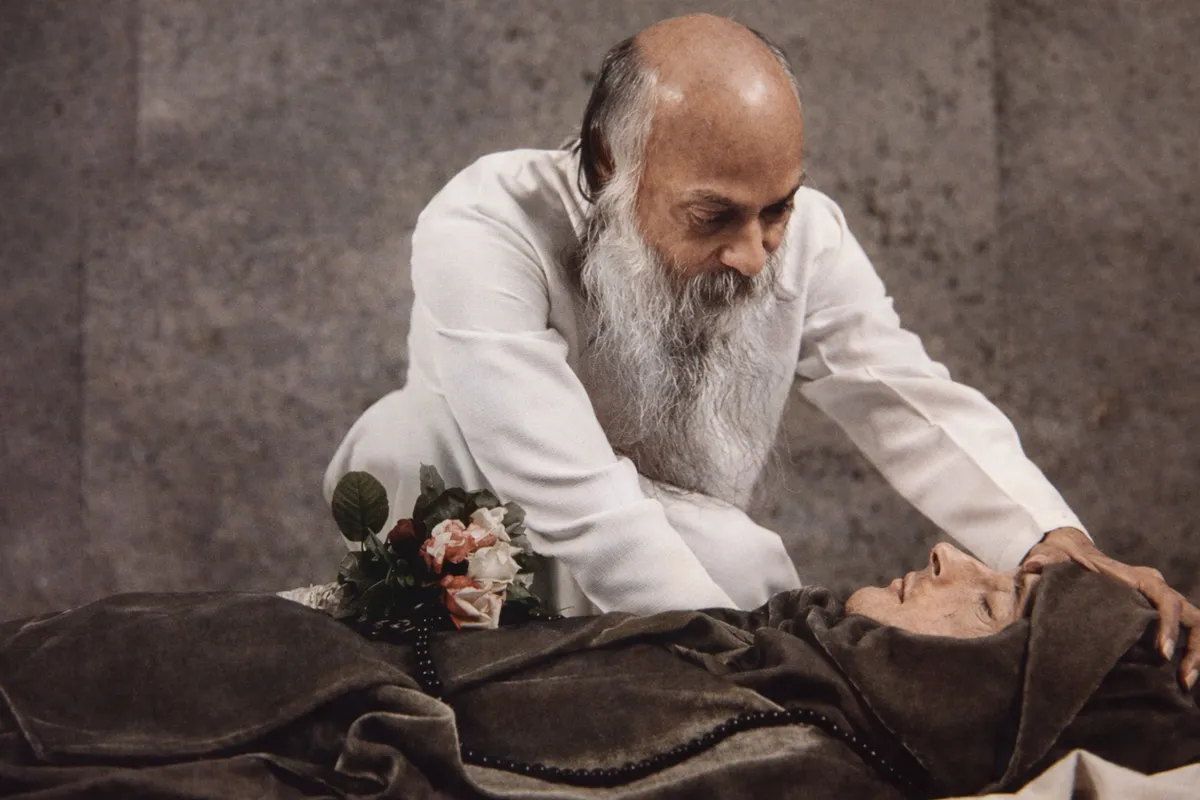
Meditation lets you safely let out angry energy while watching it, so the old pile of anger dries up and the habit to be violent disappears.
From the Discourses
Passages where Osho speaks to this question — each links to the complete discourse.
Osho, please explain how, in meditation practice, the dissolution and sublimation of violent tendencies—that is, dissolution and sublimation—take place?
Mahavira was standing near a village and some people came and beat him severely. Someone drove iron pegs into his ears. He stood watching. Later someone asked him, “You said nothing at all? You could at least have said, ‘Why are you beating me without cause?’” Mahavira said: “They were not beating me without cause. There must surely have been some cause in their minds to beat. Perhaps the cause was not related to me, but there was a cause within them. And I thought it would be better if they beat me; if they beat someone else, they would not return without receiving a return blow. Let their violence undergo nirjara. Better than me they would find it hard to find anyone.” Mahavira behaved like a pillow with those people. In meditation the nirjara of all suppressed surges takes place—whether of violence, of anger, of sex, or of greed—meditation…
The desire for violence, is not solitary. Suppression of many desires is also linked with it. The desire for violence is already there; there is a longing to commit violence, but there is no scope for it on many occasions. We wish to commit violence but are unable to do it, because our civilization, culture, way of life, circumstances and adverse situations come in our way. It is difficult to find out a person who has not, at one moment or another, thought of killing someone. It is also difficult to find a person who has not thought of at one moment or another to commit suicide. If the thought did not occur in the day time it might have occurred in a dream at the night. But all persons do not kill others and all persons do not commit suicide.
Another friend has asked in the same context: Osho, in sadhana, is the need only for the catharsis of our tendencies, or is there also a place for repression?
In sadhana there is no place at all for repression. There is place only for catharsis. The truth is, we do not have to attain the divine—we have lost it. We have to regain it. It is not a new achievement. In one sense, what is continuously present within us simply has to be uncovered. So all the junk of tendencies we have piled up by repressing them will have to be separated and thrown out. If no layer of any tendency remains as a covering on the mind, what remains is the divine. But with repression the covering increases; it does not lessen. Whatever we push down settles inside us. If we repress anger, a layer of anger settles within. Repress sex, a layer of sex settles within. Repress greed, a layer of greed settles within. If someone cannot even cry… Just two or three days ago I was…
"please explain how it is possible that one can be spiritually transformed by being total in actions that are of anger, hatred and violence."
In any situation, the volcano may erupt. It is erupting every day. Someone kills someone, and just a day before he was as normal as you. No one ever suspected that he was going to be a murderer. No one suspects about you, and you have so many thoughts in your mind to murder. You have thought, you have planned it many times. The idea to murder someone else or yourself has come to you. It has happened to you if you are not absolutely idiotic. Psychologists say that an intelligent man is bound to think of suicide at least ten times in his life -- at least ten times! -- and ten thousand times you think to murder someone. You never do it, that is another thing. But you can do it; the possibility is always there. Make your anger a total act in meditation, and then see what…
Bahaudin el-shah, great teacher of the naqshbandi dervishes, one day met a confrere in the great square of bokhara.
THE NEWCOMER WAS A WANDERING KALENDAR OF THE MALAMATI, THE "BLAMEWORTHY". BAHAUDIN WAS SURROUNDED BY DISCIPLES. "FROM WHERE DO YOU COME?" HE ASKED THE TRAVELER, IN THE USUAL SUFI PHRASE. "I HAVE NO IDEA," SAID THE OTHER, GRINNING FOOLISHLY. SOME OF BAHAUDIN'S DISCIPLES MURMURED THEIR DISAPPROVAL OF THIS DISRESPECT. " WHERE ARE YOU GOING?" PERSISTED BAHAUDIN. "I DO NOT KNOW," SHOUTED THE DERVISH. WHAT IS GOOD?" BY NOW A LARGE CROWD HAD GATHERED. "I DO NOT KNOW." " WHAT IS EVIL?" "I HAVE NO IDEA." " WHAT IS RIGHT?" "WHATEVER IS GOOD FOR ME." "WHAT IS WRONG?" "WHATEVER IS BAD FOR ME." THE CROWD, IRRITATED BEYOND ITS PATIENCE BY THIS DERVISH, DROVE HIM AWAY. HE WENT OFF, STRIDING PURPOSEFULLY IN A DIRECTION WHICH LED NOWHERE, AS FAR AS ANYONE KNEW. "FOOLS" SAID BAHAUDIN NAQSHBAND. "THIS MAN IS ACTING THE PART OF HUMANITY. WHILE YOU WERE DESPISING HIM,' HE WAS DELIBERATELY…