
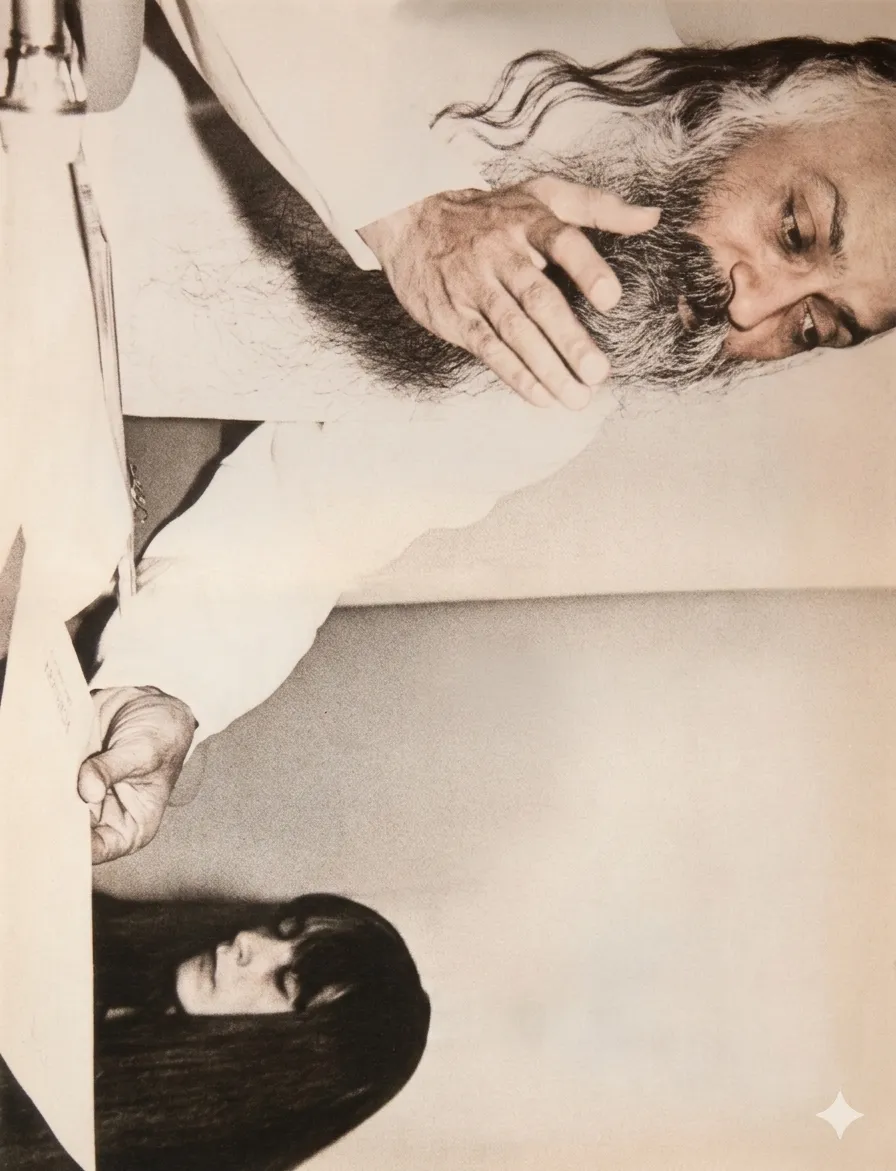
They had everything, got bored with ordinary happiness, left to find deeper joy, and people later mistook that choice as sad.
From the Discourses
Passages where Osho speaks to this question — each links to the complete discourse.
Questioner: you once said that buddha and mahavira were masochistic sannyasins. But in fact they came to sannyas from very affluent families; their sannyas was a follow up to their affluence. So how can you associate them with the sannyas of sorrow?
Gandhi found himself in such a dilemma when he wanted to discuss Krishna. In fact, he was more in agreement with Arjuna than with Krishna, How can Gandhi accept it when Krishna goads Arjuna into war? He could be rid of Krishna if he were clearly bad, but his badness is not that clear, because Krishna accepts both good and bad. He is good, utterly good, and he is also utterly bad -- and paradoxically, he is both together, and simultaneously. His goodness is crystal-clear, but his badness is also there. And it is difficult for Gandhi to accept him as bad. Under the circumstances there was no other course for Gandhi but to say that the war of Mahabharat was a parable, a myth, that it did not happen in reality. He cannot acknowledge the reality of the Mahabharat, because war is violence, war is evil to him. So…
Osho, you just said that sannyasins like Buddha and Mahavira are sorrow-centered. But their sannyas arose out of a life of great splendor; renunciation was the next phase of their opulence. So you can’t put sorrow at the base of it.
But Gandhi was far removed in time; there are five thousand years between Krishna and Gandhi. So calling a five-thousand-year-old story “myth” is not hard. The Jains did not have such distance, so they could not call the story a tale—the event happened. Jain thought is as ancient as the Vedas; the first Jain Tirthankara is mentioned in the Vedas. The antiquity of Hindus and Jains is equal. The Jains could not deny the war, nor that Krishna had it fought. So what could they do? Had they had Gandhi’s convenience, they would have done what Gandhi did—who, in the body a Hindu but in mind deeply Jain—dismissed it as myth. The Jains could not; it was contemporaneous. They had to consign Krishna to hell. Their scriptures had to say that Krishna went to hell. If someone causes so great a violence and does not go to hell, then what…
Osho, is the accusation true that Mahavira and Buddha, by saying that life is nothing but suffering, made the lives of India and Asia impoverished and miserable for centuries upon centuries? And can this outlook of rejecting life be called a healthy spirituality?
First, neither can anyone make you blissful nor can anyone make you impoverished. Whatever you become is your own decision. You can find whatever excuses you like. Mahavira said, “Life is futile.” He said it so that you might awaken to the Great Life. If you took it wrongly and dropped this life—and fell downward instead of rising into the Great Life—then that is on you. You were standing on a step of the ladder and Mahavira said, “Let go of this; move on.” You did let go, but you stepped back. The fault lies in your understanding. In life, responsibility is always ours. Drop the habit of shifting it onto others. Mahavira spoke so that you would rise toward the Great Life. He criticized this life in praise of a supreme life. This life which you call “life”—what in it deserves the name? Even if you become accomplished in…
Therefore the sages of the East called this long journey of life avagamana—coming and going—called it samsara. Samsara means: the wheel—in which the same spokes return, and the cycle keeps revolving. As long as you feel you are living something new, not even the idea of slipping out of this wheel will arise. The moment your realization deepens that nothing is new, the same is being repeated, boredom will arise. And that boredom becomes the first leaning toward the spiritual. Hence Buddha and Mahavira kept telling their disciples: remember your past lives. And they found meditative ways by which the memory of past lives becomes alert. Mahavira calls it jati-smaran—remembrance of births. Search into your past lives. And when your memory awakens you will be very surprised: what you are doing today you have done a hundred thousand times.
He has asked: Mahavira and Buddha speak of self-restraint and renunciation—so what is wrong with that?
Buddha said, “In the last village some people brought sweets. I told them, ‘My stomach is full.’ They took their trays back. I say the same to you: my belly is already full of your abuses. No hunger remains. Please take your trays back.” And Buddha added, “I feel pity for you. Those people who took their sweets back must have distributed them somewhere. But what will you do with these abuses? Because I refuse to accept them. You have the right to give; at least grant me this much right—to accept or not. I refuse to accept your abuses.” This man is not “restrained,” with anger surging inside while he grits his teeth, clenches his fist, and thinks, “I won’t let the anger out.” If he is such a person, no understanding has dawned. A man of restraint need not have understanding; but a man of understanding will have…