
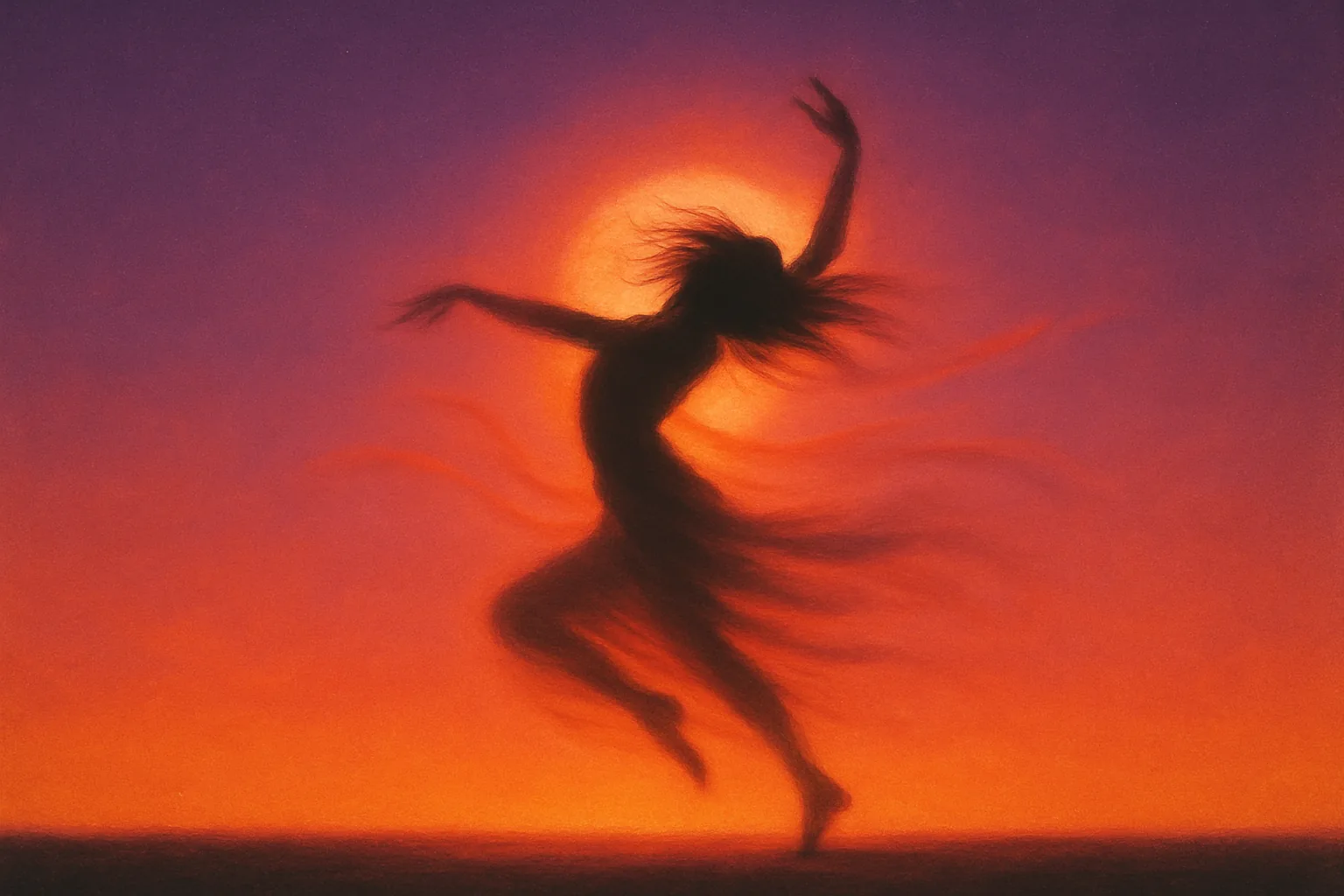
Nataraj is dance as total meditation—an invitation to let movement arise on its own, unforced and unplanned. Here, the body becomes the instrument of life energy, and you allow that energy to flow as naturally as wind and river. The spirit is playful, festive, and light; this is not a serious task to perform but a living celebration to surrender into—what the mystics of India call God’s leela, the great cosmic play.
The structure is simple and potent: an uninhibited, eyes-closed dance; a surrender into silence; and a brief, joyful celebration. Its essence is the disappearance of the ‘dancer’ so that only the dance remains. When control and self-watching drop, movement turns from a mere exercise into meditation—nourishing, freeing, and freshly alive.
Phase Instructions
First Stage: Dancing — Become the Dance (40 minutes)
Close your eyes and dance as if possessed. Let your unconscious take over completely. Do not control, shape, or direct your movements, and do not stand aside as a watcher—drop all witnessing and be totally in the dance. Allow the body to move in its own way; follow the movement rather than making it happen. Stay playful and in a mood of festivity, as if your life energy were flowing and blowing by itself, like wind and river. If you notice yourself observing or steering the dance, immediately let go of control and merge back into the movement. Continue, eyes closed, for the full 40 minutes.
Second Stage: Stillness — Lie Down (20 minutes)
Keeping your eyes closed, lie down immediately. Be utterly silent and still. Do nothing. Let the momentum of the dance subside on its own and allow the energy to settle without interference. Remain unmoving and quiet for the full 20 minutes.
Third Stage: Celebration — Dance and Enjoy (5 minutes)
Rise and dance in celebration. Enjoy. There is nothing to perform and nothing to achieve—simply let gratitude and playfulness express themselves. Allow the dance to happen once more, light and free, for the remaining 5 minutes.
Core Benefits
- Facilitates uninhibited, natural movement
- Promotes surrender and acceptance
- Encourages playful and festive spirit
- Transforms movement into meditation
- Fosters a nourishing, freeing experience
What Osho Said About This Technique
Deva means divine, nartan means dance.... Life is a dance... in many meanings life is a dance. First -- life is not constituted of matter but of energy. And energy is never static -- it is always dancing. Now the physicists also say that there is no rest in the world -- nothing like rest exists. Everything is moving, dancing. A tremendous dance is on. The electrons are dancing, the neutrons are dancing, and from those invisible electrons up to the greatest star, there is continuous dance. Only man has forgotten how to dance. Trees are dancing in the breeze, the birds and the animals are dancing. Only man has forgotten how to dance -- and by forgetting the language of dance, man has forgotten the language of religion. Dance is the basic language of religion. But the so-called religious people are almost dead people... far, far away from dancing.Read the full discourse →
Hence the blessing of the rishis had such value. People did not go to them to understand doctrine—but for grace. Let them bless—you need only extend your begging bowl, your heart; their blessings are already falling. What they say will be. What they think will be. Therefore Buddha made a rule for meditators: before entering dhyana, gain complete control over your thoughts. For it may happen that a little capacity for meditation comes; for a moment you begin to be silent; if your thoughts are not under full control and some wrong thought passes through your sky of mind at that time, it will come true. Wrong thoughts pass through your mind twenty‑four hours a day. Someone abuses you and you mutter, 'Die!'—now there is no harm, because no one dies by your saying so.Read the full discourse →
Deva means god, kabiro means great -- the great god, or, god is great. Everything else is just a part -- god is the whole. God is not a person but another name for the totality of all. To live as a part against the whole is to live in misery. To live as a part with the whole, as the whole, in the whole, is to be in bliss. Man's misery consists in his creating a separation; he creates a distance between himself and the whole that surrounds him. It is as foolish as a fish creating a distance between itself and the ocean. Hence so much misery. The fish can be happy only in the ocean, with the ocean, as the ocean, because basically it comes out of the ocean. It is a wave in the ocean, and one day it has to disappear into the ocean again.Read the full discourse →
[An indian visitor, who is a professional dancer, asked what meditation technique would be right for her, and then went on to ask about love and relationships.] There is no need to find any other meditation. Dance itself becomes a meditation if the dancer is lost. The whole point is how to lose oneself. How you do that, or where, is irrelevant. Just lose yourself. A point comes where you are not, and still things go on... as if you are possessed. Dance is one of the most beautiful things that can happen to a man. So don't think about meditation separately. Meditation is needed as something separate for people who don't have any very deep creative energy; no direction for their energy to get so deeply involved that they can be lost But a dancer, a painter, a sculptor, need not have any other meditation.Read the full discourse →
ABOUT THE AFTERNOON MEDITATION. KIRTAN, singing and dancing, is one of the secret doors, one of the deepest doors. The approach is very basic. The first thing to be understood is: don't take religion seriously. You can sing and dance in it; long faces are not needed. We have lived with long faces too long. If you see the old face of God it is sad. It creates boredom. Now -- and not only now, it has always been so, but more so today -- now. we need a dancing and laughing God. Seriousness has killed religion. Irreligious people have not killed religion. atheists have not destroyed religion -- seriousness has killed relig ion. The serious faces of the priests and prophets. Seriousness is a disease. Because of the serious face of religion.Read the full discourse →
Common Questions
The primary focus is to allow movement to arise naturally and to experience the dance as a form of meditation, where the dancer disappears and only the dance remains.
The structure includes an uninhibited, eyes-closed dance, followed by a surrender into silence, and concludes with a joyful celebration.
No, it embraces a playful, festive, and light spirit, turning the practice into a living celebration rather than a serious task.