
Ask Osho!
Osho Meditation: Nadabrahma Meditation

Nadabrahma Meditation

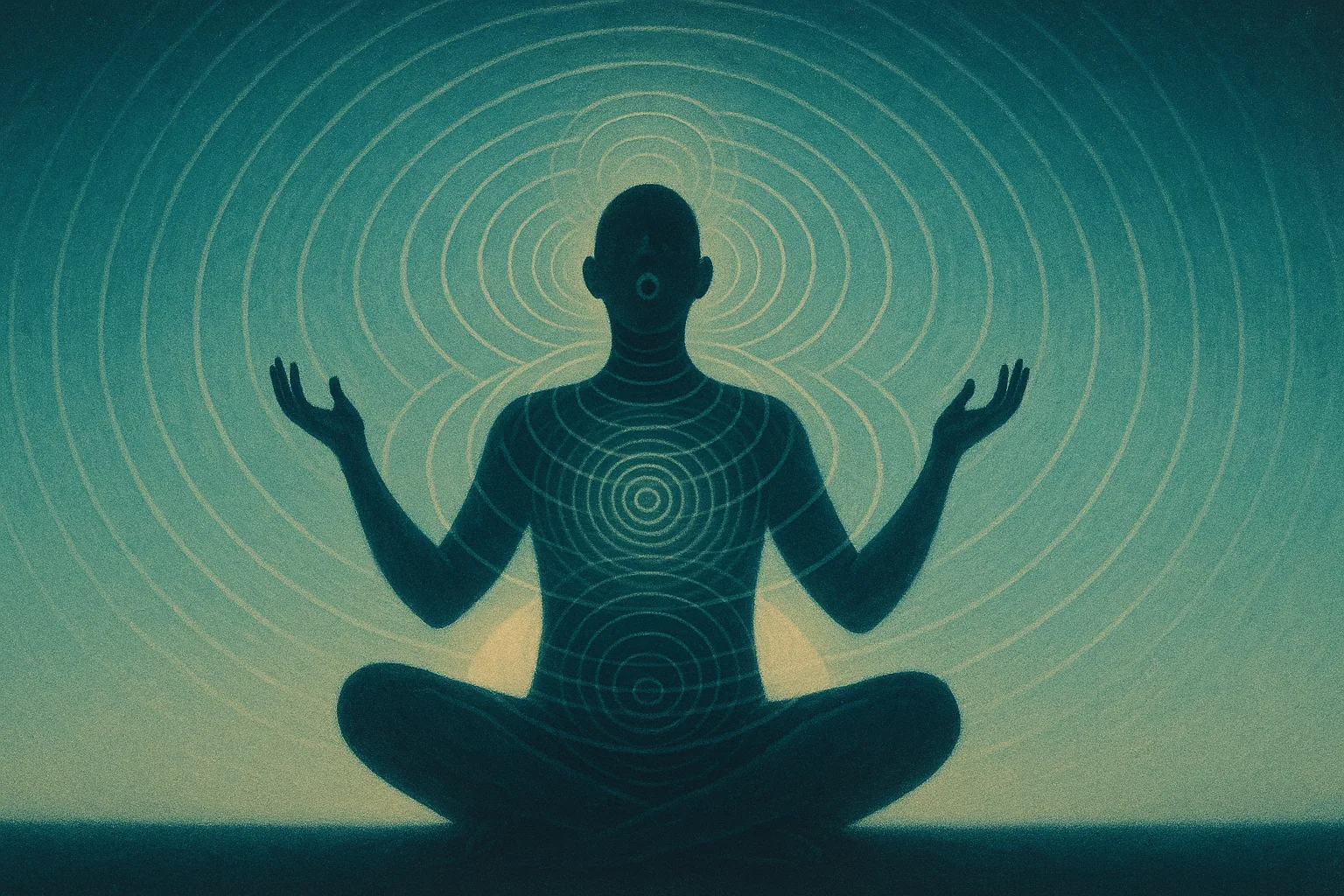
Nadabrahma is an old Tibetan technique of humming that bathes the whole body in a healing resonance while a simple, precise hand movement centers energy at the navel. The meditation unfolds in three stages: sustained humming, exquisitely slow...

Category: Active Duration: 60 minutes
Guided Audio · 1:01:16

Nadabrahma is an old Tibetan technique of humming that bathes the whole body in a healing resonance while a simple, precise hand movement centers energy at the navel. The meditation unfolds in three stages: sustained humming, exquisitely slow energy circles with the hands, and a final immersion in stillness.

It can be practiced alone or with others, at any time of day. Begin on an empty stomach and allow at least 15 minutes of quiet rest afterward. The method’s poetry lies in its simplicity: hum until the vibration hums you, move until the movement moves you, then rest in the silence that remains.


Phase Instructions

First Stage: Humming

Duration: 30 minutes. Sit in a relaxed position with your eyes closed and lips together. Begin humming—loudly enough to be heard by others—so that a palpable vibration spreads throughout your whole body. Let the sound be continuous and unforced; there is no special breathing. You may vary the pitch naturally, and allow your body to sway or move smoothly and slowly if it arises. Visualize yourself as a hollow tube or an empty vessel filled only with the vibration of the hum. A moment may come when the humming seems to continue by itself and you simply become the listener—allow this.

Second Stage: Energy Circles

Duration: 15 minutes total, in two halves of 7½ minutes each. First half (palms up): Starting at the navel, move both hands forward and then let them separate, tracing two large outward circles that mirror each other to the left and right. Keep the motion so slow that at times it may appear still. Feel you are offering energy outward to the universe. Second half (palms down): Turn the hands over and reverse the direction. Let the hands return together toward the navel and then divide outward to the sides of the body. Now feel you are drawing energy in. As in the first stage, do not inhibit any gentle, slow movements of the rest of your body.

Third Stage: Stillness

Duration: 15 minutes. Sit or lie down absolutely quiet and still, allowing all movement and effort to dissolve. When the stage ends, transition gently and remain inactive, in silence and ease, for at least 15 minutes.

Core Benefits

  • Healing resonance throughout the body.
  • Centering of energy at the navel.
  • Experience of sustained humming.
  • Slow, meditative hand movements.
  • Resting in a state of stillness.

What Osho Said About This Technique

The Great Path · Discourse 10
1974-09-20 · Chuang Tzu Auditorium · English
Question: SUKHA-ASUKHAVORBAHIRMANANAM TADVIMUKTASTU KEVALI TADARORHAPRANITESTATKSHAYAJ JIVASANKSHYA BHOOTAKANSHUKI TADAVIMUKTO BHUYAH PATISAMAH PARAH OM SHRI SHIVARPANAM SATU HAPPINESS AND SORROW ARE BUT EXTERNAL MOODS -- THIS HE KNOWS CONSTANTLY. FREED FROM THESE, HE ACHIEVES HIS ALONENESS. THE YOGI WHO IS ESTABLISHED IN HIS ALONENESS CEASES TO DESIRE, AND THUS ATTAINS FREEDOM FROM BIRTH AND DEATH. THE LIBERATED PERSON, FOR WHOM BODY AND MIND ARE NO MORE THEN CLOTHING, ATTAINS TO SHIVAHOOD. OM! THIS IS DEDICATED TO LORD SHIVA. Understand the technique. First, you have to sit quietly for ten minutes, but before you sit you have to purge yourself off all your restlessness by being totally active for five minutes; dance, jump, skip and run, whatever is required to satisfy your restlessness. It must be cleansed from every pore, from every part of the body; only then can you sit in silence for ten minutes.
Read the full discourse →
That Art Thou · Discourse 23
1972-03-28 · Mt Abu Meditation Camp, India · English

Thus, by meditation, they achieve the ultimate reality , which is unthinkable, unmanifest; the one of endless forms, the ever-auspicious, the peaceful, the immortal, the origin of the creator, the one without a beginning, a middle and an end; the only one, the non-dual, the all-pervading, the consciousness, the bliss, the formless, the wonderful.

To use a name as a repetition has its own difficulties. It is easy to throw out all else, but then it is difficult to throw out itself. If you have used "Rama" to throw out all other thoughts, it will become rooted in you, and then you cannot throw it out. It will be very difficult and very painful. Then something else will be needed to throw it out. As far as I am concerned, I never suggest this method. It is better to begin with no word. Then how to begin? Take the total energy of your body and mind as the beginning. Let you total body-mind energy be involved in it. Make it so active -- let your body energy, your mind energy becomes so active, so active at the peak -- that thoughts dissolve, because thoughts cannot exist at the peak. When your energy is moving…
Read the full discourse →
Nirvan Upanishad · Discourse 9
1971-09-29 · Mount Abu · Hindi
There is a Tibetan mantra, a great mantra—Om Mani Padme Hum. That "Hum" is a form of Hu. Om too can work like Hu—but perhaps not now. For very simple people Om also works like Hu. For complex people it does not—because Om’s strike is very mild. Om is a mild dose. It was used for those who were not very ill—simple hearts, innocent, not cunning, not deceitful, not dishonest—simple. Om was enough. A small homeopathic dose cured them. Now it cannot be without allopathy. Hu is allopathic. Om is homeopathic. Hu’s blow is tremendous—goes to the deepest. If it descends to ajapa, Hu becomes Gayatri and the vikaras are dissolved. Any mantra becomes Gayatri when it becomes Ajapa. This is the meaning of the sutra: ajapa-gayatri vikaradando dhyeyah. Mano-nirodha is their alms-bowl.
Read the full discourse →
Sadhana Sutra · Discourse 17
1973-04-14 · Mount Abu · Hindi
Thus there are two ways to say it: either call it the soundless Word—the tone that is not born of collision, not born of the impact of two—or the saints have chosen another precious term: Anahata Nada. Anahata means: not produced by striking, not produced by collision. Is there such a sound that is Anahata? Is there a sound born without striking? If there is such a sound, that alone is the fundamental note of life. Several points need to be understood. Whatever is produced by collision will perish. For collision generates a quantity of energy, but how long will that energy last? I clap my hands; the impact of my hands releases a limited force. How long will it resound? Whatever has been produced will be destroyed. Whatever is made will be unmade. Buddha said: that which is compounded cannot be eternal, cannot be Sanatana. How could it be?
Read the full discourse →
That Art Thou · Discourse 36
1972-10-14 · Mt Abu Meditation Camp, India · English

In the cavity of the heart, which is situated in the body, dwells the unborn who is eternal.

THE EARTH IS ITS BODY. IT DWELLS IN THE EARTH, BUT THE EARTH DOES NOT KNOW IT. WATER IS ITS BODY. IT DWELLS IN WATER,BUT WATER DOES NOT KNOW IT. FIRE IS ITS BODY. IT DWELLS IN FIRE BUTFIRE DOES NOT KNOW IT. AIR IS ITS BODY. IT DWELLS IN THE AIR, BUT THE AIR DOES NOT KNOW IT. THE SKY IS ITS BODY. IT DWELLS IN IT,BUT THE SKY DOES NOT KNOW IT. THE MIND IS ITS BODY. IT DWELLS IN THE MIND, BUT THE MIND DOES NOT KNOW IT. THE INTELLECT IS ITS BODY. IT LIVES IN THE INTELLECT, BUT THE INTELLECT DOES NOT KNOW IT. THE EGO IS ITS BODY. IT DWELLS IN THE EGO,BUT THE EGO DOES NOT KNOW IT. THE CONSCIOUSNESS IS ITS BODY. IT DWELLS IN THE CONSCIOUSNESS, BUT THE CONSCIOUSNESS DOES NOT KNOW IT. THE UNMANIFEST IS ITS BODY. IT DWELLS IN THE…
Read the full discourse →

Common Questions

What is the ideal time to practice Nadabrahma Meditation?

It can be practiced at any time of day, but ensure the stomach is empty.

Can Nadabrahma Meditation be practiced alone?

Yes, it can be practiced alone or with others.

What should be done post-meditation?

Allow at least 15 minutes of quiet rest afterward.

What is the core technique in Nadabrahma Meditation?

The core involves sustained humming and precise hand movements.

Why is it important to practice on an empty stomach?

Practicing on an empty stomach helps enhance the experience and avoid discomfort.