
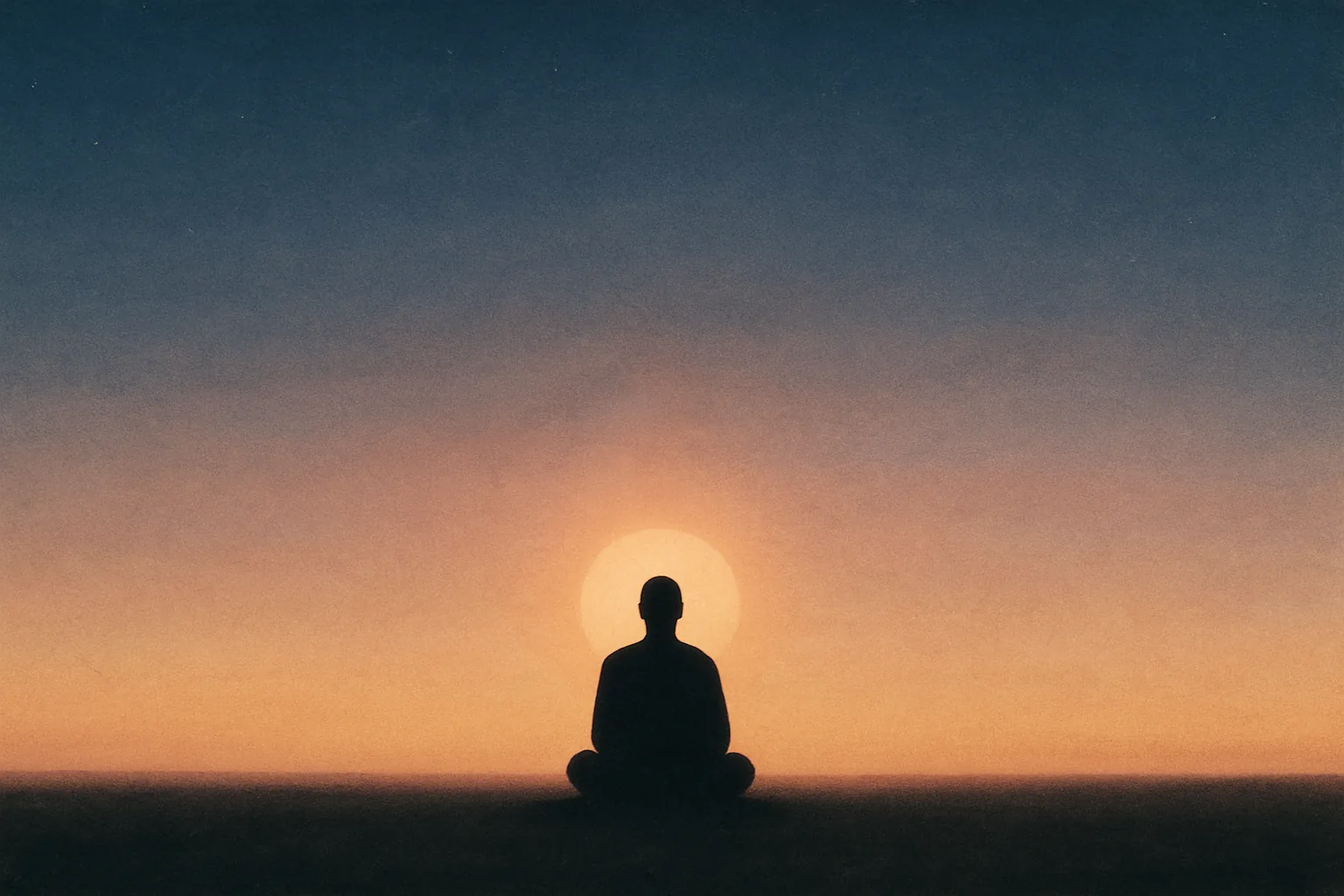
This simple, radical practice distills Osho’s central insight: meditation is not separate from life—it is the art of being aware of what is happening inside you and around you. Rather than withdrawing from the world, you learn to witness breath, sensations, feelings, thoughts, and the living environment as one continuous field of presence. Awareness becomes both the first step and the last flowering—your natural state, available in stillness and in action.
Drawn from the spirit of Osho’s teachings in The First and Last Freedom, this method invites a relaxed, nonjudgmental witnessing. You begin by centering in the body, include the inner landscape, then open equally to the outer world—sounds, light, space, and other people—letting inner and outer awareness flow together. With practice, meditation pervades everyday life: walking, speaking, working, resting. Nothing is excluded; everything becomes the path.
Phase Instructions
First Stage: Centering in the Body
Sit or stand comfortably with a relaxed spine. Let the jaw, shoulders, and belly soften. Keep the eyes gently closed or softly open. Allow the breath to be natural—no control. Feel the contact points with the floor or chair and sense the whole body from within. Adopt a witnessing attitude: whatever appears is allowed, and you simply notice it.
Second Stage: Inner Landscape Awareness
Turn attention inward. Sense the breath moving in the nostrils, chest, and belly. Notice body sensations (pressure, temperature, tingling), emotions as they arise, and thoughts passing like clouds. Do not judge, analyze, chase, or suppress—just acknowledge: “breathing,” “warmth,” “tightness,” “sadness,” “thinking,” and let each experience come and go on its own. If you drift, gently return to the felt sense of breathing.
Third Stage: Opening to the Outer World
If your eyes are closed, slowly open them and include the environment. Let sounds, light, colors, movement, and the felt space around you be part of awareness. Do not strain to name or interpret—receive directly. Hold inner and outer in a single, spacious attention: you feel the breath and body while also hearing a sound, sensing the air on the skin, seeing what is here. Allow inner and outer to meet without conflict.
Fourth Stage: Flow into Daily Life
Begin to move—stand, walk, or carry on with ordinary activities—while preserving the same witnessing. Speak and listen from awareness; eat and type from awareness; notice moments of forgetting and kindly return to the body and breath. Use brief micro-pauses during the day: one conscious inhale and exhale while sensing feet on the ground. Let action and awareness be two wings of the same bird. Close the practice with a gentle exhale and a moment of gratitude.
Core Benefits
- Integrates meditation into daily life
- Enhances awareness of inner and outer experiences
- Promotes a relaxed, nonjudgmental presence
- Facilitates a natural state of being
- Allows everything to become part of the meditation practice
What Osho Said About This Technique
Osho, you say that if there is awareness, then how are the two to be brought into harmony?
That is precisely the practice of active meditation: awareness. Awareness is the very means of going into emptiness in relation to all actions, to the movements of the mind as well. For example, if you lie there for half an hour—what will you do? In that half hour, whatever thoughts are moving in your mind, you are to be simply aware of them. Simply a witness—what else will you do? Just become a witness. Keep silently watching; let them move. But obstacles arise in our seeing. We become absorbed. We fail to remain a witness. We don’t even notice when we have become one with those very thoughts. That sense of awareness fades; a kind of stupor, a moorchha, comes in. A thought comes, a memory arises, and we stop being the watcher. We become part of that thought and of its flow. That is moorchha. And the opposite is…
प्रश्न: ओशो, आप जो बोलते हो कि जागरूकपना अगर है तो उन दोनों का समन्वय कैसे स्थित करेंगे?
वह सक्रिय ध्यान का ही प्रयोग है जागरूकता। समस्त क्रियाओं के प्रति, चित्त की क्रियाओं के प्रति शून्य में जाने का भी माध्यम जागरूकता ही है। जैसे आधा घंटा आप पड़े रहेंगे तो क्या करेंगे? उस आधे घंटे में आपके चित्त में जो भी विचार चल रहे हैं, उनके प्रति केवल जागरूक होना है। केवल साक्षी होना है, और क्या करिएगा? साक्षी भर हो जाना है। देखते रहना है चुपचाप, वे चलें। लेकिन हमारे देखने में बाधा आती है। हम तल्लीन हो जाते हैं। साक्षी नहीं रह पाते। हम कब उन्हीं विचारों में एक हो गए इसका पता नहीं रहता। यह बोध मिट जाता है, मूर्च्छा आ जाती है।
[And to remind the next sannyasin of that promise Osho gave him the name Akash -- sky!] Mind is a very small thing, it is like a prison cell. And everybody is imprisoned in his own mind: in his prejudices, creeds, dogmas, religions, philosophies -- political and spiritual. Everybody is living in a very small dark cell. The cell is made of conditionings. Meditation means unconditioning the mind and never allowing it to be reconditioned. Otherwise it is very easy to move from one dark cell to another dark cell. A Hindu can become a Christian; that is very easy, there is no conversion. Instead of worshipping Krishna he starts worshipping Christ. In fact linguists say that the word 'Christ' comes from the word 'Krishna'; they are not different words, their root is the same. So you have changed from one cell to another. A Christian can become a Hindu.
He would not like to know the truth through others, he would like to experience it himself -- because unless you drink the water your thirst is not going to be quenched. Buddha may have drunk the whole Ganges -- that is not going to make any difference to you. Just a glass of water will do for you but you have to drink it. But people are so foolish that they go on worshipping Buddha and Krishna and Christ, and hoping that their thirst will be quenched they go on worshipping scriptures -- Dhammapada, Koran, Bible. It is like a thirsty man worshipping a book of chemistry which explain that water is H2O. You can go on worshipping the book; you will remain thirsty. You are simply proving yourself silly and nothing else. Or you can go on repeating the mantra "H2O, H2O, H2O...
In 1969 followers of the Maharishi Mahesh Yogi invited Osho to talk to them. This was the first occasion on which Osho addressed a western audience, and the first time he talked publicly at length in English. The discourse has been published in OTI January 1 & 16, 1991; and February 1, 1991. Osho: Really, there can be no method as far as meditation is concerned. Meditation is not a method. Through technique, through method, you cannot go beyond mind. When you leave all methods, all techniques, you transcend mind. So meditation itself is not a method. Truth cannot be achieved through method. Method is our own invention. We, who are ignorant, have achieved knowledge through methods constructed, created, projected, in our ignorance. Through method you can achieve a sort of self-hypnosis, a sort of auto-hypnosis. Any method, whatsoever it's name, can only give you an illusory kind of peace.
How is it possible that by simply becoming aware at a particular point in the breathing process one can attain enlightenment? How it is possible to become free from the unconscious by just being aware of such a small and momentary gap in the breathing?
After meditating on death, after seeing every day, night and day, dead bodies being burned, dissolved into ashes -- just a smoke remains and then disappears -- after meditating for months together, a certainty will arise: the certainty that death is inevitable. It is the only certainty really. The only thing certain in life is death. Everything else is uncertain: it may be or it may not be. But you cannot say that it may be or it may not be for death. It is; it is going to be. It has already occurred. The moment you entered life, you entered death. Now nothing can be done about it. When death is certain there is no fear. Fear is always with things which can be changed. If death is to be, fear disappears. If you can change, if you can do something about death, then fear will remain. If nothing…
Common Questions
This meditation emphasizes living awareness intertwined with daily activities, rather than retreating into stillness separate from life.
Yes, awareness meditation involves opening to the outer world and letting inner and outer awareness flow together, making it suitable for any setting.
No, this meditation welcomes beginners as it focuses on natural awareness, accessible to everyone regardless of experience.
Begin by centering in the body and be patient, allowing the practice to naturally pervade everyday life over time with consistent practice.
Yes, by promoting a relaxed, nonjudgmental witnessing of experiences, this meditation can reduce stress and enhance overall well-being.