
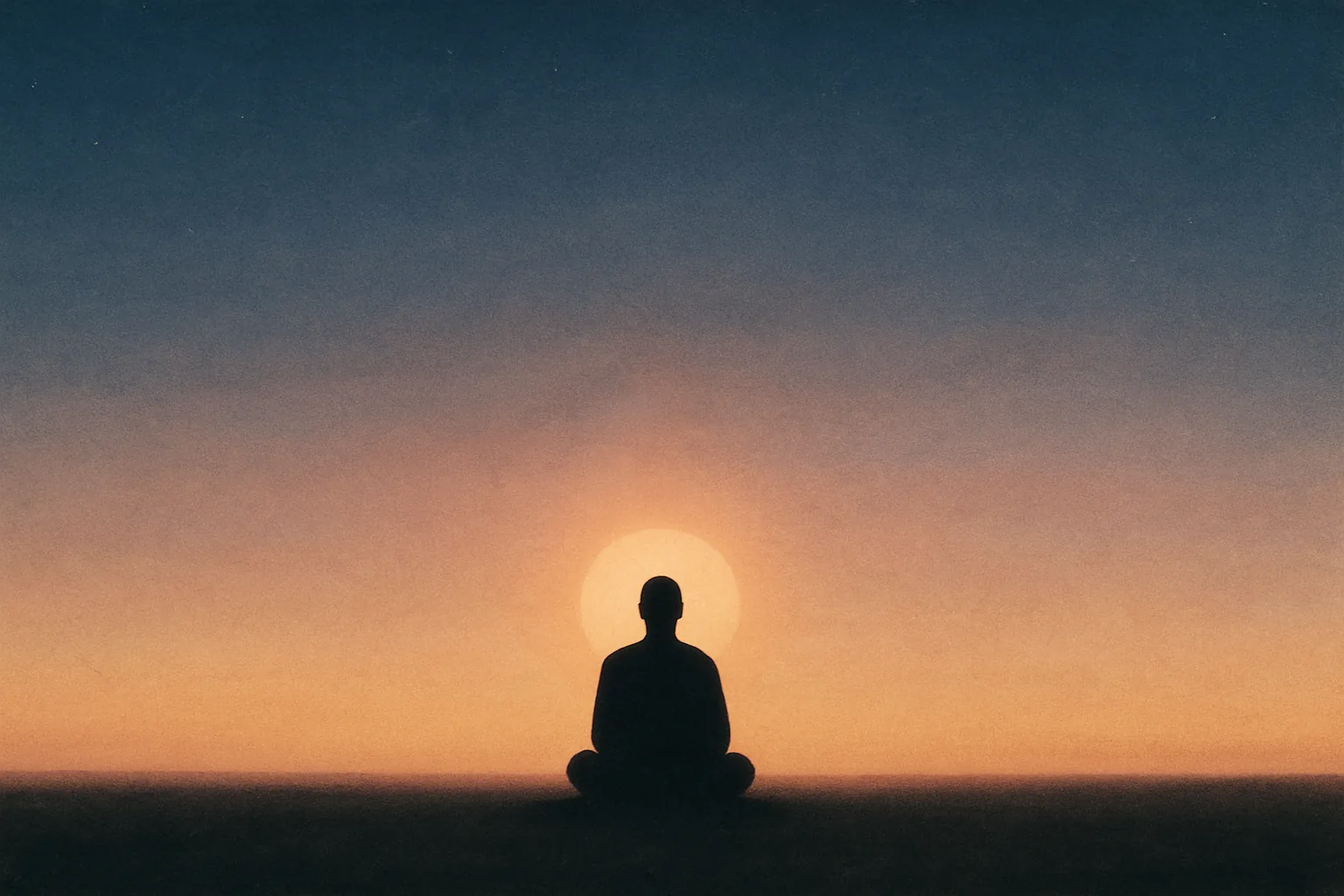
This meditation comes from the Vigyan Bhairav Tantra, presented in Osho’s living language as the sixth technique: stay attentive to the silent pause between breaths while engaged in the world. Rather than withdrawing from life, you anchor in the subtle interval that appears twice each cycle—after the in-breath and after the out-breath—allowing a new center of awareness to dawn amidst movement, conversation, and responsibility.
Practiced continuously, attention rests in the gap while ordinary life proceeds at the periphery. The felt result is twofold: doing on the circumference, being at the center. Actions begin to feel like roles in a divine play—natural, skillful, yet lightly held—dissolving heavy identification and seriousness. Osho hints that with faithful practice, in a few days you feel born anew: life still happens, yet it is as if it happens to someone else, while you remain rooted in the silent center.
Phase Instructions
Begin in Activity: Locate the Two Gaps
Do not withdraw from life. While already engaged in any ordinary activity, let the breath remain completely natural. Place gentle attention not on inhalation or exhalation themselves, but precisely on the brief, quiet interval between them. Feel the upper pause—after the in-breath, just before it turns outward—and the lower pause—after the out-breath, just before it turns inward. Attend to this stillness without lengthening, holding, or manipulating the breath.
Maintain Dual Awareness While Acting
Let all activity continue exactly as it is—walking, typing, speaking, cooking—while you keep your primary attention resting in the gap. Allow a two-layered sense of yourself to emerge: actions flow on the circumference; your awareness abides in the center. Each time activity pulls you outward, gently and immediately re-center in the next natural pause between breaths. Stay simple: forget the breath’s movement; keep returning to the silent in-between.
Apply Across Daily Moments
Walking: feel steps and surroundings, yet let your attention touch each upper and lower pause as they occur. Eating: taste and chew, while awareness returns to the delicate stillness between breaths. Speaking and listening: let words flow, but keep a thread of attention in the gap. Working: continue tasks without interruption; re-touch the interval again and again. Do not stop activity; keep the body-mind engaged while the heart of attention remains with the pause.
As You Fall Asleep
At night, lie down as usual and allow sleep to come by itself. Without interfering with breathing, keep feeling the interval—after the in-breath, after the out-breath. Let attention rest in that quiet opening as you drift into sleep. If you notice you have followed breathing or thoughts, simply re-find the next natural gap and soften into it.
Remember the Play: Loosen Identification
Move through the day as an actor who knows the role yet remains oneself. Let the sense of the gap keep you lightly rooted at the center, so actions become skillful play rather than heavy identity. If you forget the gap, you become the role and seriousness returns; the moment you re-touch the interval, life regains the flavor of play. With attention centered, what happens on the periphery is known, yet it feels as if it happens to someone else.
Continuity and Fruit
This is a continuous practice—return to the gap repeatedly, all day. Do not force or count; simply meet each pause as it arrives. Over days of steady remembrance, a fresh clarity appears: actions proceed, yet a quiet, changeless core remains. From this center, you feel renewed—born anew—while life carries on with ease.
Core Benefits
- Anchors awareness in the subtle interval between breaths.
- Promotes a sense of being centered amidst daily activities.
- Facilitates a lighter approach to responsibilities and roles.
- Helps dissolve heavy identification with daily actions.
- Cultivates a feeling of being reborn with a new perspective.
What Osho Said About This Technique
What is meditation?
A consciousness that is focused only on words is non-meditative and a consciousness that is focused only on gaps is meditative. Whenever you become aware of the gaps, the words will be lost. If you observe carefully, you will not find words; you will only find a gap. You can feel the difference between two words, but you cannot feel the difference between two gaps. Words are always plural and the gap is always singular: "the" gap. They merge and become one. Meditation is a focusing on the gap. Then, the whole gestalt changes. Another thing is to be understood. If you are looking at the gestalt picture and your concentration is focused on the old lady, you cannot see the other picture. But if you continue to concentrate on the old lady -- if you go on focusing on her, if you become totally attentive to her -- a…
Osho, you say that if there is awareness, then how are the two to be brought into harmony?
That is precisely the practice of active meditation: awareness. Awareness is the very means of going into emptiness in relation to all actions, to the movements of the mind as well. For example, if you lie there for half an hour—what will you do? In that half hour, whatever thoughts are moving in your mind, you are to be simply aware of them. Simply a witness—what else will you do? Just become a witness. Keep silently watching; let them move. But obstacles arise in our seeing. We become absorbed. We fail to remain a witness. We don’t even notice when we have become one with those very thoughts. That sense of awareness fades; a kind of stupor, a moorchha, comes in. A thought comes, a memory arises, and we stop being the watcher. We become part of that thought and of its flow. That is moorchha. And the opposite is…
प्रश्न: ओशो, आप जो बोलते हो कि जागरूकपना अगर है तो उन दोनों का समन्वय कैसे स्थित करेंगे?
वह सक्रिय ध्यान का ही प्रयोग है जागरूकता। समस्त क्रियाओं के प्रति, चित्त की क्रियाओं के प्रति शून्य में जाने का भी माध्यम जागरूकता ही है। जैसे आधा घंटा आप पड़े रहेंगे तो क्या करेंगे? उस आधे घंटे में आपके चित्त में जो भी विचार चल रहे हैं, उनके प्रति केवल जागरूक होना है। केवल साक्षी होना है, और क्या करिएगा? साक्षी भर हो जाना है। देखते रहना है चुपचाप, वे चलें। लेकिन हमारे देखने में बाधा आती है। हम तल्लीन हो जाते हैं। साक्षी नहीं रह पाते। हम कब उन्हीं विचारों में एक हो गए इसका पता नहीं रहता। यह बोध मिट जाता है, मूर्च्छा आ जाती है।
Chidaditya swaroopam deepah "to be established in the sun of awareness is the only lamp."
That is why a Tantra practitioner, if he is a man, will always worship the partner. The partner is not just a sex object. She is Divine! She is a goddess! And the act is not carnal at all. If you can go into it consciously, it is the deepest spiritual act possible. But the deepest is bound to be virtually impossible. So use either breath or sex. Mahavir has used hunger. That again is a very deep thing. Hunger is not just hunger for your taste or for something else -- it is for your very survival. Mahavir used hunger, fasting, as a method of awareness. It is not an austerity. Mahavir was not an ascetic. People have misunderstood him completely. He was not an ascetic at all. No wise man ever is. But he was using fasting, hunger, as a vehicle for awareness. You might have stumbled upon…
Common Questions
You stay attentive to the silent pause between breaths while engaged in everyday tasks and interactions.
You'll begin to feel like you're observing life from a center, with actions appearing as roles in a divine play.
With dedicated practice, it may take a few days to feel as if you are reborn, observing life from the silent center.
Yes, it can be practiced during any activity, allowing you to anchor awareness while life continues at the periphery.
The primary focus is on the silent pause between the in-breath and out-breath, which offers a new center of awareness.