
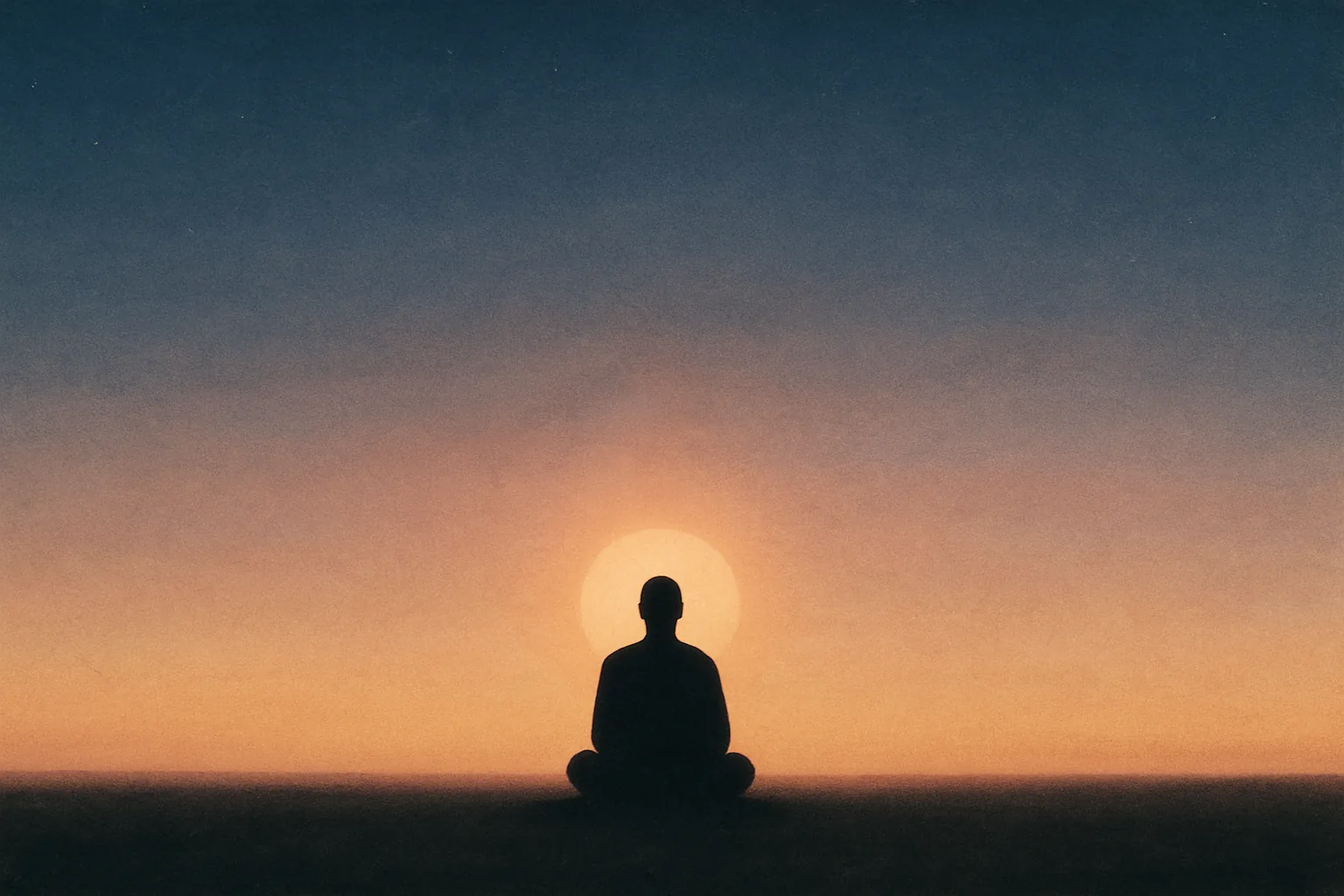
Meditation is an understanding before it is a technique. In this approach, you do not decorate the mind—you empty the inner house. Osho describes meditation as a dangerous beauty: to enter it deeply is to allow the death of the old—of your past, your self-image, your habits—and to be reborn into a fresh, silent space. The first task is simple and radical: clear the inner space of all thoughts without choosing between them. Good and bad alike are only occupation; silence needs a room that is utterly empty.
When this understanding is present, it functions like a master entering a house where noisy servants (thoughts) instantly fall still. You move beyond mind into a space where no thought, dream, or imagination operates—you are simply a nobody, alert and at ease. From there, enlightenment is not forced; it ripens through patient, passionate waiting, a whole‑being thirst. Osho points to vipassana as the pure essence of meditation—nothing to add, nothing to subtract—just clear seeing and silent presence.
Phase Instructions
First Stage: Wholehearted Decision
Acknowledge inwardly that enlightenment is your essential purpose. Let this clarity gather your energy into a single-pointed direction, like an arrow toward its target. Recognize that deep meditation asks for a discontinuity with your past—the willingness to let the old die. Sit in a quiet place; let the body settle comfortably and alert. Allow this resolve to become simple, calm, and total.
Second Stage: Clearing the Inner Space
Close the eyes gently and turn attention inward. See every thought—pleasant or unpleasant, high or low—as the same: mental occupation. Do not argue, select, analyze, or improve thoughts. The moment a thought is noticed, let it go completely, without retaining any residue. Keep releasing all inner talk, images, and memories. Your only criterion is emptiness: make space for silence by allowing all thoughts to fall away.
Third Stage: Invite the Master—Understanding, Not Doing
Now stop all efforting. Simply understand, clearly and directly, what meditation means: a silence so deep that nothing stirs within. Let this very understanding enter you like a dignified master arriving; feel how the mind, a mere servant, falls quiet in its presence. Do not try to control or suppress. Rest as a witness where no imagination runs, no dream forms. Be at ease as a nobody—present, spacious, unoccupied.
Fourth Stage: Abide in No-Mind
Remain in the gap beyond thought. If a thought arises, recognize it instantly and let it dissolve without following. Feel the qualitative shift from mental noise to living silence. Let the body breathe naturally; let awareness be bright and effortless. Nothing needs to be done; allow the silence to deepen by itself. Trust the simplicity of pure vipassana: clear seeing without interference.
Fifth Stage: Passionate, Patient Waiting
When the meditative space is present, do not reach for attainment. Instead, wait with a whole‑being longing—like a desert traveler whose thirst spreads from a word in the head to every cell of the body. Sense this quiet, wordless thirst pervading you, yet remain patient and unhurried. You cannot pull the ultimate down; you can only be utterly available. Abide in this poised waiting until the sitting completes itself. End gently, carrying a thread of silence with you.
Core Benefits
- Understanding meditation versus technique.
- Empties the mind of all thoughts.
- Transcends self-image and habits.
- Achieves a state of silent presence.
- Facilitates natural enlightenment.
What Osho Said About This Technique
When wolves were discovered in the village near master shoju's temple, shoju entered the graveyard nightly for one week and sat in zazen. This put a stop to the wolves' prowling.
OVERJOYED, THE VILLAGERS ASKED HIM TO DESCRIBE THE SECRET RITES HE HAD PERFORMED. 'I DIDN'T HAVE TO RESORT TO SUCH THINGS,' HE SAID, 'NOR COULD I HAVE DONE SO. WHILE I WAS IN ZAZEN A NUMBER OF WOLVES GATHERED ROUND ME, LICKING THE TIP OF MY NOSE, AND SNIFFING MY WINDPIPE, BUT BECAUSE I REMAINED IN THE RIGHT STATE OF MIND, I WASN'T BITTEN. AS I KEEP PREACHING TO YOU, THE PROPER STATE OF MIND WILL MAKE IT POSSIBLE FOR YOU TO BE FREE IN LIFE AND DEATH, INVULNERABLE TO FIRE AND WATER. EVEN WOLVES ARE POWERLESS AGAINST IT. I SIMPLY PRACTICE WHAT I PREACH. ... You cannot see both together. They are contradictory. They cannot be seen together. When you see the figure, the background disappears; when you see the background, the figure disappears. Mind has a limited capacity to know -- it cannot know the contradictory. That s why
What is meditation?
Meditation is not an Indian method; it is not simply a technique. You cannot learn it. It is a growth: a growth of your total living, out of your total living. Meditation is not something that can be added to you as you are. It can come to you only through a basic transformation, a mutation. It is a flowering, a growth. Growth is always out of the total; it is not an addition. You must grow toward meditation. This total flowering of the personality must be understood correctly. Otherwise one can play games with oneself, one can occupy oneself with mental tricks. And there are so many tricks! Not only can you be fooled by them, not only will you not gain anything, but in a real sense you will be harmed. The very attitude that there is some trick to meditation -- to conceive of meditation in terms…
What is meditation?
MEDITATION is A STATE OF NO-MIND Meditation is a state of pure consciousness with no content. Ordinarily, your consciousness is too much full of rubbish, just like a mirror covered with dust. The mind is a constant traffic: thoughts are moving, desires are moving, memories are moving, ambitions are moving -- it is a constant traffic! day in, day out. Even when you are asleep the mind is functioning, it is dreaming. It is still thinking; it is still in worries and anxieties. It is preparing for the next day; an underground preparation is going on. This is the state of no meditation -- just the opposite is meditation. When there is no traffic and thinking has ceased, no thought moves, no desire stirs, you are utterly silent -- that silence is meditation. And in that silence truth is known, and never otherwise. Meditation is a state of no-mind. And…
For example, it brings you the experience that not the body, so clearly, so solidly, so categorically, that even if the whole world denies it, it cannot make any difference: you know from your innermost core you are not the body. It brings you the experience that you are not the mind either. And the moment you know you are neither the body nor the mind, suddenly a door opens. You have never been born and you are never going to die because only that which is born can die. The body was born, the mind was born -- they will die -- but you were before your birth and you will be after your death. Once this reality is revealed to you all fears and all miseries disappear. You become part of eternity. Only one thing remains and that is pure consciousness. And pure consciousness is nothing but godliness.
Meditation means becoming so aware, so intensely aware, now, this very moment, that all these stupidities are seen as stupidities, and the moment you see something as false you are free of it. Not only that, there is even more danger for the vested interests, for the establishment; the person who has come to know the false as the false and the true as the true does not remain hidden. He cannot remain hidden. He has to share his experience. He has to spread his fire. And that fire can burn all the temples and all the churches and all the mosques. The meditative person will not be Christian, will not be Hindu, will not be Buddhist, will not be Mohammedan. He will simply be human. Hence the Christians will be against him, the Hindus will be against him, all the organised religions will be against him.
Common Questions
The primary task is to clear the inner space of all thoughts without choosing between them.
Osho describes meditation as a dangerous beauty, a process that allows the death of the old self to create space for a fresh existence.
When the understanding is present, it functions like a master entering a house, causing noisy servants (thoughts) to instantly fall still, moving one beyond the mind into a space of alertness and ease.
Vipassana emphasizes clear seeing and silent presence, focusing on the pure essence of meditation without additions or subtractions.