
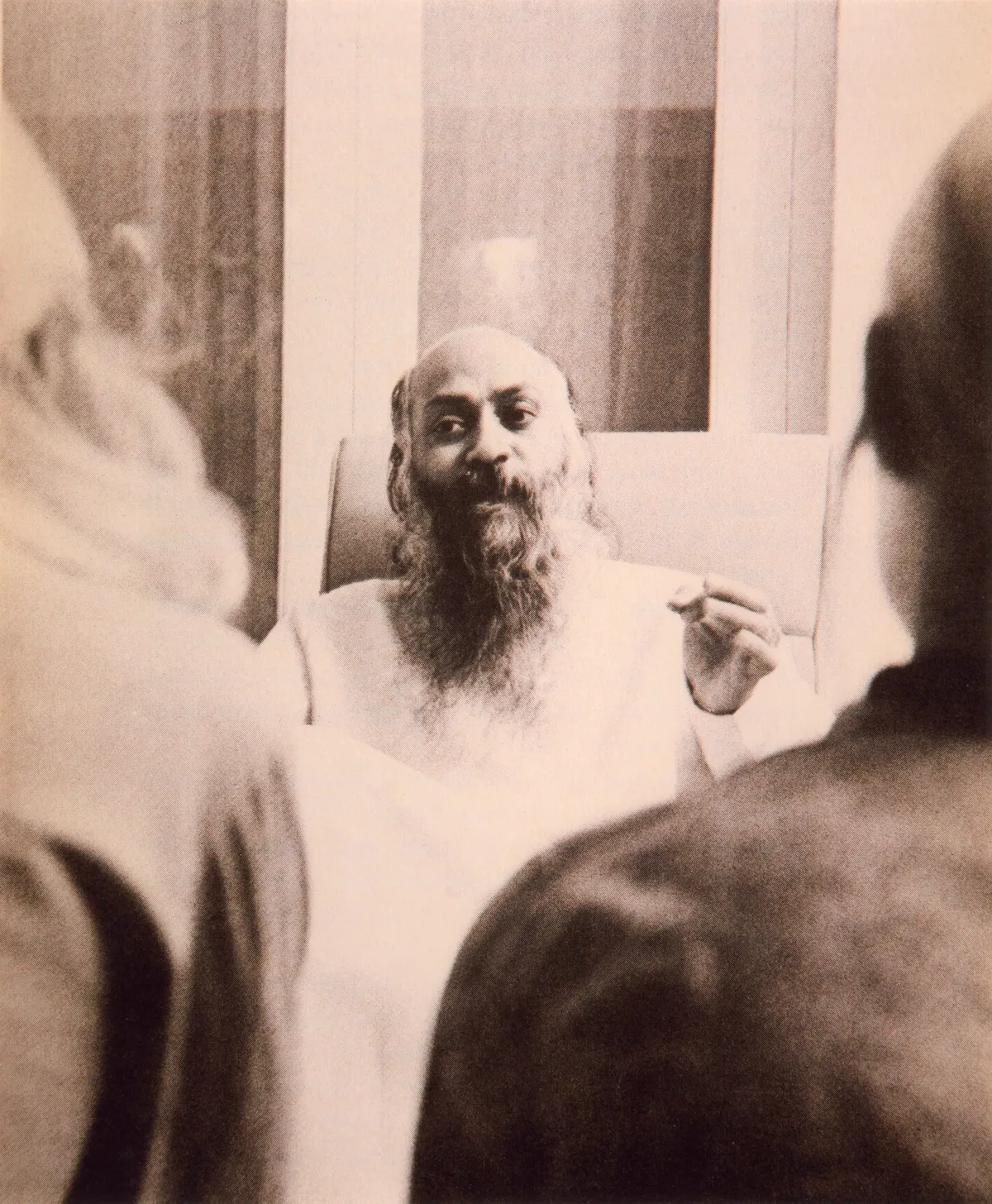
A master is like a window to the sky of God—look through it to the beyond, but don’t worship the window.
From the Discourses
Passages where Osho speaks to this question — each links to the complete discourse.
Osho, who needs god when we are blessed with the beautiful feet of a beautiful master to sit under?
This is one calamity. It has happened so much that . man like J. Krishnamurti has moved to the other extreme He is constantly afraid of this calamity, naturally, because so many times it has happened that he is afraid it may happen again with him. So from the very beginning he says that there is no need for a Master, that there is no need to be a disciple. Now he is being misunderstood, because only the egoist becomes interested in him -- only the egoist, who is incapable of surrender, who is incapable of trust, who is absolutely obsessed with his own ego. He finds Krishnamurti very appealing. He says, "This is the right man! You need not surrender, you need not trust, you need not follow. You are absolutely free. There is no question of dropping anything; you remain yourself." Now he clings to his ego. This…
Buddha did not have a master, jesus did not have a master, you did not have a master. Why do we need a master?
But only through this pain does growth happen. This is a growth pain, and a growth pain is far more valuable than the health which does not allow growth. To be abnormal and mad is far better if growth comes through it than to be normal and sane if no growth comes through it. The whole point is growth: you should not remain what you are. You should not remain the seed, you should burst forth into thousands of flowers. But before that the seed has to die in the soil. The master is just a climate, a soil, in which the disciple dies. Trusting, he falls into the soil and dies. There is no way of guaranteeing your future, what will happen. How can you guarantee a seed that "It is absolutely certain that a sprout will come when you are gone. There will be great foliage and greenery…
Osho, the witness, the seer, consciousness is always separate—virginal and unbound. And the whole play of life is nothing but the movement of the gunas within themselves. In such a situation, if a person’s qualities of sattva, rajas, and tamas are calmed in a scientific or chemical way, or if a person is made sattvic, will he then attain that ever-free witness? If the witness is forever free and present, then by chemically altering the three gunas will it not be revealed? Would the person not then become religious? What is the fundamental difference between solving the problem arising from the
Sadhana means we are dissolving the current itself, not breaking the bulb. There is no point in breaking the bulb. In fact, the bulb is useful; it tells you whether the current is flowing or not, whether there is current or not. Your anger within tells you you are still sunk in ignorance. Lust tells you your life energies have not yet become aware. If we remove these elements, anger will stop manifesting and you will also stop knowing that you are in deep ignorance. It is as if a man is sick and we snatch away the symptoms of his disease so that he doesn’t even come to know he is ill. And keep in mind, anger is an opportunity. Only the unwise say anger is simply bad; I do not say so. Anger is an opportunity; you can use it badly or well. Anger is a chance. In…
Beloved Osho, I have been listening to your words for sometime and I can accept everything you say on truth and no-truth. Only one question remains in my mind: if my enlightenment depends on me and my relationship with totality and nothing else, what is the point in my surrendering to a human master?
Certainly it depends on you, but not as you are right now. This you is false. This you has to go. This you has to cease, then the real you will arrive. ... AND MY RELATIONSHIP WITH TOTALITY AND NOTHING ELSE, WHAT IS THE POINT IN MY SURRENDERING TO A HUMAN MASTER? It is certainly true that the question is of your relationship with totality and nothing else is needed -- but as long as you are, you will resist totality, you will fight totality. You cannot relate with totality. You have to go, only then is the relationship there. The Master is needed only to take away all that is unnecessarily around you -- the hindrances, the barriers. The Master will give you your real being by taking all that is unreal in you. When you surrender to a Master, you surrender only the unreal because you have only…
Osho, is it wrong to try to save somebody? Is it not part of compassion?
That reminds me again of Natthu Kaka. I was a regular visitor to his salon. I had no beard at that time -- I was a child -- and no mustache, so there was no fear, but I had to use a scarf because I had long hair, and if Natthu Kaka was in the mood he might start cutting. And once he had cut your hair you could not do anything. And he was such a nice man, he would say, "Why be worried? -- you need not pay." It was, every day, a problem that he had shaved somebody without asking him, and now the man was angry. Particularly in India, people shave if they become sannyasins; that means they are dying in a ritualistic way. When a person dies, he is shaved; it is just symbolic. Just as when a person dies he is shaved, in the…