
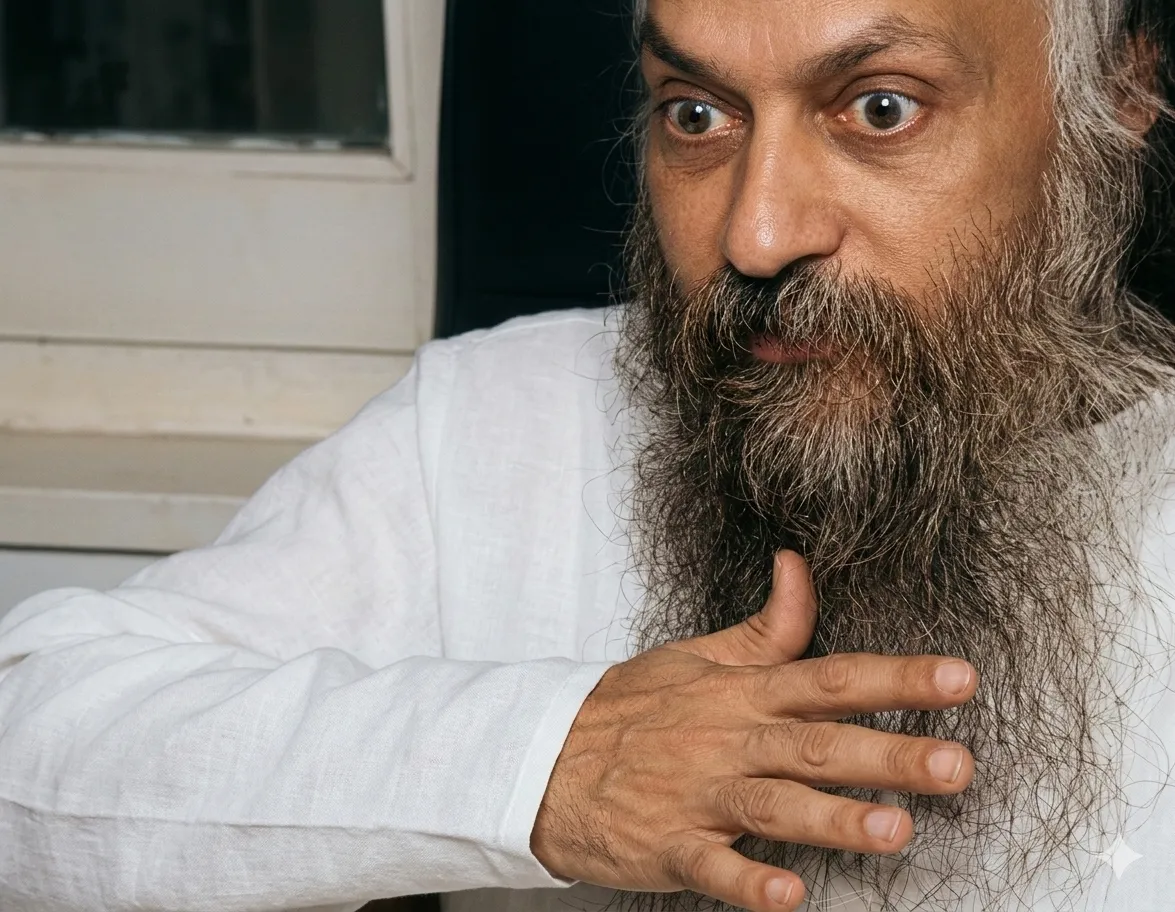
Who is a siddha?
Synthesized from Source
definition
"A siddha is one who has transcended all attachments, embodying an indivisible presence where all divisions dissolve into the oneness of existence. In this state, the seeker, the sought, and the act of seeking become a seamless continuum of being."
According to Osho, a siddha is one who is utterly unattached and therefore unbroken—an indivisible, nondual presence in which all divisions (I/you, inner/outer, light/dark) have dissolved. In this realized state, one’s whole being is one continuum: seed, field, farmer, and fruit are oneself; reality is non-relative, contradictions vanish, and the person stands as a complete, undivided individual (abhang).
A siddha is someone so free of attachment that they are whole and one with everything, with no inside/outside or me/you left.
Why this matters practically
- Reduces inner conflict and stress by loosening attachment to roles, opinions, and preferences.
- Builds inner unity, ending self-division and indecision.
- Fosters equanimity and clarity by seeing beyond opposites and contradictions.
- Builds inner unity, ending self-division and indecision.
- Fosters equanimity and clarity by seeing beyond opposites and contradictions.
AI Confidence Score: 97%
Read Original Discourse →