
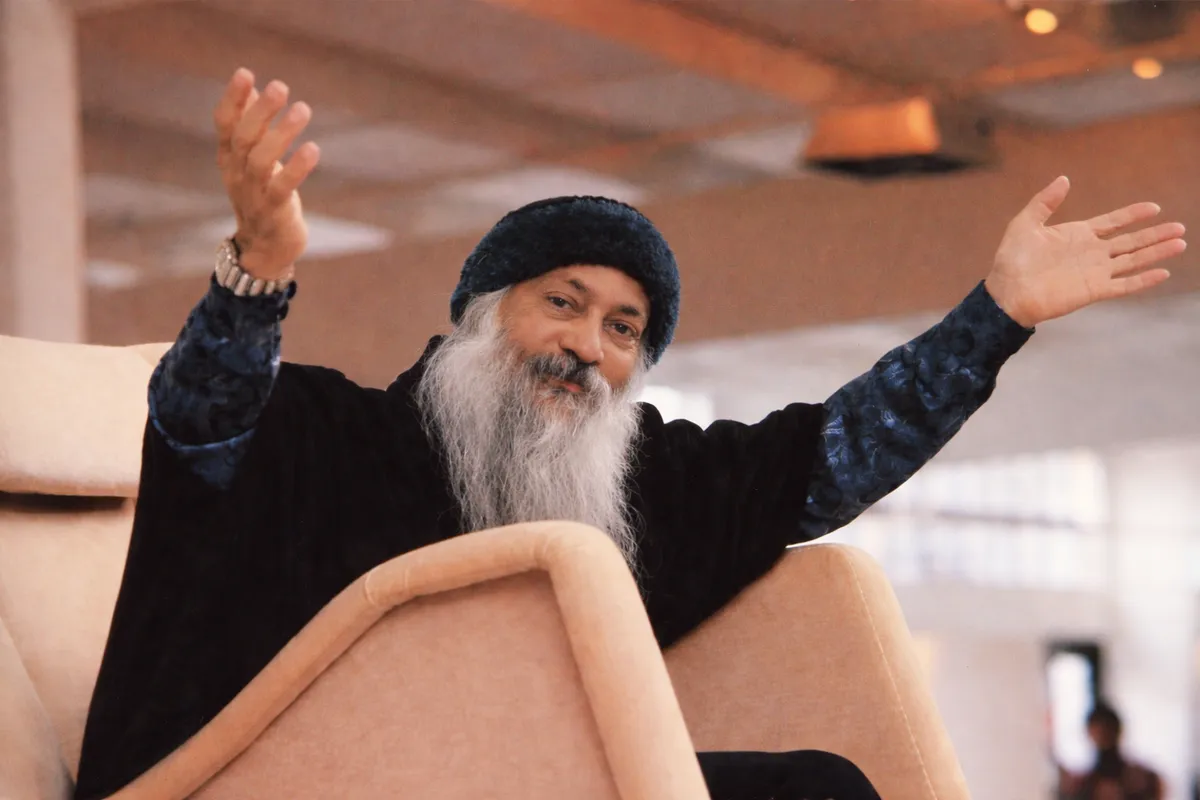
It’s okay to call someone "God" only if you mean everyone and everything is God, not that one person is special.
From the Discourses
Passages where Osho speaks to this question — each links to the complete discourse.
And this same friend has asked a second question—what I am saying will become clear through it. He has asked: Is it proper to confer the title “God” on someone, or for anyone to accept such a title? Pharaoh’s greatest crime was precisely that he claimed to be God.
On the other hand is Muhammad, with nine marriages—hard to digest. But look from Muhammad’s side, think straight. None of those marriages were about lust. The Arab lands were warlike; men fell in battle, the number of women rose, men became fewer. Where women are many and men few, great immorality spreads—inevitably. So Muhammad made a rule: every Muslim should marry up to four women. To others, in lands where the numbers never skewed so, this may look absurd; but in that historical moment it was meaningful. Those four marriages saved the morality of Muslim societies; otherwise they would have sunk. Muhammad himself married nine times. That too is reasonable: if the disciples are to go four steps, the master must go further. It is simple arithmetic. He went ahead by two steps so you would move a little—otherwise you would not move at all. A man is harried enough…
Osho, perhaps they never even said it?
No—no one says it. It gets attributed afterward. It isn’t necessary that they say it; later it is attributed—heavily attributed. Because we cannot live without God, without an avatar. We pick someone and instantly install him as an avatar. We want security, safety, support—a crutch. So if my words are right, that alone won’t do. For my words to be completely right, it is necessary that I become God! Even if I don’t claim it, four people will get together and claim that I am God. Then my words are right. For when have a man’s words ever been right in this world? Only God’s words are right! So to make the words right, you must declare a God. Very few people in the world have been so honest as to be free even of this “sattvic” ego. In fact, even being a guru gratifies a great ego. To claim…
Osho, Nanakdev was also an awakened man. But he never said, “I am God.” He also said that one should acknowledge none but the One Supreme. And the person who shows the path of spirituality should be called a guru. It has been asked by R. S. Gill. Only a Sikh could ask such a question—because the question has not come from the heart. The question is hollow; it comes from the intellect. It comes from tradition, from belief, from prejudice. Yet it is worth understanding, because such prejudices are piled up inside everyone.
Hence so many differing notions of God; hence every century has a different God. It changes—not because God changes, but because the reflections change, because the reflectors change. The God of the Old Testament is very wrathful—rudra-like—angry over trifles, raining fire for small things, bringing a deluge for small things. In rage He once drowned the world, saving a few chosen ones in Noah’s ark; on cities He rained fire; slight offense, terrible wrath! Is God wrathful? No. Those who wrote the Old Testament must have been wrathful. The Old Testament tells us about the Jews who wrote it. The Vedas’ idea of God does not inform us about God; it tells us about those who composed the Vedas. A rishi prays, “May the milk in my cows’ udders increase, and may my enemy’s cows go dry. Lord, see that my fields yield well and my neighbor’s do not.” Does…
Why do you call yourself bhagwan ? Why do you call yourself god?
The last thing about it. I am not a philosopher. Always remember me as a poet. My approach towards life is that of poetry, is that of romance. It is romantic, it is imaginative. I would like you all to be gods and goddesses. I would like you to reveal your true being. Calling myself god is a challenge. It is a subtle challenge. There are only two ways to settle with it. One is, you say, 'This man is not god, and go away, because then what are you doing here? If this man is not god, then why waste your time? You go away. Or, you accept that this man is god, and then you start being with me, and your own godliness starts flowering. One day you will also be a god, a goddess. Accepting me as god is in fact deep down accepting the possibility that…
For the last twenty-five years I belonged to the organization of the seventh day adventist church, (saturday sabbath). Though I am concentrating in listening to you, I have not passed the stage of conflicts. One of the conflicts has been whether ellen g. White, the founder of the church, was the messenger of god or not. Would you please explain it to me.
So he came with me. The host where we were staying, he asked me immediately, "Who is this man?" I said, "He is a PARAMAHANSA. He keeps quiet -- he is a great soul." The man said, "But we never heard about him, so how did you hear?" "He never publicises, he is not a Mahesh Yogi, he does not believe in advertisement. He is very, very esoteric." The man fell at his feet! The garland that he had brought for me... he forgot me completely. And that man, I had trained him in the train as to what to do, so he started swaying -- the host also started swaying! I said, "Look, your kundalini is rising!" He said, "I can feel something; in my spine there is some sensation. I have never felt it and I have been to so many saints -- but this man is a…