
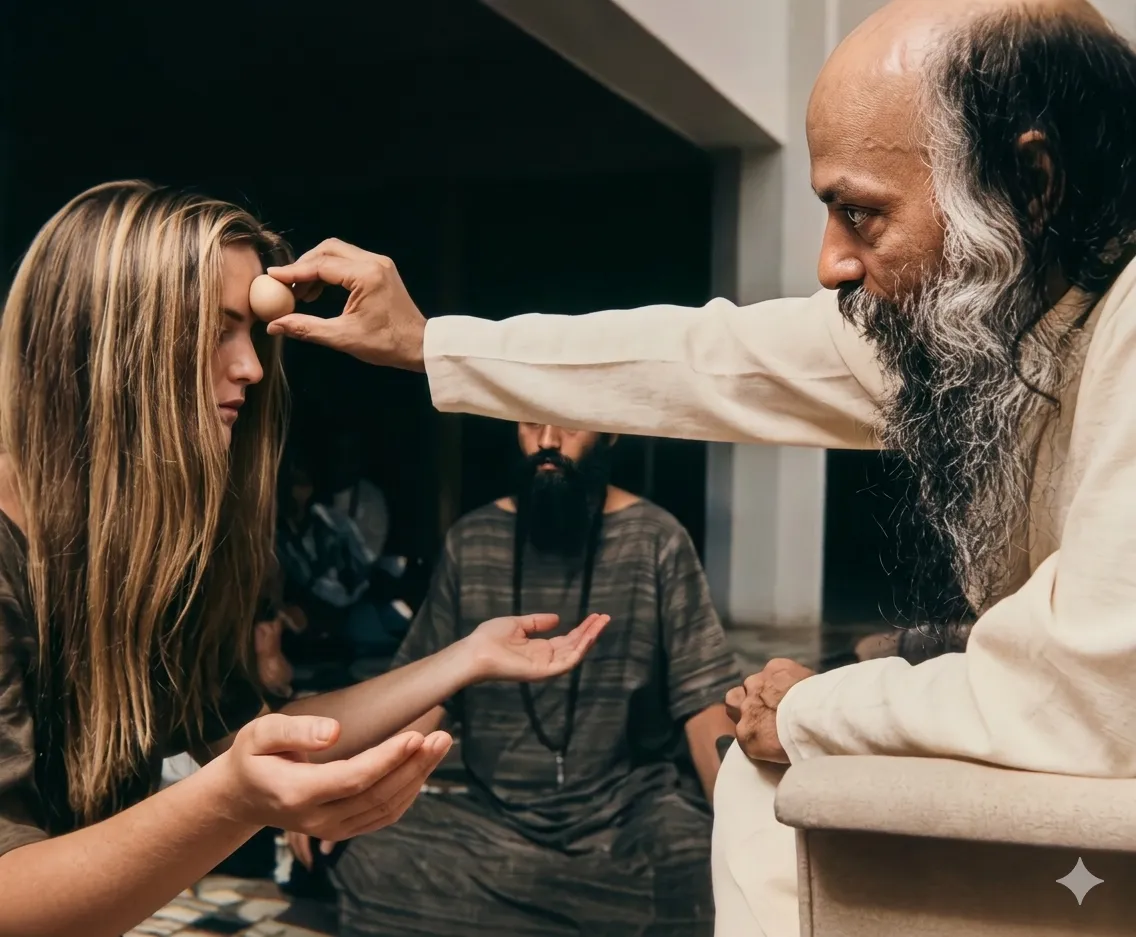
According to Osho, one does not 'go' into depth by striving; depth happens naturally when you accept the whole of experience—shallow and deep alike—without denial or preference. The very desire to be deep keeps you superficial. Embrace what is as Brahman in all its layers; in total acceptance, a wordless depth appears that transcends shallow-versus-deep.
Stop trying to be deep; say yes to everything as it is, and real depth will quietly show up on its own.
From the Discourses
Passages where Osho speaks to this question — each links to the complete discourse.
As you move into meditation this feeling starts becoming stronger every day. That does not mean that you start neglecting the body, on the contrary, you start caring about the body more carefully because it is a beautiful house, a gift of god. You have to keep it clean and beautiful and young and vital, energetic, alive, because you have to live in it for many many years. There is no need to make it ugly, poor, starved. Make it a palace, make it a marble palace, make it a temple, but remember "I am not it," so when it dies you are not dying. The body is born, the body dies; you are never born and you never die. And the method of meditation is very simple: just watching. Three things have to be watched. The first is the body and its actions.
These are the problems in meditation: when you go deep, a desire arises to go to the same depth again or even deeper. But now the desire is a new element. It was not there when you went for the first time. You were not aware at all of where you were going. You were simply going into the unknown with no desire... at the most an enquiry, exploring, not knowing where you are going and what is going to happen -- good or bad. But then the experience was so beautiful that it has created a desire in you. That desire is wrong because it can be very dangerous to health and it is not helpful to meditation. If you go into that death experience again you will not be able to go to the same depth because this desire will constantly be there.
Osho, you have spoken of the four steps of meditation; please explain the full meaning of all four.
First, understand this clearly: three are only steps, not meditation; meditation is the fourth. The gateway is the fourth; the first three are only steps. Steps are not the door; they lead to the door. The fourth alone is the door—rest, pause, emptiness, surrender, dying, dissolving—that is the door. And the three steps lead you to that door. The fundamental basis of those three steps is one: if you want to enter rest, it becomes very easy after going into total tension. Just as a person who labors all day can sleep at night. The more the labor, the deeper the sleep. Someone may ask, “But labor and sleep are opposites; how can labor lead to sleep? The one who has worked all day should not be able to sleep!” And the one who has lazed on the bed all day should sleep! But the one who stayed in bed…
These are three concentric circles around the center. Of course the heart is closer to being, so it is better to be in the heart than to be in the mind. The mind is closer than the body; it is better to be in the mind than in the body. But the ultimate goal is to be just your being -- no action, no thought, no feeling, just pure witnessing. And then the satori happens and one becomes full of light, full of truth. Then to live is a blessing. Before it, it is just a drag; after it, it is a dance. (Really, meditation is a journey, Osho told Bhavan, from your head to your heart to your being.) Meditation is not-knowing, it is not like knowledge, It is far closer to feeling. It is not like logic, it is far more like love.
Question: First question: Osho, why should I meditate? Divakar Bharti! In life there are some things that are not means but ends. And there are many things that are means, not ends. One may ask, “Why should I earn money?” One cannot ask, “Why should I meditate?” Because money is a means—the “why” can be answered. Money has a utility; meditation has no utility. Meditation is an end in itself—like love. Someone asks, “Why should I love?” What answer could there be? Love! There is no question of “why”; no question of motive; it is an inner fragrance. As a flower has fragrance—there is no “why” about it. When the flower of the heart blossoms, the fragrance of love arises. You cannot ask, “Why life?”... It will be simpler to think like this: when there is suffering, you can ask “why,” “what is the cause?