
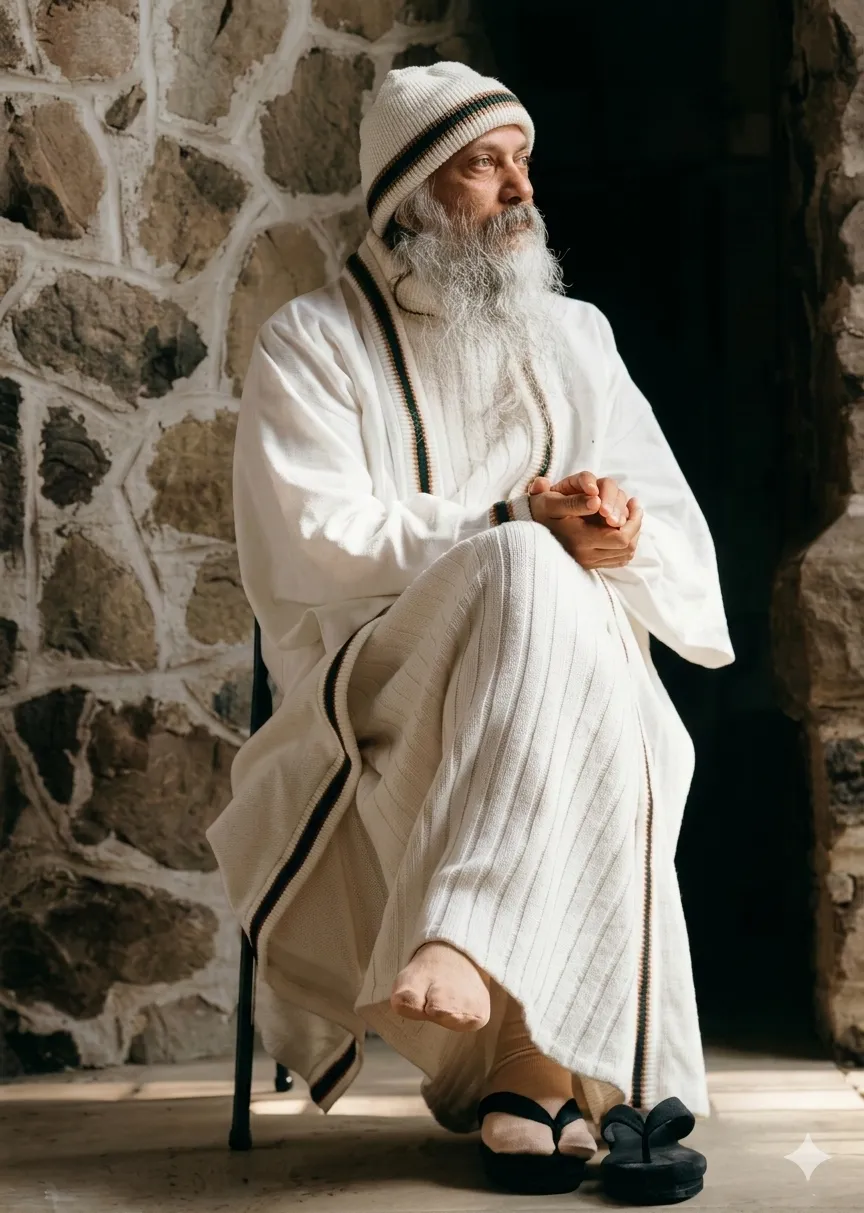
According to Osho, only the eternal rebels: living dharma is a fire that opposes time-bound convention and the ash of tradition. Dharma has two faces: the label-less, ever-fresh truth, and its institutionalized corpse. When truth descends, it must cremate dead forms, so it appears rebellious to those attached to religions, yet this revolt protects the purity and renewal of the real.
Real dharma is a living fire that burns old religious ashes, so it looks like rebellion to people clinging to the past.
From the Discourses
Passages where Osho speaks to this question — each links to the complete discourse.
Osho, you often say that religion is rebellion, revolt. But by definition dharma is that which upholds all; dharma is the supreme law; dharma is eternal. How can that supreme, that eternal, be rebellious?
The danger is this: because of worshipping that corpse, whenever an intelligent person is born in your house and says, “Be free of this dead body,” the whole house turns against him. “You tell us to burn our mother? To burn our scripture? Our tradition that has always been—our fathers worshipped this corpse, and their fathers, and their fathers. From this has come our very birth. This is our culture, our civilization!” Whenever discernment is born in such a house, there is turmoil; rebellion becomes necessary. Some son has to rebel. And the irony is: the son who rebels is the one who stands for life. The traditionalist is an enemy of life, a mere follower of a line. He is a worshipper of the past—he has respect for the dead, and contempt for the living. Who were those who crucified Jesus? Not bad people—remember this. You often fall into…Read the full discourse →
Question: Second question: Osho, is religion rebellion? Religion is rebellion; a sect is not. A sect is status-quo-ism. A sect means: religion has died. Rebellion has died; it has become an organization. The breaths of revolution have stopped; a corpse lies there. The privacy of every sannyasin must be protected. At no price should he let the inner flame of rebellion be diminished. Revolution is collective; rebellion is individual. Revolution is future-oriented; rebellion is in the present. Revolution says: tomorrow, when we are organized and when we change society, then the golden age will come, then we will create a new world. Revolution looks toward tomorrow. Remember, society looks toward yesterday; the revolutionary looks toward the coming tomorrow. The rebel lives in today—he has no anxiety about the yesterday that has passed, nor any concern about the tomorrow to come. Tomorrow will come of itself.Read the full discourse →
Question: BELOVED OSHO, WHAT IS YOUR NOTION OF REBELLION AND OF A REBEL? A rebel is one who throws away the whole past because he wants to live his own life according to his own longings, according to his own nature -- not according to some Gautam Buddha, or according to some Jesus Christ, or Moses. The rebel is the only hope for the future of humanity. The rebel will destroy all religions, all nations, all races -- because they are all rotten, past, hindering the progress of human evolution. They are not allowing anybody to come to his full flowering: they don't want human beings on the earth -- they want sheep. Jesus continuously says, "I am your shepherd, and you are my sheep...." And I have always wondered that not even a single man stood up and said, "What kind of nonsense are you talking?Read the full discourse →
The Rebel · Discourse 4
1987-06-02 · Chuang Tzu Auditorium · English
Question: BELOVED MASTER, WHAT ARE THE QUALITIES OF A REBEL? A rebel simply lives his life in the moment, with awareness, with no desire to dominate, either while he is living or when he is dead. He does not have any lust for power. He is a scientist of the soul -- that is the fourth dimension. Just as science uses doubt, skepticism, inquiry, he uses the same methods for his inner search. Science uses them for objective reality, he uses them for his subjectivity. But he does not condemn doubt, he does not condemn skepticism, he does not condemn disobedience, he does not condemn a nonbelieving approach to reality. He enters within his own being with a scientific mind. His religion is not superstitious -- it is scientific.Read the full discourse →
Question: BELOVED MASTER, WHAT IS THE RELIGION OF A REBELLIOUS SPIRIT? His whole life is a pilgrimage, always moving closer and closer and closer to the ultimate reality; that realization that releases one from all bondage, all frustration, all misery, all anguish, and allows one to taste freedom, truth, beauty, love and an outburst of creativity -- creativity in the multidimensions of life. The rebellious man has a golden touch -- whatever he touches becomes gold, it does not matter what. He may play on a bamboo flute and it becomes pure gold, twenty-four carat. He may dance alone under the starry sky, and his dance is more meaningful, more significant than all the paintings in the world, all the statues and all the holy scriptures. His creativity may simply be expressed in his silence. But his silence will not be an ordinary silence -- just an absence of noise.Read the full discourse →