
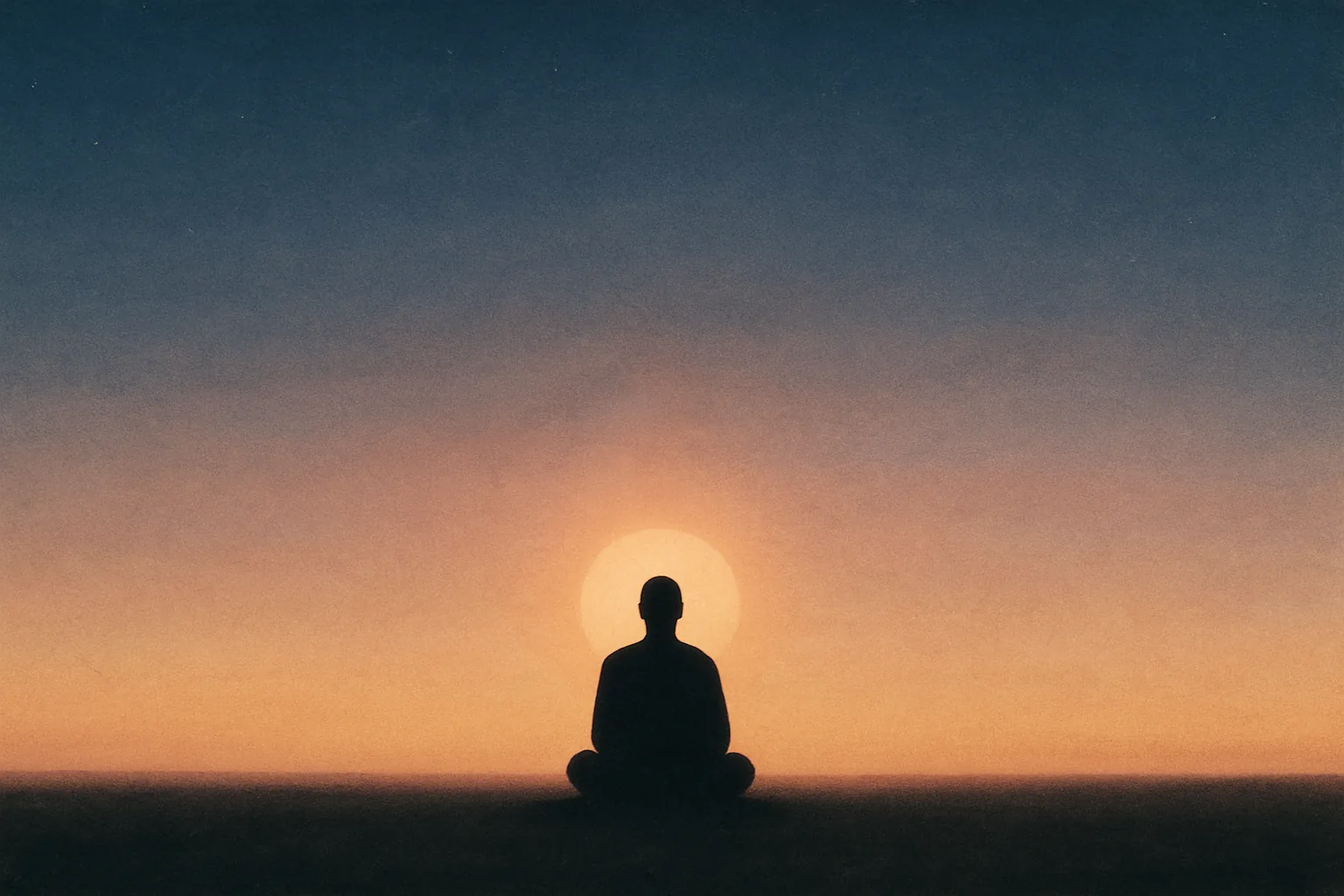
Effortless Witnessing is a direct, simple, and radical path drawn from Osho’s guidance on non‑doing and pure awareness. It invites you to sit silently, to notice the dark, heavy space within without judging it, and to remain the “watcher on the hill” while the valleys of inner weather move below. In this approach, doing becomes an obstruction; awareness—left utterly unforced—purifies itself and naturally dispels inner darkness. You don’t fight, fix, or improve; you witness. As awareness clarifies, it reveals its own luminosity, which dissolves darkness on its own accord.
This meditation echoes Lao Tzu’s “action by inaction” and the Zen spirit of “effortless effort.” It is not a technique of achievement but an intimate return to your incorruptible center—the space that needs no alteration. You simply sit, allow a subtle magnetic pull inward, and trust the universal law of the inner world: when you stop interfering, existence transforms you. Patience, waiting, and a gentle clarity are your only companions; all else happens by itself.
Phase Instructions
First Stage: Arrive and Commit to Non‑Doing
Sit comfortably with a natural spine. Let the breath be as it is. Close your eyes or keep them softly lowered. Make one inner decision: you will not do anything to change your inner state. No fixing, no improving, no pushing away, no inviting in. Simply be a silent presence. Let this intention settle: I am the watcher, not the doer.
Second Stage: Become the Watcher on the Hill
Sense the inner landscape as if you are seated on a quiet hill, looking down into the valleys of your being. If a dark, heavy space appears, acknowledge it clearly. Do not call it good or bad. Do not try to drop it. Let it be exactly as it is. Observe its textures, edges, movements, temperatures, and moods, the way you would watch passing clouds from a distance. Keep your posture easy and your gaze inwardly spacious.
Third Stage: Effortless Allowing (Action by Inaction)
Avoid every impulse to interfere. If the mind suggests techniques, solutions, or judgments, notice that suggestion and let it pass. Remain still and unoccupied. Let awareness grow more clear by itself. Rest in “effortless effort”: no manipulation of breath, no concentration, no suppression or indulgence—only watching. Trust that in the inner world, doing disturbs; non‑doing clarifies.
Fourth Stage: Recognize the Innate Luminosity
As watching becomes purer, begin to sense that awareness itself is luminous—radiant without your help. Feel how this quiet light naturally dissolves the darkness. Do not claim credit, do not hurry it. If you notice a gentle, magnetic pull inward, allow it wholeheartedly; do not hold anything back. Let yourself be possessed by stillness, as if existence is doing everything and you are simply available.
Fifth Stage: Abide, Wait, and Trust
Continue waiting, watching, and being patient. If heaviness returns, receive it as a guest and keep witnessing. Each time you are drawn toward doing, relax back into non‑doing. Let clarity deepen until only the silent witness feels real and everything else passes freely.
Sixth Stage: Closing and Carrying the Flavor
Without breaking the silence abruptly, take a few natural breaths and open your eyes softly. Stand or move slowly, keeping the sense of the watcher with you. Do not evaluate the session; carry the fragrance of non‑doing into ordinary activities, remembering that the temple of transformation is within, and awareness works best when you do not interfere.
Core Benefits
- Purifies awareness naturally.
- Dissolves inner darkness.
- Encourages non-doing and pure awareness.
- Promotes an intimate return to the inner center.
- Trusts the natural transformative process.
What Osho Said About This Technique
Beloved Osho, you spoke the other morning about rising through the different levels of consciousness and bringing light to their respective counterparts in the unconscious. Are special techniques needed for this, or will watchfulness of the mind, the body, and the emotions simply bring us through these different levels?
He said, "The woman you were talking about. I believe in ghosts; just this is enough. But no more than this! I have heard the sound, and I don't want to get into all that trouble that that other woman had" -- because the story had spread all over the city that that woman... She stopped coming to the house because she became so afraid. She had a constant fever for three or four days; even after she became conscious and went to her home she had a fever, the fear went so deep. And the old man said, "I don't want to get into that trouble. Just open the door and let me go to my home!" I said, "You are such a God-believing person. This is the time to test your God." He said, "I am not going to listen to you; you are a dangerous fellow. God?…
Drik swaroop awasthanam akshataha to be established in one's own witnessing nature is akshat -- the unpolished and unbroken rice used for the worship.
Breathe, be aware. And if you are trying to be aware of your breathing, you cannot think, because the mind cannot do two things simultaneously -- thinking and witnessing. The very phenomenon of witnessing is absolutely, diametrically opposite to thinking, so you cannot do both. Just as you cannot be both alive and dead, as you cannot be both asleep and awake, you cannot be both thinking and witnessing. Witness anything, and thinking will stop. Thinking comes in, and witnessing disappears. Witnessing is a passive awareness with no action inside. Awareness itself is not an action. One day Mulla Nasrudin was very much worried, in deep brooding. Anyone could look at his face and feel that he was lost somewhere in thoughts, very tense, in anguish. His wife became alarmed. She asked, "What are you doing, Nasrudin? What are you thinking? What is the problem? Why are you so worried?"…
Osho said that there was no need to try to still the mind, to stop the thoughts. He said that just as the traffic goes by and one remains on the sidewalk, unaffected, just a watcher, so one should simply witness the thoughts as they went by. We are not our thoughts, and recognising that we are the witness is enough. The very acceptance of the thoughts makes one more relaxed. The relaxation helps to create a distance, to separate oneself. To evaluate a thought as good or bad means that you are attached to your thoughts -- so one should not put labels on them.] ... put yourself aside, sit under a tree, and just watch the traffic. Soon, one day, the traffic disappears and the road is empty. Suddenly there is an interval and in that interval is meditation. But that interval cannot be created or cultivated.
Beloved master, sitting with you every day, I am becoming aware of a dark, heavy space inside me. It feels as if it is not part of me, but I know I carry it around with me. Will it disappear if I keep on watching, or do I need to do something more?
Shivam Suvarna, the path of meditation brings everyone to the awareness of a dark space within; and simultaneously, the absolute certainty that "I'm not it." All that is needed of you is just to watch and not to do anything. It seems simple, but it is the most difficult thing in the world, not to do anything. Just remain silent. Let it be there. Just look more closely, be more perceptive, more clear of all its aspects... but as far as doing is concerned, avoid it completely. Doing, in the sphere of the inner world, is your undoing. Doing is perfectly right in the outside world -- it is needed there. You cannot simply watch and things will start happening -- you have to make some effort. The inner follows just the opposite law: if you do something you get caught into doing, you lose your purity of awareness; and…
Osho, to go beyond the gunas you have suggested the practice of witnessing. It seems the central element of all your teaching is witnessing. For years I have been listening to you, and perhaps I have also been practicing witnessing. But like the horizon, it seems to stay just where it is—always at a distance. Please tell me where I am going wrong.
Just this one mistake: you have turned witnessing into a doing. You think you are practicing witnessing. Witnessing appears to you as something to do. That is the mistake. Witnessing is not an act; it is the awareness toward all acts. Therefore witnessing itself is not a doing. Nothing needs to be done for witnessing. Whatever you do, simply see it. And if you make witnessing into a deed, then you will have to watch that too. Behind that you would again have to be a witness. The witness is final; there is no going behind it. So do not make witnessing a doing—let it be natural. It is a little difficult, because we turn everything into doing. We try to “practice” witnessing as well. It is like telling a man that nothing needs to be done to bring sleep. And he does not get sleep. He asks me, “That…
तीसरा प्रश्न: ओशो, गुणातीत में जाने के लिए आपने साक्षीभाव का प्रयोग बताया। लगता है, आपकी सारी शिक्षा का केंद्रीय तत्व साक्षीत्व है। वर्षों से मैं आपको सुनता हूं और संभवतः साक्षीत्व का प्रयोग भी करता हूं। लेकिन क्षितिज की तरह वह मुझसे जहां का तहां खड़ा मालूम होता है। कृपा करके बताएं कि मेरी भूल क्या है?
बस इतनी ही भूल है कि यह साक्षीभाव को भी आप क्रिया बना लिए हैं। आप सोचते हैं, आप साक्षीभाव साधते हैं। साक्षीभाव भी आपको कुछ करने जैसा मालूम होता है। एक भूल। साक्षीभाव कृत्य नहीं है, समस्त कृत्यों के प्रति बोध का भाव है। इसलिए साक्षीभाव स्वयं कृत्य नहीं है। साक्षीभाव के लिए कुछ करना नहीं पड़ता। जो भी आप करते हैं, उसको देखना है। और साक्षीभाव को अगर आप कर्म बना लेंगे, तब तो फिर आपको इसको भी देखना पड़ेगा। इसके पीछे फिर आपको पुनः साक्षी होना पड़ेगा। साक्षी अंतिम है, उसके पीछे जाने का कोई उपाय नहीं है। इसलिए आप साक्षीभाव को कर्म मत बनाएं, उसे सहज रहने दें।
Common Questions
Simply sit silently and observe without judgment, allowing awareness to naturally clarify.
It means allowing processes to happen without forcing or actively trying to achieve something.
Yes, because it focuses on simplicity and non-doing, making it accessible even for those new to meditation.
Gently bring your attention back to being an observer, without self-criticism or force.
Yes, as it requires minimal time and encourages a practice of observing without engagement, which can be done anywhere.