
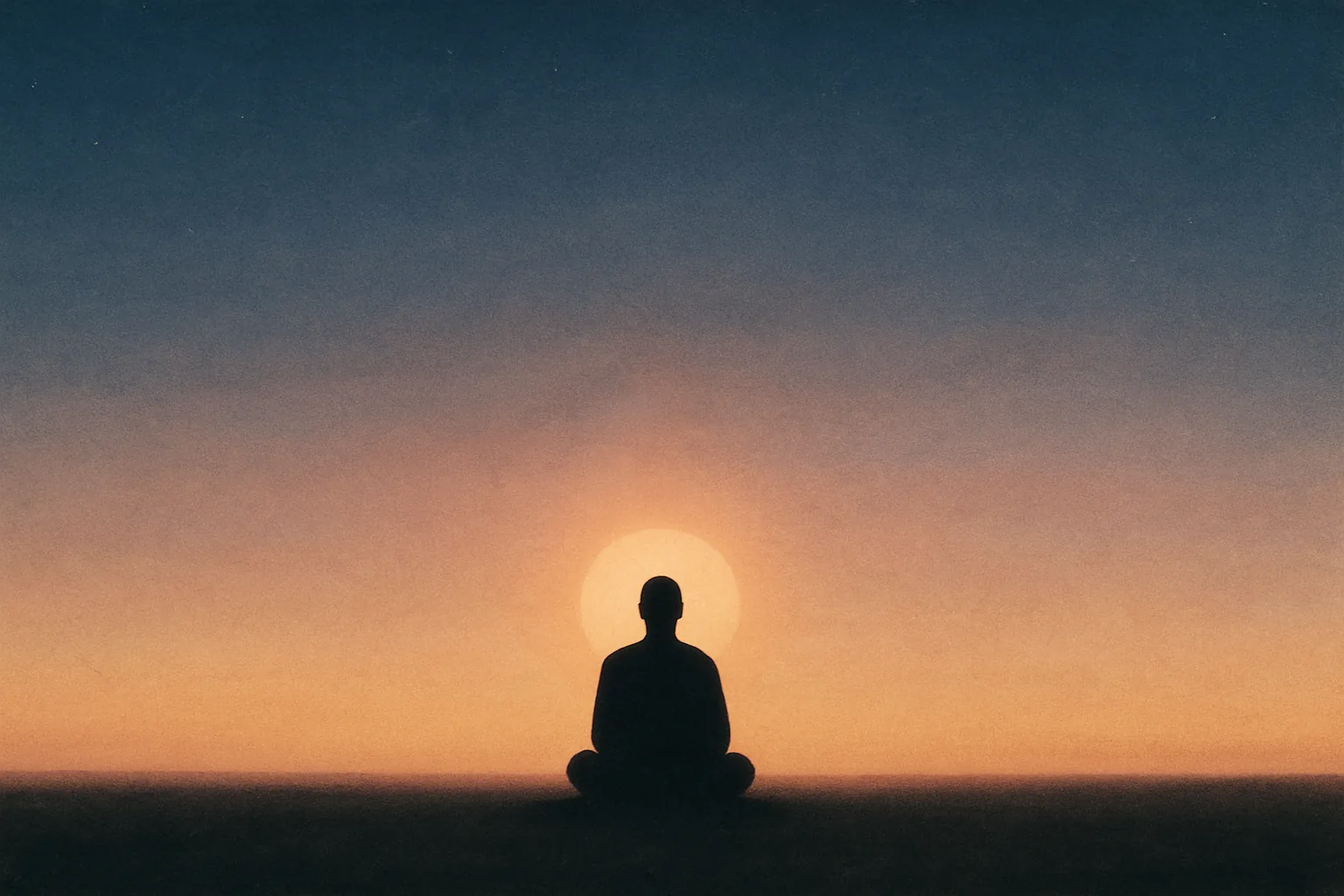
Dynamic Meditation is a powerful, five-stage method from the Tantra stream of Osho’s work, created for the modern mind that carries tension, repression, and restlessness. Rather than asking you to sit still immediately, it first stirs your life-energy through breath, movement, sound, and intensity—so that stillness can arrive on its own. It is best practiced at sunrise on an empty stomach, with eyes closed (a comfortable blindfold helps) and music designed to mark each stage.
The journey moves from chaos to catharsis to a focused breakthrough, and then into utter immobility and joyous celebration. Breath becomes a bellows, the body a drum, the voice a cleansing river. Energy is awakened and released, then gathered and transformed into witnessing silence. Finally, that silence flowers into dance and gratitude, carrying awareness into everyday life.
Phase Instructions
First Stage: Chaotic Breathing (10 minutes)
Stand with feet hip-width apart, knees soft, spine free. Keep your eyes closed (use a blindfold if helpful). Breathe rapidly and deeply through the nose, with no rhythm—let the exhalation be forceful and the inhalation happen by itself. Pull the breath down into the belly; let the chest and shoulders stay loose. Use the body to intensify the breath: shake, sway, stamp—whatever helps increase energy. Keep attention on the exhalation and on building intensity; this is not calm breathing, it is alive, erratic, total. Continue without pause until the music changes.
Second Stage: Catharsis (10 minutes)
Let everything erupt. Give your body, face, and voice full permission to express—cry, shout, laugh, growl, sob, jump, tremble, pound a cushion; move however the energy wants to move. Don’t perform or plan—allow. If emotions or memories surface, let them pass through you as sound and movement. Keep eyes closed, don’t involve others, and don’t suppress anything. This stage is a cleansing storm: total, conscious, and safe. Continue until the next musical cue.
Third Stage: Mantra and Jumping (10 minutes)
Raise both arms straight up. Jump in place, landing on the whole foot with knees soft. With each landing, shout a deep, sharp “HOO!” from the belly so the sound strikes the pelvic center. Keep the mouth open and the jaw loose; let the sound punch downward as you land. Stay vertical, arms up, and keep a steady, compelling rhythm. When you feel tired, go even deeper. Continue relentlessly until the command to stop.
Fourth Stage: Stop—Absolute Stillness (15 minutes)
On the signal, freeze instantly in whatever position you find yourself. Become a statue. Don’t adjust, don’t cough, don’t scratch—no movement at all. Eyes remain closed. Witness everything: breath, heartbeat, sensations, the urge to move—without acting on it. If a movement happens involuntarily, become still again immediately. Let awareness be bright and detached, as if the whole room is meditating through you. Remain utterly unmoving until the music changes.
Fifth Stage: Celebration (15 minutes)
Let the body burst into dance—light, grateful, total. Smile from the belly; let the movement be playful and effortless. Keep a thread of witnessing while you celebrate, so joy and awareness move together. Allow any remaining energy to circulate through free, fluid gestures. End by standing quietly, hands on heart or belly, receiving the echo of the practice.
Core Benefits
- Relieves tension from the modern mind.
- Allows repression to surface and be released.
- Transmutes restlessness into energy and aliveness.
- Facilitates a natural arrival to stillness.
- Transforms energy into witnessing silence and gratitude.
What Osho Said About This Technique
What is dynamic meditation?
The first thing to be understood about Dynamic Meditation is that it is a method of creating a situation through tension in which meditation can happen. If your total being is completely tense, the only possibility that remains is relaxation. Ordinarily one cannot go directly into relaxation, but if your whole being is at a peak of total tension then the second step comes automatically, spontaneously: silence is created. The first three stages of the technique are done in order to achieve this climax of tension throughout all the layers of your being. The first layer is the physical body. Beyond that is the prana sharir, the vital body: this is your second body, the etheric body. Beyond it is the third body, the astral body. Your vital body takes in breath as its food. If the normal intake of oxygen is changed, the vital body is bound to change.…
Question: in hatha yoga there is an exercise in which one tenses every muscle in the body and then releases the tension and becomes relaxed. Is this similar to what happens in dynamic meditation?
You are not aware of the spiritual because you have so much tension in the body, so much tension in the mind. But if you are not tense in the physical and mental realms, you will automatically know the bliss of the spiritual, the relaxation of the spiritual. It comes to you; it has been waiting for you. Your whole attention is so absorbed by the physical and the mental that there is no attention left to divert to the spiritual. Only if the body and the mind are not tense can you delve into the spiritual, can you know the bliss of it. The spiritual is never tense; it cannot be. There is no spiritual tension, only bodily tension, only mental tension. Bodily tension has been created by those who, in the name of religion, have been preaching anti-body attitudes. In the West, Christianity has been emphatically antagonistic toward…
The state in which the soul, with the help of the energies of the sun and other gods, and through the instrumentality of these fourteen: mind, intellect, mind stuff, ego, and the ten sense organs -- becomes sensitive to sound, touch and such other gross objects, is called the waking state. When the living being, on account of the unfulfilled desires of the waking state, becomes sensitive to sound, touch and such other gross objects -- even in the absence of the latter -- it is called the dreaming state of the self or soul.
This state of dreaming, the rishi says, means without the instrumentality of your senses. The senses are closed -- they are not aware of the world beyond you; now you are within your cells, within your body, but still you can create you own worlds. This creation of your own worlds in dreams becomes possible because your mind is a conditioning of everything you have known, you have felt; everything has been accumulated in it. It is an accumulation, not only of this life, but of all the lives one has lived; and not only of human lives, of animal lives also; and not only of animal lives, but of vegetable lives also. So in a dream you can become a tree; in a dream you can become a lion. Sometime you have been a tree: that memory is still there -- it can unfold. This unfolding of past memories,…
Question: dynamic meditation is very active, very strenuous.can one not go into meditation just by sitting silently?
You can go into meditation just by sitting, but then be just sitting; do not do anything else. If you can be just sitting, it becomes meditation. Be completely in the sitting; nonmovement should be your only movement. In fact, the word zen comes from the word zazen, which means, just sitting, doing nothing. If you can just sit, doing nothing with your body and nothing with your mind, it becomes meditation; but it is difficult. You can sit very easily when you are doing something else but the moment you are just sitting and doing nothing, it becomes a problem. Every fiber of the body begins to move inside; every vein, every muscle, begins to move. You will begin to feel a subtle trembling; you will be aware of many points in the body of which you have never been aware before. And the more you try to just…
SECOND STAGE Now we have to enter the second stage. Continue deep breathing, and let go of the body. Leave the body to do what it wishes to do. Let go of it. Let it take whatever asanas or postures it wants to take; let it form whatever mudras or gestures it likes. Leave it free to move and shake and whirl as it likes. If it wants to weep let it. Let go of the body completely. Continue deep breathing and let go of the body. Let the body fall down if it wants to fall down. And let it rise again if it wants to rise. And if it wants to dance allow it wholly. Let go of the body absolutely. Let it do whatever it wants to do. Leave it free. Don't impede it even in the least. Cooperate with the body. If it spins, let it.
Common Questions
It is best practiced at sunrise on an empty stomach.
No, it should be done with eyes closed, and a comfortable blindfold can help.
It stirs life-energy through breath, movement, sound, and intensity so that stillness can arrive naturally.
The music is designed to mark each stage and guide the flow of the meditation.
After the meditation, the silence flowers into dance and gratitude, bringing awareness to one's daily activities.