
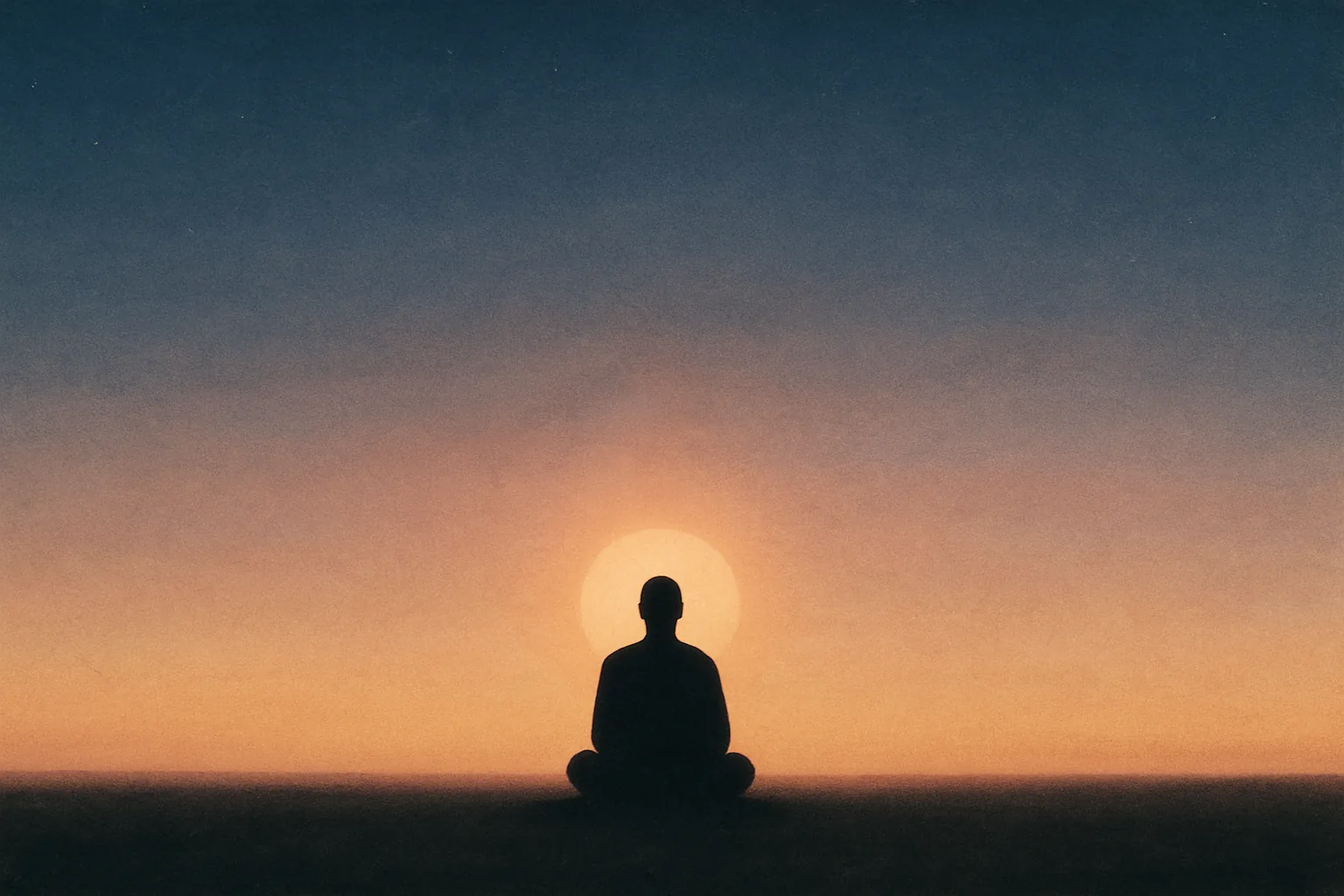
This meditation is a direct path of witnessing as articulated by Osho: a passage from doing to non‑doing, from effort to effortless presence. Rather than trying to fix, cleanse, or overcome inner heaviness, you learn to sit utterly still and watch. In this clear, choiceless awareness, the felt sense of a "dark, heavy space" within is allowed to be exactly as it is—unjudged, untouched, unmanipulated. As watching becomes pure, a quiet alchemy unfolds: awareness reveals its own luminosity and the darkness thins by itself.
Rooted in Osho’s discourses from Pune, this method embodies action through inaction—what Taoists call non‑doing and Zen names effortless effort. You remain a silent witness, like a watcher on a hill, perceiving the valley below without entering it. No technique is added, no inner work is performed. You simply allow existence to work on you. Patience, clarity, and non‑interference are the whole path and its fruition.
Phase Instructions
First Stage: Arrive and Sit in Silence
Choose a quiet place. Sit comfortably with an upright, relaxed spine. Rest your hands easily. Let your eyes close or remain softly downcast. Do not regulate the breath—let it find its own rhythm. Set a simple inner commitment: for this session, you will do nothing to change your inner state. Just sit, be still, and remain available.
Second Stage: Notice the Dark Space
Turn attention inward and allow the sense of a dark, heavy, or dense space to be noticed—wherever and however it appears (in the chest, belly, head, or as an overall mood). Do not label it as bad or wrong, do not try to drop it, heal it, or understand it. Simply acknowledge: "There is darkness," and stay present.
Third Stage: Watch Without Interference
Be a silent witness. Imagine you are a watcher on a hill, looking down into a valley where this darkness dwells. See its textures, edges, movements, and stillness with increasing clarity. If impulses arise to analyze, fight, fix, or escape, recognize each as doing and let it pass. Keep the body unmoving and the breath natural. Your task is only to see.
Fourth Stage: Abide in Effortless Effort
Rest in pure awareness. Allow thoughts, feelings, and sensations to appear and disappear inside a wide, open field of knowing. Make no inner commentary. Each time you notice subtle striving—pushing for progress, expecting results—relax the effort and return to simple watching. Non‑interference is the meditation.
Fifth Stage: Recognize the Inherent Luminosity
Begin to sense that awareness itself is clear and quietly radiant. Without trying to brighten anything, let this natural luminosity be felt, as if a gentle light is present by itself. Notice how, in this clarity, the darkness softens or thins on its own. If you feel a subtle, magnetic pull inward, allow it completely—let yourself be drawn deeper without holding back.
Sixth Stage: Patient Waiting
Stay with waiting and watching. You are not trying to reach a state; you are allowing reality to reveal itself. If judgment appears ("this is heavy," "this should be gone by now"), see the judgment and let it float by. Return to the still, choiceless observing. Trust that transformation, if and when it happens, is not your doing.
Seventh Stage: Completion and Integration
In the final minutes, keep the same non‑doing while gently sensing the whole body and the surrounding space. Let the eyes open softly. Move slowly. Carry a thread of witnessing into ordinary activity—walking, speaking, listening—allowing awareness to remain unagitated and inclusive.
Core Benefits
- Allows inner heaviness to be exactly as it is, unjudged
- Facilitates the revelation of awareness's luminosity
- Promotes effortless presence
- Embodies action through inaction
- Encourages patience, clarity, and non-interference
What Osho Said About This Technique
Beloved master, sitting with you every day, I am becoming aware of a dark, heavy space inside me. It feels as if it is not part of me, but I know I carry it around with me. Will it disappear if I keep on watching, or do I need to do something more?
Shivam Suvarna, the path of meditation brings everyone to the awareness of a dark space within; and simultaneously, the absolute certainty that "I'm not it." All that is needed of you is just to watch and not to do anything. It seems simple, but it is the most difficult thing in the world, not to do anything. Just remain silent. Let it be there. Just look more closely, be more perceptive, more clear of all its aspects... but as far as doing is concerned, avoid it completely. Doing, in the sphere of the inner world, is your undoing. Doing is perfectly right in the outside world -- it is needed there. You cannot simply watch and things will start happening -- you have to make some effort. The inner follows just the opposite law: if you do something you get caught into doing, you lose your purity of awareness; and…
Osho, for many years I have been making continuous efforts—nothing happened. I did this, I did that—nothing happened. But yesterday, when I simply sat holding awareness, I was astonished: What was that? What happened was beyond my imagination.
It will be; it is bound to be beyond imagination. You don’t even know—what will happen is utterly unknown and unknowable. You cannot make any expectation of it; you have no idea what it will be. What will happen in meditation cannot be said in advance, nor can it be imagined. What happens is unprecedented. It has never been known before. It is totally unknown, utterly unknowable. It will happen only when this entire known mind of yours becomes utterly quiet. And it will become quiet. Awareness stills the mind. When the mind becomes still, meditation descends. Meditation is not something you do; it descends. It surrounds you. Meditation is a state outside the mind-field. Meditation is the very nature of the soul. As soon as the mind-field is quiet, meditation begins to spread. So, very quietly, very effortlessly, without any tension, in silence; everyone sit with a little space…
In the beginning you will find only darkness or absurd, irrelevant thoughts, dreams floating here and there. It will look like a chaos but go on watching, go on looking. We are not worried about what you are seeing. Our whole effort is to see. Remember, the emphasis is on seeing, not on the seen, so it does not matter what you see. Thoughts, desires, memories, dreams -- it doesn't matter what you are seeing. Everything is just an opportunity to make the inner eye function. So remember the emphasis otherwise people become tired; they think 'What is the point? We don't see any light, we don't see god, we don't see the soul we don't see this, we don't see that. Just ordinary thoughts are there so what is the point? They have missed the whole message.
Darkness surrounds—this darkness is being known; the peace of this darkness is being known. Remember, do not only assume you are outside of restlessness. Go deeper and you will find you are outside of peace as well. Where restlessness never reaches, how can peace reach? You are outside both. There is neither darkness nor light there. Let this inquiry go deeper and deeper within: Am I outside? Am I outside? Ask it; know it; seek it. And as you continue the search, the mind will settle. A silence will descend such as perhaps you have never known. An explosion from within—so vast—that perhaps you have never been aware of it. For the first time you will know: I am outside the well—and I have never been inside. In these three days we will explore this intensively, as deeply as possible.
Beloved Osho, you spoke the other morning about rising through the different levels of consciousness and bringing light to their respective counterparts in the unconscious. Are special techniques needed for this, or will watchfulness of the mind, the body, and the emotions simply bring us through these different levels?
He said, "The woman you were talking about. I believe in ghosts; just this is enough. But no more than this! I have heard the sound, and I don't want to get into all that trouble that that other woman had" -- because the story had spread all over the city that that woman... She stopped coming to the house because she became so afraid. She had a constant fever for three or four days; even after she became conscious and went to her home she had a fever, the fear went so deep. And the old man said, "I don't want to get into that trouble. Just open the door and let me go to my home!" I said, "You are such a God-believing person. This is the time to test your God." He said, "I am not going to listen to you; you are a dangerous fellow. God?…
Common Questions
The main principle is to witness inner experiences exactly as they are without judgment or interference, embodying a state of non-doing.
Unlike traditional techniques that involve doing, this meditation advocates for total stillness and witnessing without adding any technique or performing inner work.
Allow the discomfort to be, watching it without judgment or attempt to manipulate, as the goal is to let existence work on you.
No prior experience is required; the meditation is based on watching and witnessing, which anyone can practice.
Progress is recognized through increased patience and clarity, where one naturally experiences a thinning of the inner darkness and a revelation of awareness's own luminosity.