
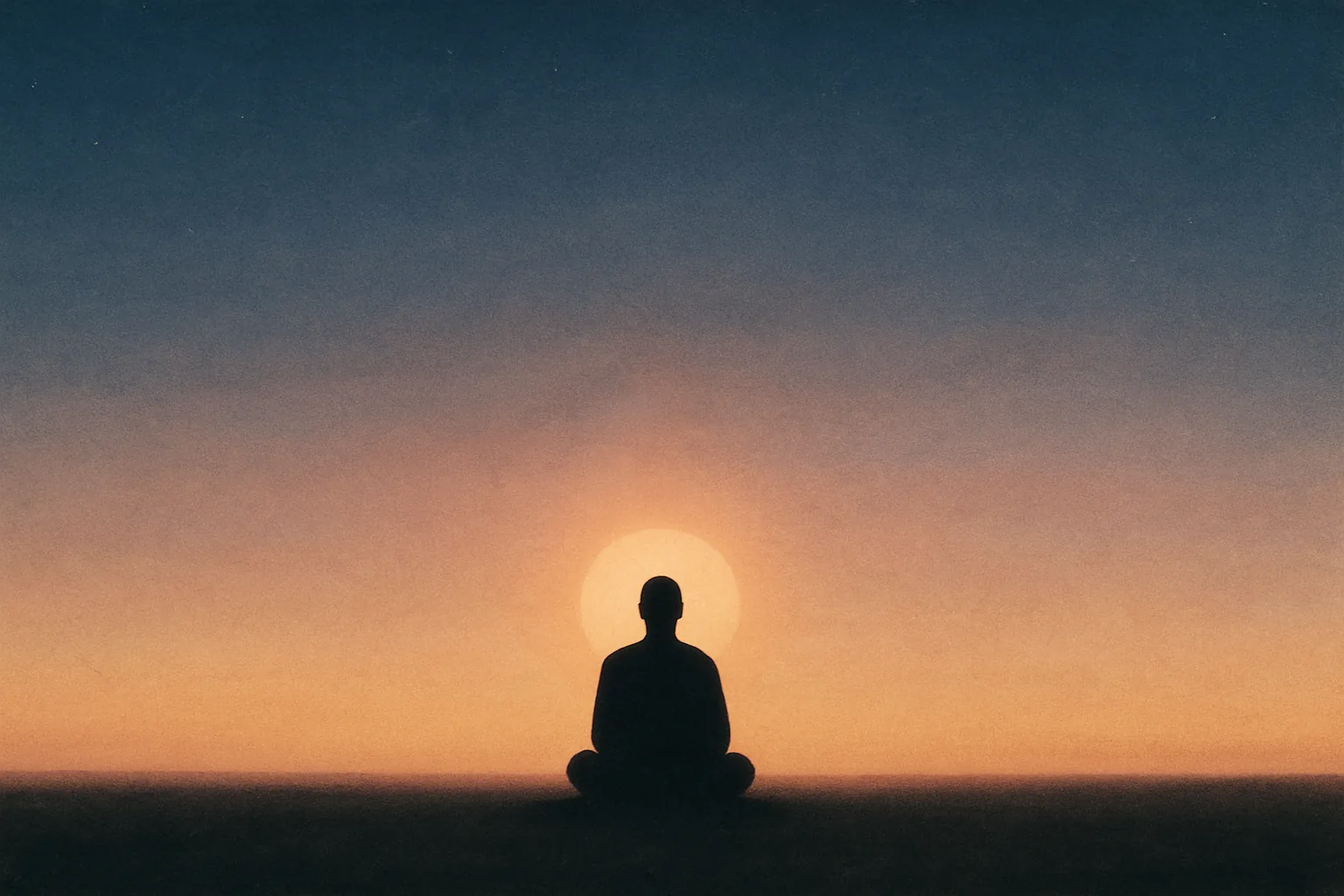
Rooted in Osho’s guidance and the spirit of Basho’s haiku — Sitting silently, doing nothing; the spring comes and the grass grows by itself — this meditation invites a radical shift from effort to effortless being. Rather than manipulating breath, mind, or mood, you rest in profound relaxation and non-doing. When grasping and goals subside, the inner climate ripens on its own, and silence flowers without being forced.
This is not a technique to accomplish, but a way of becoming utterly available. By being non-aggressive toward experience, open and prayerful in heart, you allow existence to move through you. In this relaxed nothingness, qualities like love, truth, compassion, gratitude, and prayer arise naturally — not as achievements, but as spontaneous blessings. Your part is simply to be here, unmoving in body and without strategy in mind, trusting that when the inner spring comes, the grass grows by itself.
Phase Instructions
First Stage: Arrive and Let Doing Fall Away
Choose a quiet place. Sit upright yet at ease, on a cushion or chair, hands resting loosely. Decide the session length, then release the agenda of getting anywhere. Close your eyes or let them rest half-open without focus. Allow the breath to be exactly as it is; do not count, chant, or regulate. Silently acknowledge: nothing to fix, improve, or achieve.
Second Stage: Sit Like a Stone Statue — Doing Nothing
Become utterly still, as if a stone statue of the Buddha: the body unhurried, the face soft, the spine naturally tall. Let thoughts, sensations, and feelings appear and pass without pursuit or resistance. Neither follow nor fight the mind; do not replace thoughts with methods. Do nothing with the breath. Do nothing with attention. Simply remain, unmoving in body and non-interfering in mind.
Third Stage: Wait for the Spring — Receptivity and Trust
Rest in relaxed alertness, free of impatience. If impulses to adjust, analyze, or improve arise, notice them as weather moving through an open sky and let them pass. Soften your sense of being somebody doing something; allow the feeling of being a nobody, a clear and prayerful openness. Trust existence. As the inner noise settles, let silence fill you by itself — as if flowers are showering and the grass is growing without your help.
Fourth Stage: Completion and Carrying the Flavor
When the time ends, do not rush. Feel the body’s weight, the touch of breath, the space around you. Gently open your eyes. Move slowly. Let this taste of non-doing accompany action: act when action is needed, and otherwise rest in the same open, non-aggressive presence through the day.
Core Benefits
- Profound relaxation and non-doing
- Silence flowers naturally without being forced
- Naturally arises qualities like love, truth, compassion, gratitude, and prayer
- Allows existence to move through you
- Trust in natural development as inner climate ripens on its own
What Osho Said About This Technique
Beloved Osho, when I first heard you say, "sitting silently, doing nothing, the spring comes and the grass grows by itself," my western mind thought this was a metaphor, and sought to find the meaning. Then I thought you really meant to sit silently -- and I felt it was impossible. Now, sitting silently in your presence, doing nothing I find is pure hedonism -- and the grass is growing by itself. Beloved master, I am amazed, and my gratitude is beyond words.
I had a friend, Professor Wilson, who was teaching in a theological college in Jabalpur. He could not understand that there can be a religion which has no God, which has no prayer. The West, for the last four or five centuries, has never conceived that religion is possible without God, without prayer. In fact it is only possible without them. They are the disturbances, obstructions on the way to religious revolution. They are the enemies. The devil has not done any wrong in the world -- he does not exist. God also does not exist, but he has done immense harm. God has kept man's mind focused on something outside, and when you are focused on the outside, you remain in the mind. Meditation cannot be focused outside; only mind has the capacity to be focused outside. Mind cannot be focused inside; only meditation can do that. So meditation…
So first: now, when we sit for meditation—our entire language is the language of doing. We even say, We will do meditation. It is wrong to say, for there is no possibility of doing in meditation. But our entire language—human language—is the language of doing; we have no language for non-doing. In Japan, about a hundred and fifty years ago, there was a great monastery, a vast ashram. Some five hundred bhikshus practiced there. The emperor became eager to see it and went. The ashram spread far and wide in the forest; cottages were scattered. The head monk began to show them: In this cottage our monks cook; in this cottage they study; in this cottage they sing—here they do this, there they do that; here they bathe. In the middle stood a large building—the monk said nothing about it.
तो पहली बात, अभी जब हम ध्यान के लिए बैठेंगे, हमारी सारी भाषा करने की भाषा है। ध्यान करने बैठेंगे, ऐसा कहेंगे, गलत है कहना, क्योंकि ध्यान में करने जैसी कोई संभावना नहीं है। लेकिन हमारी सारी भाषा, मनुष्य की सारी भाषा करने की भाषा है, न-करने की हमारे पास कोई भाषा नहीं है। जापान में कोई डेढ़ सौ वर्ष पहले एक बहुत बड़ी मोनेस्ट्री थी, एक बड़ा आश्रम था। वहां कोई पांच सौ भिक्षु साधना करते थे। सम्राट उत्सुक हो गया उस आश्रम को देखने और गया। दूर-दूर जंगल में फैला हुआ वह आश्रम था, दूर-दूर फैली हुई कुटियां थीं। एक-एक कुटी को दिखाने लगा भिक्षु, जो प्रधान था और बताने लगा, इस कुटी में हमारे भिक्षु भोजन बनाते हैं, इस कुटी में हमारे भिक्षु अध्ययन करते हैं, इस कुटी में गीत गाते हैं; यहां यह करते हैं, वहां वह करते हैं; वहां स्नान करते हैं।
(As Susana sits in front of Osho listening to the explanation of her new name, Anand Archano, her eyes close and her head slowly falls back. Moments later a tear plops off her cheek onto her lap.) I know only one prayer and that is being blissful. Nothing has to be said to god, one has simply to be blissful and all is said through one's bliss. People can pray but if they are sad, miserable, their prayer is only words, empty words with no content. If one is blissful then words are not needed at all; one can simply dance and sing or just sit silently, joyously -- and that's enough. That gratitude reaches to the ultimate source of light. So that is going to be your prayers no words but a silent joy pervading your whole being. -- How long will you be here? -- Forever.
When wolves were discovered in the village near master shoju's temple, shoju entered the graveyard nightly for one week and sat in zazen. This put a stop to the wolves' prowling.
OVERJOYED, THE VILLAGERS ASKED HIM TO DESCRIBE THE SECRET RITES HE HAD PERFORMED. 'I DIDN'T HAVE TO RESORT TO SUCH THINGS,' HE SAID, 'NOR COULD I HAVE DONE SO. WHILE I WAS IN ZAZEN A NUMBER OF WOLVES GATHERED ROUND ME, LICKING THE TIP OF MY NOSE, AND SNIFFING MY WINDPIPE, BUT BECAUSE I REMAINED IN THE RIGHT STATE OF MIND, I WASN'T BITTEN. AS I KEEP PREACHING TO YOU, THE PROPER STATE OF MIND WILL MAKE IT POSSIBLE FOR YOU TO BE FREE IN LIFE AND DEATH, INVULNERABLE TO FIRE AND WATER. EVEN WOLVES ARE POWERLESS AGAINST IT. I SIMPLY PRACTICE WHAT I PREACH. ... You cannot see both together. They are contradictory. They cannot be seen together. When you see the figure, the background disappears; when you see the background, the figure disappears. Mind has a limited capacity to know -- it cannot know the contradictory. That s why
The buddha said: my doctrine is to think the thought that is unthinkable; to practise the deed that is not doing; to speak the speech that is inexpressible; and to be trained in the discipline which is beyond discipline. Those who understand this are near; those who are confused are far. The way is beyond words and expressions, is bound by nothing earthly. Lose sight of it to an inch or miss it for a moment, and we are away from it forever more.
A doctrine is arrived at through logical thinking. A doctrine comes through the process of 'about-ism'. A siddhanta is arrived at not by closing your eyes, not by thinking too much, but by dropping thinking as such, in toto; by opening your eyes with no prejudice, with no a priori conceptions, and looking direct into reality, facing reality direct. It is already there, it needs only you to be there. And when you are absolutely without any thought, your mind is still, your memory is still, your thinking has completely ceased to be, then reality erupts, explodes. Then you become a receiver. Then siddhanta arises. <q>MY SIDDHANTA IS TO THINK THE THOUGHT THAT IS UNTHINKABLE....</q> The first thing, Buddha says, is to think the thought that is unthinkable. It is a contradiction, a paradox. Now, no logician will ever utter such nonsense. It is from the very beginning nonsensical. That's…
Common Questions
The focus is on effortless being, resting in profound relaxation, and non-doing rather than manipulating any part of your experience.
Approach this meditation by being non-aggressive toward experiences, open and prayerful in heart, and unmoving in body without strategy in mind.
One does not achieve goals but rather allows qualities such as love, truth, compassion, gratitude, and prayer to arise spontaneously as blessings.
No, this is not a technique to accomplish but a practice of becoming utterly available to the present moment.
This phrase means that when goals and grasping subside, conditions are naturally created for inner growth and silence, without any forceful effort.