
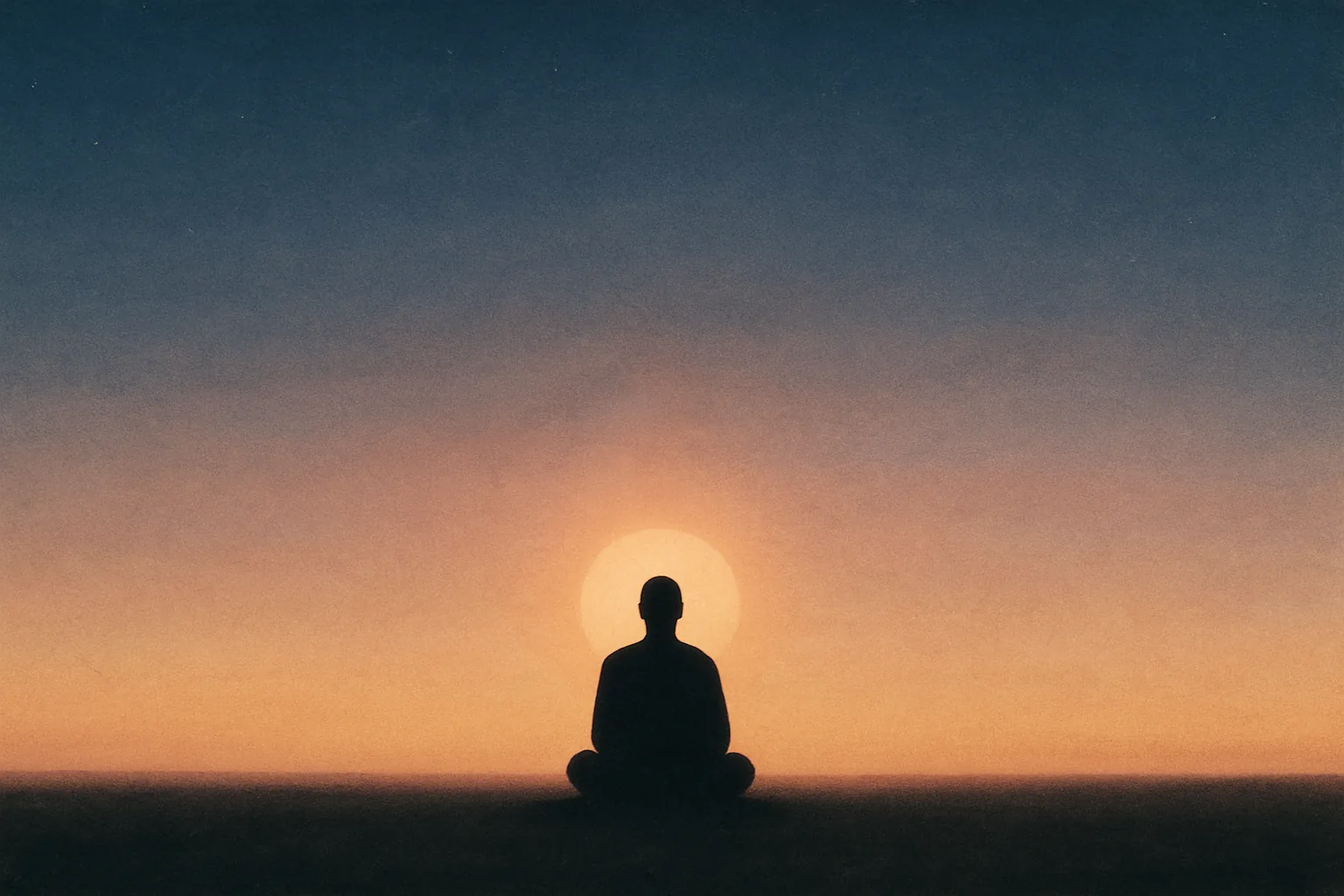
Witnessing is the art at the heart of meditation: neither cold nor hot, neither happiness nor unhappiness, beyond all pairs of opposites. The ancient whisper of Neti, Neti—not this, not that—points to a presence that does not cling to joy nor recoil from sadness. As Osho illuminates, true witnessing does not chase bliss or name God; it opens into Shunyam—the full emptiness where nothing is missing, an utter silence that is not indifference but living plenitude.
Practice becomes a mirror: totally available, absolutely present, reflecting whatever appears without prejudice. Joy passes and the mirror does not become joy; a dark cloud passes and the mirror does not become sorrow. Like a still lake upon which a bird flies—there is reflection without possession, relating without relationship. This meditation guides you to sit as the watcher on the hill, to let all inner weather come and go, and to rest in the natural peace that remains when grasping and resistance fall away.
Phase Instructions
First Stage: Enter the Watcher on the Hill
Sit comfortably with a relaxed, upright spine—on a chair or cushion. Let the hands rest easily. Gently close the eyes or keep them half-closed. Take a few unforced breaths and feel the simple fact of being here. Sense the body from crown to soles, as if you are sitting on a quiet hill, overlooking the landscape of your life. Let the mood be soft and alert. Nothing needs to be achieved; simply arrive, whole and unhurried.
Second Stage: Neti, Neti—Mirror the Inner Weather
For the next 15 minutes, allow sensations, thoughts, and emotions to appear on their own. Do not pursue the pleasant or push away the unpleasant. If joy arises, watch it as a color in the sky; if sadness appears, watch it as a passing cloud. Silently remember: not this, not that. Be utterly present—not neutral, not indifferent—present like a flawless mirror that reflects without choosing. Feel breath moving, hear sounds, notice thoughts, and let each impression pass through awareness without sticking.
Third Stage: The Lake and the Bird—Non-Identification
For 20 minutes, deepen into the image of a still mountain lake. Whatever comes—the wing of a bird, a memory, a surge of delight, a knot of fear—is reflected and gone. The lake has no intention to reflect; the bird has no intention to be reflected; reflecting happens naturally. Let there be no relationship with what passes—no holding, no hoping it returns, no commentary. If you notice clinging or aversion, smile inwardly, soften your eyes and belly, and return to being the lake. Relating happens; relationship is not created.
Fourth Stage: Rest in Shunyam—Full Emptiness
For 10 minutes, drop all images and pointers. Simply remain as open, awake space—silent, at ease. Nothing is missing. Do not name this peace as joy or call it emptiness in the sense of lack. Let thoughts rise and fall without interference; let sensations ripple and fade. Be total in presence yet free of effort, as if awareness is a clear sky that neither prefers the sun nor refuses the night.
Fifth Stage: Return and Carry the Mirror
Gently open your eyes. Let the body move slowly. Stand, walk a few steps, and allow hearing, seeing, and touching to be reflected just as they are—no grasping, no turning away. As you re-enter daily activity, keep a trace of the watcher on the hill: relating fluidly to each moment, creating no fixed relationship with what comes and goes.
Core Benefits
- Transcending opposites by practicing detachment
- Experiencing a state of full emptiness and inner silence
- Reflecting on experiences without prejudice
- Developing a stillness of the mind that allows inner peace
- Letting go of grasping and resistance to emotions
What Osho Said About This Technique
Drik swaroop awasthanam akshataha to be established in one's own witnessing nature is akshat -- the unpolished and unbroken rice used for the worship.
Breathe, be aware. And if you are trying to be aware of your breathing, you cannot think, because the mind cannot do two things simultaneously -- thinking and witnessing. The very phenomenon of witnessing is absolutely, diametrically opposite to thinking, so you cannot do both. Just as you cannot be both alive and dead, as you cannot be both asleep and awake, you cannot be both thinking and witnessing. Witness anything, and thinking will stop. Thinking comes in, and witnessing disappears. Witnessing is a passive awareness with no action inside. Awareness itself is not an action. One day Mulla Nasrudin was very much worried, in deep brooding. Anyone could look at his face and feel that he was lost somewhere in thoughts, very tense, in anguish. His wife became alarmed. She asked, "What are you doing, Nasrudin? What are you thinking? What is the problem? Why are you so worried?"…
Osho does witnessing always bring joy? The moments that I call witnessing sometimes feel distant -- almost cold in their neutrality. Other times it is like sprouting wings and soaring in joy over the open sea.
THE STATE OF WITNESSING IS NEITHER COLD NOR hot. It is neither happiness nor unhappiness. It is neither dark nor light. It is neither life nor death. The Upanishads say NETI NETI -- neither this nor that. If you feel joy you have already become identified; witnessing is gone. If you feel sad you are no more a witness; you have forgotten witnessing, you have become involved. You are colored by your psychology of the moment. Joy, sadness, all these qualities, are part of your psychology. And witnessing is a transcendence; it is not psychological. The whole art of meditation consists in witnessing. Then what does it bring? At the most we can say it brings total peace; it simply brings eternal silence. You cannot define it as joy. The moment you define it as joy you have fallen into the world of duality again. Then you have become part…
For years I am most of the time witnessing and I feel it like a disease. So is it that there are two kinds of witnessing and mine is wrong? Tell me.
And only then can the third step be taken, which will bring you close to what Gurdjieff calls self-remembering, or Krishnamurti calls awareness, or the Upanishads call witnessing. But first the two steps have to be fulfilled; then the third comes easy. Don't start doing the third immediately. First the object, then the consciousness, then the subject. Once the object is dropped and the emphasis on the consciousness is no longer a strain, the subject is there but there is no subjectivity in it. You are there but there is no "I" in it, just being. You are, but there is no feeling that "I am." That confinement of "I" has disappeared; only amness exists. That amness is divine. Drop the "I" and just be that amness. And if you have been working too long on witnessing, then for a few months, at least for three months, drop it completely,…
Osho said that there was no need to try to still the mind, to stop the thoughts. He said that just as the traffic goes by and one remains on the sidewalk, unaffected, just a watcher, so one should simply witness the thoughts as they went by. We are not our thoughts, and recognising that we are the witness is enough. The very acceptance of the thoughts makes one more relaxed. The relaxation helps to create a distance, to separate oneself. To evaluate a thought as good or bad means that you are attached to your thoughts -- so one should not put labels on them.] ... put yourself aside, sit under a tree, and just watch the traffic. Soon, one day, the traffic disappears and the road is empty. Suddenly there is an interval and in that interval is meditation. But that interval cannot be created or cultivated.
So learn to witness more and more: outer things, people, nature. Witness -- don't forget that you are just a witness, a watcher. Then inner things -- thoughts, desires, memories -- watch and remember that you are a witness. This is what George Gurdjieff used to call self-remembering. Continuously remember that you are a witness; never for a moment let this remembrance lapse. Many times you will forget and you will become identified. The moment you remember that you have forgotten, don't repent. Don't waste time in repentance, because that is getting identified with a new idea, the idea of repentance. Don't feel guilty, otherwise again you are identified. Just take note that you had forgotten, that's all: remember again. No need to repent, no need to feel guilty. Again start watching, and slowly slowly, the knack...
Common Questions
Witnessing Meditation teaches us to observe emotions without attaching to them, allowing us to experience them fully without being overwhelmed.
Yes, Witnessing Meditation can be practiced by anyone. Beginners may need time to develop the ability to observe without attaching to thoughts and emotions.
'Neti, Neti' translates to 'not this, not that', guiding practitioners to recognize the impermanent nature of experiences and identify with the ever-present witness.
Yes, by cultivating a non-reactive relationship with thoughts and emotions, Witnessing Meditation can help reduce stress and promote a sense of calm.