
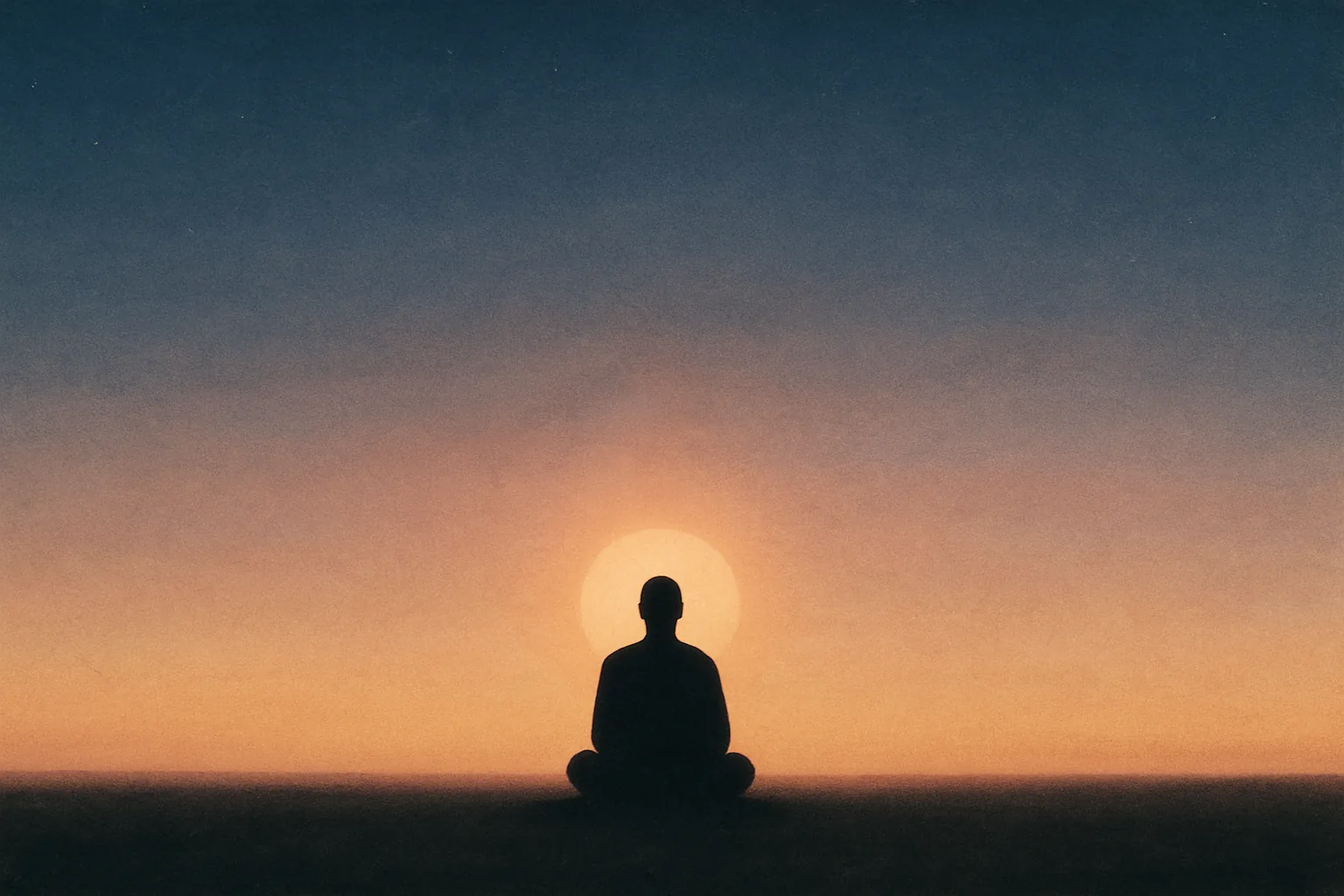
Vipassana, literally “to see things as they really are,” is among India’s most ancient meditation methods. Rediscovered by Gautama the Buddha over 2,500 years ago, it is a universal, non-sectarian path taught as an art of living. In the Osho Vipassana approach, this path is presented simply and directly: by observing yourself without judgment, the mind’s impurities dissolve and a deep freedom, clarity, and peace begin to flower.
Vipassana is self-transformation through self-observation. By sustaining disciplined attention on the body’s moment-to-moment sensations, you directly experience the intimate interconnection of mind and body. Thoughts, feelings, judgments, and sensations are seen arising and passing away according to their own laws. With patient witnessing, reactivity loosens, equanimity strengthens, and the heart naturally opens in love and compassion.
Phase Instructions
First Stage: Arrive, Sit, and Set the Intention
Choose a quiet space. Sit with the spine naturally upright—on a cushion or chair—relaxed yet alert. Close the eyes. Set a clear intention to observe whatever arises without judgment, without suppressing or indulging. Let the body be still and the breath natural. Decide to rely on direct sensation as your guide.
Second Stage: Collect Attention in Raw Sensation
Begin by feeling simple, undeniable bodily sensations: contact with the seat, the touch of clothing on skin, temperature, pressure, the subtle movement of breathing. Do not regulate the breath; only feel it. Each time the mind wanders, gently return to these immediate sensations—again and again—with patience and kindness.
Third Stage: Systematic Observation (Body Scan)
Sweep attention methodically through the body—from the crown of the head to the toes, then toes to head—section by section. In each region, notice whatever is present: tingling, pulsing, warmth, coolness, heaviness, lightness, itch, pressure, neutrality. Do not seek pleasantness or resist discomfort; neither cling nor push away. Let sensations reveal their changing nature while you remain steady, balanced, and aware.
Fourth Stage: Seeing the Mind–Body Interplay
As sensations are observed, notice how thoughts, moods, and judgments arise alongside them. Recognize that each mental event also appears, changes, and dissolves. Do nothing with them—no analysis, no commentary. Keep returning to direct sensation as the anchor while allowing the mind to be seen as passing phenomena in the same open field of awareness.
Fifth Stage: Equanimity, Letting Be, and Closure
Allow the attention to widen and include the whole body at once, resting in spacious, choiceless awareness. Abide as the silent witness of all that comes and goes. If you need to adjust posture, do so slowly and consciously, then return to stillness. Conclude by acknowledging the clarity and peace that have emerged, and carry this non-reactive, compassionate awareness into daily life.
Core Benefits
- Self-transformation through self-observation.
- Deep freedom, clarity, and peace.
- Equanimity strengthens.
- Mind’s impurities dissolve.
- Heart opens in love and compassion.
What Osho Said About This Technique
Beloved Osho! Yesterday, for the very first time I did Vipassana meditation at the camp. I felt such a flight! Please shed more light on Vipassana.
Buddha says: if you try to regulate the breath in any way, great fruit never comes from effort. The effort is yours; you are small. Your effort cannot be bigger than you. Your hands are small; wherever the imprint of your hand falls, smallness will remain. Therefore Buddha did not say: change the breath. Buddha did not endorse pranayama. He said: you simply sit; the breath is already moving—just sit and watch it as it is moving. As one sits by the roadside and watches the passersby, or sits on a riverbank and watches the flowing current. What will you do? If a big wave comes, you will watch; if no wave comes, you will watch. Cars and buses pass on the road—you watch; if none pass, you watch. Cows and buffaloes pass—you watch. Whatever is there, as it is, keep looking at it just so. Do not impose even…
पहला प्रश्न: प्यारे ओशो! कल प्रथम बार मैंने शिविर में विपस्सना ध्यान किया। इतनी उड़ान अनुभव हुई! कृपया विपस्सना के बारे में और प्रकाश डालें।
बुद्ध कहते हैं, तुम अगर चेष्टा करके श्वास को किसी तरह नियोजित करोगे, तो चेष्टा से कभी भी महत फल नहीं होता। चेष्टा तुम्हारी है, तुम ही छोटे हो; तुम्हारी चेष्टा तुमसे बड़ी नहीं हो सकती। तुम्हारे हाथ छोटे हैं; तुम्हारे हाथ की जहां-जहां छाप होगी, वहां-वहां छोटापन होगा। इसलिए बुद्ध ने यह नहीं कहा है कि श्वास को तुम बदलो। बुद्ध ने प्राणायाम का समर्थन नहीं किया है। बुद्ध ने तो कहा: तुम तो बैठ जाओ, श्वास तो चल ही रही है; जैसी चल रही है बस बैठकर देखते रहो। जैसे राह के किनारे बैठकर कोई राह चलते यात्रियों को देखे, कि नदी-तट पर बैठ कर नदी की बहती धार को देखे। तुम क्या करोगे? आई एक बड़ी तरंग तो देखोगे और नहीं आई तरंग तो देखोगे। राह पर निकली कारें, बसें, तो देखोगे; नहीं निकलीं, तो देखोगे। गाय-भैंस निकलीं, तो देखोगे। जो भी है, जैसा है, उसको वैसा ही देखते रहो। जरा भी उसे बदलने की आकांक्षा आरोपित न करो। बस शांत बैठ कर श्वास को देखते रहो। देखते-देखते ही श्वास और शांत हो जाती है। …
Beloved master, the other night during darshan, listening to your answer to nivedano's question, I had tears running down my face. For the first time in the seven years I've been with you, I could not only intellectually understand, but really feel that to look inside oneself is the only way to find the real treasures of life. Even though I am feeling this so strongly, it doesn't make it easier to meditate, to look inside. In the past my favorite subject for you to talk about has always been love and relationships. Now, I can't get enough of hearing you talk about meditation. Beloved master, c
Prem Sampurna, there are hundreds of methods of meditation, but perhaps vipassana has a unique status; just the same way as there have been thousands of mystics, but Gautam Buddha has a uniqueness of his own. In many ways he is incomparable, in many ways he has done more for humanity than anybody else. In many ways his search for truth was more sincere, more authentic than anybody else's. Why am I reminded of Gautam Buddha? I am reminded of Gautam Buddha because you have asked a question about vipassana meditation. That is the meditation through which Gautam Buddha became enlightened. The very word vipassana in Pali, the language in which Gautam Buddha spoke... he was perfectly acquainted with Sanskrit; as a prince he was well educated in the highest literature of those days. But when he started speaking he never used Sanskrit because Sanskrit was the language of the…
Osho, in the practice of Vipassana, when does catharsis occur? I practice Vipassana. How can my work in music assist me toward awareness?
Vipassana is an age-old method of meditation. It must have been discovered thousands of years ago; who discovered it, no one knows. It is a wondrous process, the simplest device to get acquainted with oneself. The word Vipassana means: to sit silently and become a witness to yourself. Pashy means: to see. Vipassana means: just sit silently within and watch. This breath came in, this breath went out—watch that too. The heart beat—watch that too. Sit silently inside and watch whatever is happening. And by and by, all the noises disappear and a vast emptiness surrounds you. Buddha spread the process of Vipassana throughout the world. But there is a hitch: two and a half thousand years have passed since Buddha. The method of Vipassana is the same, unchanged. But man’s waywardness is not the same—he has gone further and further into it. Vipassana is simple for an innocent, guileless…
प्रश्न: ओशो, विपस्सना की साधना में कैथार्सिस कब होती है? मैं विपस्सना का अभ्यास करता हूं। मेरा संगीत का कार्यक्षेत्र होश की दिशा में मेरे लिए किस प्रकार सहायक हो सकता है?
विपस्सना सदियों पुरानी पद्धति है ध्यान की। इसकी खोज हजारों वर्ष पहले हुई होगी। किसने इसे खोजा, पता नहीं है। अदभुत प्रक्रिया है। स्वयं से परिचित होने का सरलतम उपाय है। विपस्सना शब्द का अर्थ है: चुपचाप बैठ कर अपने आपका साक्षी हो जाना। पश्य का अर्थ है: देखना। विपस्सना का अर्थ है: बस चुपचाप भीतर बैठ कर देखना। यह श्वास भीतर आई, यह श्वास बाहर गई, इसको भी देखना। यह हृदय धड़का, इसको भी देखना। चुपचाप भीतर बैठ कर, जो भी हो रहा है, उसे देखना। और देखते-देखते ही सारी आवाजें विलीन हो जाती हैं और एक महाशून्य तुम्हें घेर लेता है। बुद्ध ने विपस्सना की प्रक्रिया को सारे जगत में विस्तीर्ण किया। लेकिन एक अड़चन है। और वह अड़चन यह है कि बुद्ध को हुए ढाई हजार वर्ष हो गए। विपस्सना की पद्धति वही की वही है। लेकिन आदमी की नालायकी वही की वही नहीं है। आदमी नालायकी से और नालायकी की तरफ बढ़ता गया। विपस्सना किसी भी भोले-भाले आदमी के लिए सरल मामला है। लेकिन आधुनिक आदमी भोला-भाला नहीं है। …
Osho, I thought that meditation was a simple thing. But seeing people doing vipassana, I am losing all hope of ever becoming a successful meditator. Please give me a little encouragement.
Paul, meditation is not difficult. It is simple. Precisely because it is simple you are feeling the difficulty. You would like to do many things, and there is nothing to do; that is the problem. It is a GREAT problem, because we have been taught to do things. We ask what should be done, and meditation means a state of non-doing: you have not to do anything, you have to STOP doing. You have to be in a state of utter inaction. Even thinking is a kind of doing -- drop that too. Feeling is a kind of doing -- drop that too. Doing, thinking, feeling -- all gone, you simply are. That is being. And being is meditation. It is very simple. In your mother's womb you were in the same space. In vipassana you will be entering again into the same space. And you will remember, you will…
Question: SEEKER! DO NOT BE RECKLESS. MEDITATE CONSTANTLY OR YOU WILL SWALLOW FIRE AND CRY OUT: "NO MORE!" IF YOU ARE NOT WISE, HOW CAN YOU STEADY THE MIND? IF YOU CANNOT QUIETEN YOURSELF, WHAT WILL YOU EVER LEARN? HOW WILL YOU BECOME FREE? WITH A QUIET MIND COME INTO THAT EMPTY HOUSE, YOUR HEART, AND FEEL THE JOY OF THE WAY BEYOND THE WORLD. LOOK WITHIN -- THE RISING AND THE FALLING. WHAT HAPPINESS! HOW SWEET TO BE FREE! IT IS THE BEGINNING OF LIFE, OF MASTERY AND PATIENCE, OF GOOD FRIENDS ALONG THE WAY, OF A PURE AND ACTIVE LIFE. SO LIVE IN LOVE. DO YOUR WORK. MAKE AN END OF YOUR SORROWS. FOR SEE HOW THE JASMINE RELEASES AND LETS FALL ITS WITHERED FLOWERS. LET FALL WILLFULNESS AND HATRED. ARE YOU QUIET? QUIETEN YOUR BODY. QUIETEN YOUR MIND. YOU WANT NOTHING. YOUR WORDS ARE STILL.
Common Questions
Osho Vipassana is a meditation method focused on self-observation to dissolve the mind’s impurities and promote clarity and peace.
It emphasizes observing sensations and the interconnection of mind and body, fostering equanimity and compassion.
The main technique involves sustaining disciplined attention on the body’s moment-to-moment sensations.
The goal is to achieve deep freedom, clarity, peace, and a naturally open heart through self-observation.
It is a universal, non-sectarian path suitable for anyone interested in self-transformation and self-observation.