
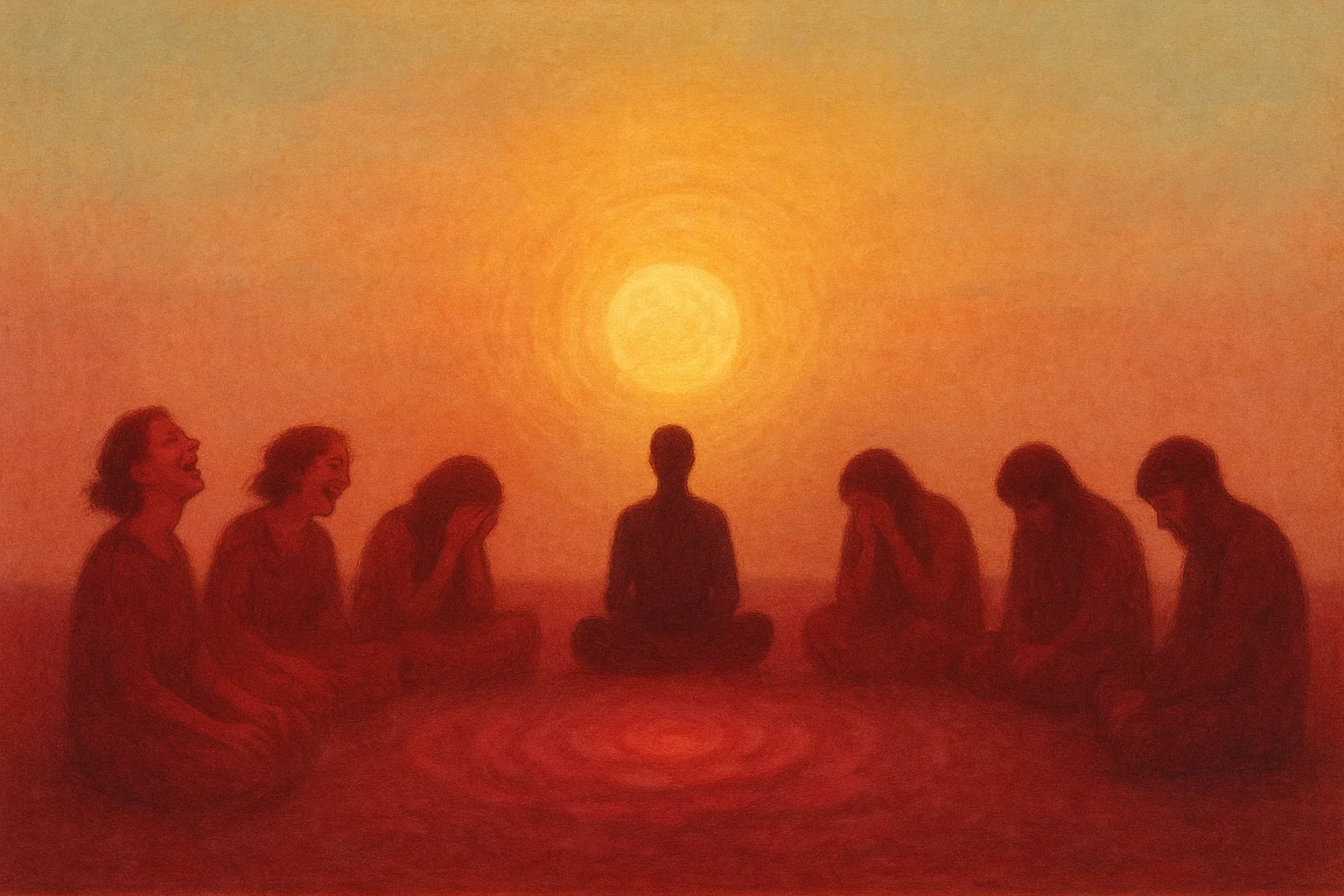
Created by Osho as a direct, experiential path into meditation, the Mystic Rose is a 21‑day group process in three distinct movements: laughter, tears, and silent witnessing. It is a profound inner cleanse for beginners and seasoned meditators alike—first melting the armor of seriousness through unreasonable laughter, then washing the heart with long‑held tears, and finally revealing the clear sky of awareness in simple, relaxed witnessing.
Osho called it a meditative therapy: nothing to believe, much to do—deeply, totally—so meditation can happen by itself. The first two weeks empty the unconscious of repressed energies; the third week lets you sit in the fragrance that remains, the watcher on the hill. The method is simple, playful, and radically effective when done as prescribed: three hours a day, for seven days per stage, with sincerity, totality, and a friendliness toward whatever arises.
Phase Instructions
First Week: Laughter Without Reason
For 7 days, 3 hours each day, laugh for no reason at all. Let the laughter begin even if it feels "as if"—fake the first sparks and allow them to catch fire. Keep the body free: stand, sit, roll, dance, shake; let the belly move and the breath flow. Keep the eyes gently closed or soft to stay inward. Do not talk, explain, or make stories—just laugh. If thoughts, shyness, or seriousness appear, include them and laugh at them too. Allow sounds, snorts, squeaks—whatever comes—without forcing a particular style. If the energy dips, lightly jiggle the body, exaggerate a chuckle, or breathe deeply into the belly to rekindle it. Respect your space and others’: move with awareness, avoid intentional contact, and give your own process full permission. When waves of laughter subside, rest in the gaps without suppressing anything; then let the next wave arise. Complete the daily 3 hours, then sit or lie quietly for a few minutes, feeling the afterglow.
Second Week: Tears and Catharsis
For the next 7 days, 3 hours each day, give yourself totally to crying. Invite the tears: let sobs, wails, whimpers, and trembling move through without restraint or apology. Keep attention inward; no talking or narrating your history—let the body speak in tears. If tears feel blocked, soften the face (let the corners of the mouth drop), remember small hurts or losses, or cradle yourself and breathe into the heart until the dam breaks. Allow images and memories to pass like clouds—feel them fully, but do not chase or dramatize them at others. Rock, curl, stamp, or hold a cushion if the body needs support; release the voice without attacking yourself or anyone else. If a dry spell comes, be with the ache beneath it, patient and present, until tears return. When a wave completes, rest in the quiet hollows it leaves, then surrender again. Finish the daily 3 hours and sit or lie down silently for a few minutes, sensing the heart clean and light.
Third Week: The Watcher on the Hill
For the final 7 days, 3 hours each day, sit in silence—simply witnessing. Sit comfortably with an upright, relaxed spine (or lie down if needed, remaining alert). Close the eyes and let the breath be natural. Do nothing: just watch. Notice sensations in the body, the flow of breath, the play of thoughts and feelings—coming and going on their own. If laughter or tears reappear, neither follow nor suppress them; allow and watch. Keep the body as still as is comfortable; when restlessness arises, see it before gently adjusting, then return to stillness. If you are pulled into thinking, acknowledge it and come back to the simple fact of breathing, to the sensations in the belly or the touch of air at the nostrils. Rest as a clear, spacious awareness in which everything appears and disappears. Complete the daily 3 hours, and let the silence echo into the rest of your day.
Core Benefits
- Melts the armor of seriousness through laughter
- Washes the heart with long-held tears
- Reveals the clear sky of awareness
- Encourages deep and total meditation
- Provides a profound inner cleanse
What Osho Said About This Technique
The second step is tears. Tears have been repressed even more deeply. It has been told to us that tears are a symptom of weakness -- they are not. Tears can cleanse not only your eyes, but your heart too. They soften you, it is a biological strategy to keep you clean, to keep you unburdened. It is now a well-known fact that less women go mad than men. And the reason has been found to be that women can cry and weep more easily than men. Even to the small child it is said, "Be a man, don't cry like a woman!" But if you look at the physiology of your body, you have the same glands full of tears whether you are man or woman. It has been found that less women commit suicide than men.
Beloved Osho, in what soil and in which climate might one find the mystic rose?
Before dying he gave his robe to a person to whom he had never spoken a single word. And the person touched the feet of Mahakashyap and again the same story... the tears of joy and gratitude and thankfulness. And the man said, "You were a great master; you have given me a great responsibility, but I promise you that I will fulfill it with my total heart." This man became the second patriarch of Zen Buddhism. And because Mahakashyap gave his robe, this became the form of choosing the successor. For all these twenty-five centuries Zen masters have chosen their successors by just giving them their bowl, their robe. It is called the transmission of the light, the opening of the mystic rose. You are asking, "In what soil and in which climate might one find the mystic rose?" Your heart is the soil. Your trust is the climate.…
SECOND STAGE Now we have to enter the second stage. Continue deep breathing, and let go of the body. Leave the body to do what it wishes to do. Let go of it. Let it take whatever asanas or postures it wants to take; let it form whatever mudras or gestures it likes. Leave it free to move and shake and whirl as it likes. If it wants to weep let it. Let go of the body completely. Continue deep breathing and let go of the body. Let the body fall down if it wants to fall down. And let it rise again if it wants to rise. And if it wants to dance allow it wholly. Let go of the body absolutely. Let it do whatever it wants to do. Leave it free. Don't impede it even in the least. Cooperate with the body. If it spins, let it.
But it is difficult to conceive of a cool welcome. We say a 'warm welcome'. Somehow, all that is hot is thought to be alive; that's not true. There is a love which is cool, absolutely cool. The love of a buddha... you will feel the coolness of it. It is like a great tree, and you are sitting under the shade of it, and a cool breeze is blowing. Or you are under a cool shower... or in a small pool of cool water in the hilly... everything silent. And the coolness is not only outside. It has entered you... you have become one with it. When this happens for the first time, one feels very much afraid, as if life is going out of one's hands, as if one will never be able to love again, never be able to be excited again.
A second friend has asked: When, in meditation, the experience of light occurs, that light too would still be a light of nature, and the seer would remain separate, wouldn’t he?
Experience—experience bliss filling you; let it spread through every fiber. And just behind bliss, the sense of the Divine begins to dawn. Following bliss, the Divine seems present everywhere. Bliss opens the door to God. Experience that God is present on all sides—only He is present, surrounding from every side; He is outside, He is within. Bliss opens the door of the Lord. Feel His nearness… Feel the presence of the Divine all around. Bliss opens the door. Now the door is open—feel the presence, feel the presence of the Divine. Experience the Lord’s presence—feel His presence. He is all around, He is all around. Experience it—the Divine stands encircling you on every side. This is the moment—do not miss it. Experience—experience clearly—experience His presence. He is the incoming breath; He is the outgoing breath. Experience—only He is present; the Divine alone is present. Rejoice—experience His presence. God stands surrounding…
दूसरे मित्र ने पूछा है कि जब ध्यान में प्रकाश का अनुभव होता है, तो वह प्रकाश भी तो प्रकृति प्रकाश ही होगा और द्रष्टा तो अलग ही रहेगा!
अनुभव करें, आनंद को भरता हुआ अनुभव करें, रोएं-रोएं तक फैल जाने दें... और आनंद के पीछे ही परमात्मा की प्रतीति शुरू हो जाती है...आनंद के पीछे ही परमात्मा सब ओर मौजूद मालूम होने लगता है...आनंद द्वार खोल देता है परमात्मा के...अनुभव करें, परमात्मा चारों ओर मौजूद है...वही मौजूद है, सब ओर से उसी ने घेर रखा है, वही बाहर है, वही भीतर है...आनंद खोल देता है द्वार प्रभु के...उसकी निकटता को अनुभव करें... फील दि प्रेजेंस ऑफ दि डिवाइन आल अराउंड...ब्लिस ओपन्स दि डोर...नाउ दि डोर इज़ ओपन, फील दि प्रेजेंस, फील दि प्रेजेंस ऑफ दि डिवाइन...प्रभु की उपस्थिति अनुभव करें...प्रभु की उपस्थिति अनुभव करें...चारों ओर वही है, चारों ओर वही है...अनुभव करें, परमात्मा चारों ओर से घेरे खड़ा है...यही मौका है, इस क्षण को न खोएं...अनुभव करें, स्पष्ट अनुभव करें, उसकी मौजूदगी अनुभव करें...वही आती श्वास में है, वही जाती श्वास में है...अनुभव करें, वही मौजूद है, परमात्मा ही मौजूद है...आनंदित हों, उसकी मौजूदगी को अनुभव करें...परमात्मा चारों ओर से घेरे खड़ा है...वही मौजूद है, और कुछ भी नहीं है...
Common Questions
Each stage lasts seven days, with three hours of practice per day.
Yes, it is suitable for both beginners and seasoned meditators.
It empties the unconscious of repressed energies, allowing for emotional release through laughter and tears.
Silent witnessing in the third week allows participants to experience awareness and relaxation.
Participants should approach the process with sincerity, totality, and friendliness toward whatever arises.