
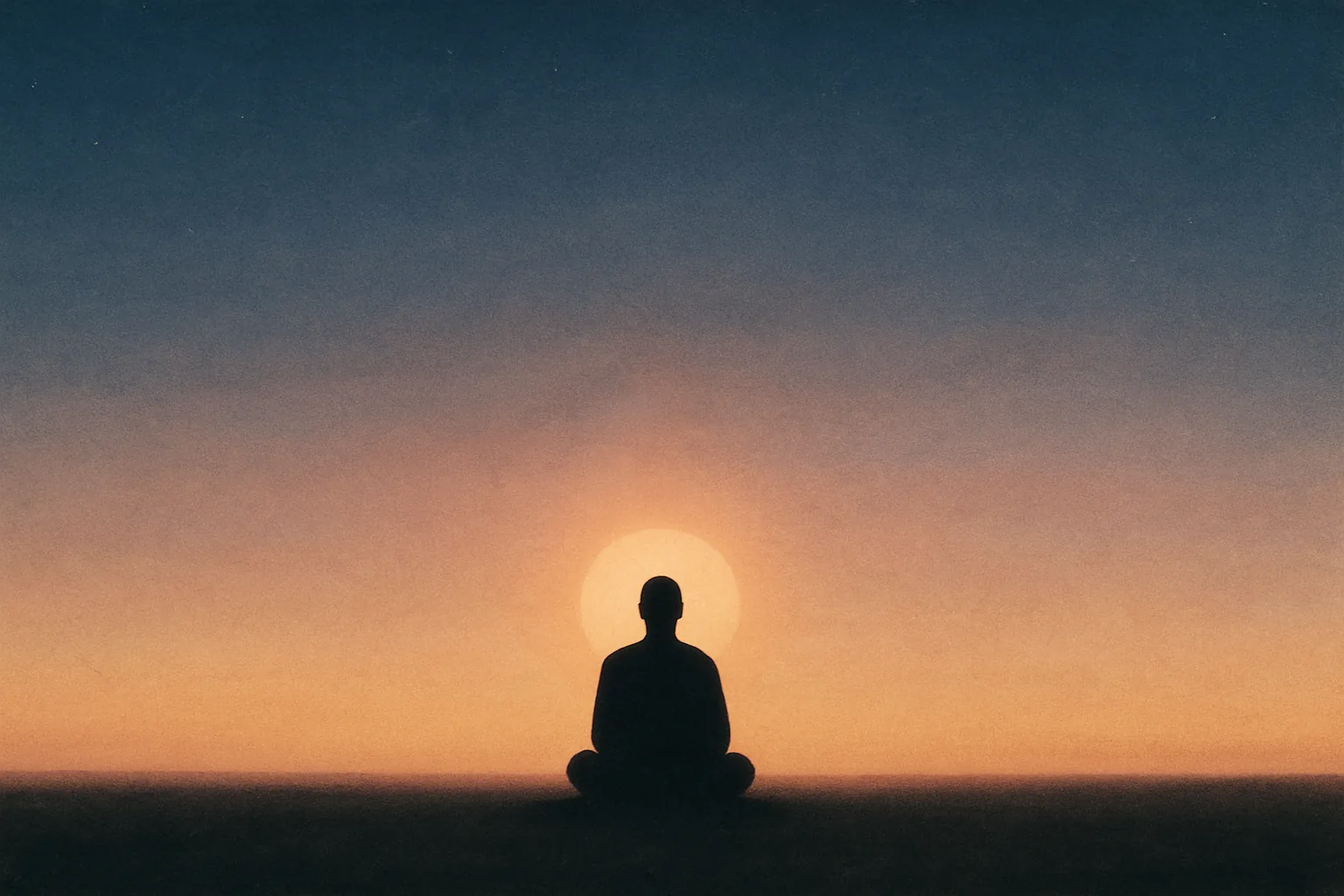
Waiting, Watching, and Non-Doing is an Osho method that invites you to meet the "dark, heavy space" within and discover that you are not it. Rather than improving, fixing, or fighting anything, you rest as a silent witness. In this effortless clarity, awareness grows pure and luminous on its own, and that very luminosity dispels the inner darkness. This is the heart of what Lao Tzu called "action by inaction" and what Zen calls "effortless effort."
Drawn from Osho’s discourse "The Rebel" (Chapter 35), this meditation turns the usual logic of doing upside down. Doing is needed in the outer world; inside, doing becomes your undoing. Here, real meditation begins when you stop intervening and simply watch—without judgment, without the desire to overcome, with patience like a watcher on the hill gazing into the valley. As you allow existence to work through non-doing, an alchemical transformation unfolds: fear loosens, silence deepens, and the light of your being reveals itself.
Phase Instructions
First Stage: Arrival and Settling
Sit comfortably with a stable, relaxed posture—on a cushion or chair—spine natural, shoulders soft, hands resting on thighs or in the lap. Let the eyes close gently or remain half-closed with a soft gaze. Allow the breath to settle into its natural rhythm. Set a simple inner resolve: today I will not do; I will only watch. No mantra, no breath control, no technique—just presence.
Second Stage: Watching the Dark Space
Turn attention inward and become aware of the inner field. Notice if a dark, heavy, or dense space is present—its texture, temperature, movement, or stillness. Acknowledge: it appears within me, but I am not it. Take the vantage of a watcher on the hills, looking down into the valleys where the darkness dwells. Do not judge it as bad or something to drop. Refrain from labeling, analyzing, visualizing light, or trying to change anything. Simply see more clearly, more intimately.
Third Stage: Non-Doing and Patient Waiting
Practice pure non-interference. Let thoughts, sensations, and the urge to fix or improve come and go without following them. If impulses to act arise, silently note them as doing, and return to witnessing. Do not manipulate breath or posture unless genuine discomfort requires a simple adjustment. Remain calm and quiet; wait, watch, and be patient. Here the purity of awareness strengthens by itself.
Fourth Stage: Allowing Luminosity to Emerge
As awareness grows clearer, you may sense a soft radiance—awareness is not only clear; it is luminous. Allow this light to naturally spread and, by its own power, dispel the darkness. Do not push, claim credit, or desire to overcome anything; let the universal inner law work. If you feel a subtle magnetic pull inward, allow it wholeheartedly without holding back, yet without forcing. Rest in effortless effort, actionless action.
Fifth Stage: Abiding and Closure
Remain a few more minutes simply as the witness—no goal, no evaluation. Recognize: I am the awareness, not the passing darkness. When it feels complete, deepen the breath slightly, sense the body, and gently open the eyes. Carry the taste of silent watching into activity, remembering that transformation continues through non-doing and patient presence.
Core Benefits
- Effortless clarity allows awareness to grow pure and luminous.
- Inner darkness is dispelled by the luminosity of awareness.
- An alchemical transformation unfolds, loosening fear.
- A deeper silence is achieved as existence works through non-doing.
- The light of your being reveals itself.
What Osho Said About This Technique
So first: now, when we sit for meditation—our entire language is the language of doing. We even say, We will do meditation. It is wrong to say, for there is no possibility of doing in meditation. But our entire language—human language—is the language of doing; we have no language for non-doing. In Japan, about a hundred and fifty years ago, there was a great monastery, a vast ashram. Some five hundred bhikshus practiced there. The emperor became eager to see it and went. The ashram spread far and wide in the forest; cottages were scattered. The head monk began to show them: In this cottage our monks cook; in this cottage they study; in this cottage they sing—here they do this, there they do that; here they bathe. In the middle stood a large building—the monk said nothing about it.
तो पहली बात, अभी जब हम ध्यान के लिए बैठेंगे, हमारी सारी भाषा करने की भाषा है। ध्यान करने बैठेंगे, ऐसा कहेंगे, गलत है कहना, क्योंकि ध्यान में करने जैसी कोई संभावना नहीं है। लेकिन हमारी सारी भाषा, मनुष्य की सारी भाषा करने की भाषा है, न-करने की हमारे पास कोई भाषा नहीं है। जापान में कोई डेढ़ सौ वर्ष पहले एक बहुत बड़ी मोनेस्ट्री थी, एक बड़ा आश्रम था। वहां कोई पांच सौ भिक्षु साधना करते थे। सम्राट उत्सुक हो गया उस आश्रम को देखने और गया। दूर-दूर जंगल में फैला हुआ वह आश्रम था, दूर-दूर फैली हुई कुटियां थीं। एक-एक कुटी को दिखाने लगा भिक्षु, जो प्रधान था और बताने लगा, इस कुटी में हमारे भिक्षु भोजन बनाते हैं, इस कुटी में हमारे भिक्षु अध्ययन करते हैं, इस कुटी में गीत गाते हैं; यहां यह करते हैं, वहां वह करते हैं; वहां स्नान करते हैं।
Meditation is always passive; the very essence of it is passive. It cannot be active because the very nature of it is non-doing. If you are doing something, your very doing disturbs the whole thing; your very doing, your very "activeness," creates the disturbance. Non-doing is meditation, but when I say non-doing is meditation I do not mean that you need not do anything. Even to achieve this non-doing, one has to do much. But this doing is not meditation. It is only a stepping stone, only a jumping board. All "doing" is just a jumping board, not meditation. You are just on the door, on the steps.... The door is non-doing, but to reach the non-doing state of mind one has to do much. But one should not confuse this doing with meditation. Life energy works in contradictions. Life exists as a dialectic: it is not a simple movement.
In 1969 followers of the Maharishi Mahesh Yogi invited Osho to talk to them. This was the first occasion on which Osho addressed a western audience, and the first time he talked publicly at length in English. The discourse has been published in OTI January 1 & 16, 1991; and February 1, 1991. Osho: Really, there can be no method as far as meditation is concerned. Meditation is not a method. Through technique, through method, you cannot go beyond mind. When you leave all methods, all techniques, you transcend mind. So meditation itself is not a method. Truth cannot be achieved through method. Method is our own invention. We, who are ignorant, have achieved knowledge through methods constructed, created, projected, in our ignorance. Through method you can achieve a sort of self-hypnosis, a sort of auto-hypnosis. Any method, whatsoever it's name, can only give you an illusory kind of peace.
Beloved master, sitting with you every day, I am becoming aware of a dark, heavy space inside me. It feels as if it is not part of me, but I know I carry it around with me. Will it disappear if I keep on watching, or do I need to do something more?
Shivam Suvarna, the path of meditation brings everyone to the awareness of a dark space within; and simultaneously, the absolute certainty that "I'm not it." All that is needed of you is just to watch and not to do anything. It seems simple, but it is the most difficult thing in the world, not to do anything. Just remain silent. Let it be there. Just look more closely, be more perceptive, more clear of all its aspects... but as far as doing is concerned, avoid it completely. Doing, in the sphere of the inner world, is your undoing. Doing is perfectly right in the outside world -- it is needed there. You cannot simply watch and things will start happening -- you have to make some effort. The inner follows just the opposite law: if you do something you get caught into doing, you lose your purity of awareness; and…
The buddha said: my doctrine is to think the thought that is unthinkable; to practise the deed that is not doing; to speak the speech that is inexpressible; and to be trained in the discipline which is beyond discipline. Those who understand this are near; those who are confused are far. The way is beyond words and expressions, is bound by nothing earthly. Lose sight of it to an inch or miss it for a moment, and we are away from it forever more.
A doctrine is arrived at through logical thinking. A doctrine comes through the process of 'about-ism'. A siddhanta is arrived at not by closing your eyes, not by thinking too much, but by dropping thinking as such, in toto; by opening your eyes with no prejudice, with no a priori conceptions, and looking direct into reality, facing reality direct. It is already there, it needs only you to be there. And when you are absolutely without any thought, your mind is still, your memory is still, your thinking has completely ceased to be, then reality erupts, explodes. Then you become a receiver. Then siddhanta arises. <q>MY SIDDHANTA IS TO THINK THE THOUGHT THAT IS UNTHINKABLE....</q> The first thing, Buddha says, is to think the thought that is unthinkable. It is a contradiction, a paradox. Now, no logician will ever utter such nonsense. It is from the very beginning nonsensical. That's…
Common Questions
This meditation emphasizes non-doing and simply watching, in contrast to traditional practices that involve active interventions.
'Effortless effort' refers to the practice of observing without judgment or striving, allowing things to unfold naturally.
Patience is necessary because it allows you to silently witness the unfolding of inner processes without the urge to intervene.