
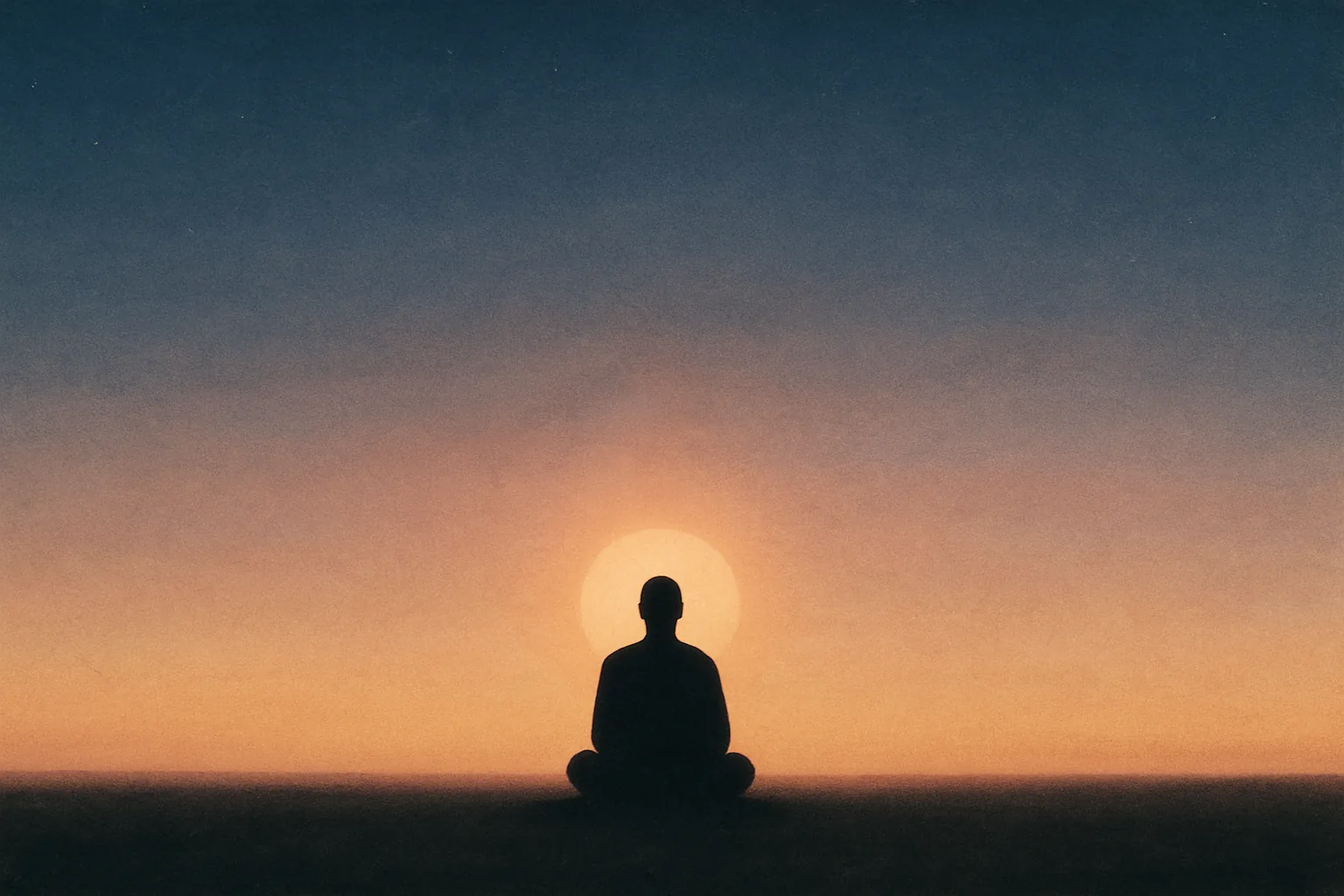
Focus on fire rising through your form, from the toes up, until the body burns to ashes—but not you. This simple, potent method draws from tantra’s direct approach and echoes the Buddha’s taste for cremation awareness. It is a solitary meditation done in privacy; to an onlooker it may not be obvious that you are meditating. The practice burns away identification with the body and gently reveals the deathless witness within.
Buddha often sent seekers to the burning ground first—to watch bodies turn to ash without analysis or conversation—so that the certainty of death became visceral, not theoretical. Here, the same spirit is invoked: an intimate, fearless meeting with impermanence. The breath becomes your ally—especially exhalation, the taste of release—so that when the inner fire ascends and the body is imagined to burn, you remain as the calm, unburnt awareness: silent, peaceful, untouched.
Phase Instructions
Preparation and Privacy
Choose a quiet time when you will not be disturbed. This meditation is done alone and requires privacy. Sit upright on a cushion or chair, or lie down if needed, keeping the spine relaxed but alert. Soften the jaw and shoulders, let the eyes close gently. Set a clear intention: to witness the body as impermanent and to discover the awareness that is not burned. If strong fear of death is present, acknowledge it and plan to emphasize the exhalation practice (Phase 3) for several sessions before proceeding deeply.
Optional but Powerful: Visit the Burning Ground
If possible, once before beginning regular practice, visit a cremation ground and silently observe one body being burned from beginning to end. Do not think about it, do not discuss, do not distract yourself—simply watch the phenomenon. Let the fact sink in that this same fate belongs to your body. If you cannot visit, contemplate quietly the certainty of death and recall that with birth, death has already begun; life and death move together like inhalation and exhalation.
Taste of Release: Emphasis on Exhalation (5–10 minutes)
Sit comfortably. For several minutes, place gentle attention on breathing out. Exhale slowly and completely; then do nothing—allow the body to inhale by itself. Do not force inhalation; let the body’s wisdom breathe in. Notice the peace that accompanies exhalation and the softening of egoic tension as you empty. If fear or restlessness arises, keep returning to a full, easy exhale and the natural, unforced inhale. This readiness—tasting the calm of letting go—prepares you for the fire meditation.
Main Practice: Fire Rising, Body to Ashes (20 minutes)
Keep eyes closed. Begin at the toes. Imagine a clear, living fire kindling at the tips of the toes. It is not painful; it is purifying. With each gentle exhalation, let the fire rise a little higher, and wherever it passes, the body is reduced to fine gray-white ash. - Feet and ankles: Feel warmth spread through the soles and heels. With the next exhale, the feet become ash—light, powdery, already released. - Calves and knees: The flame rises through the shins and calves. Exhale and see them crumble to ash. - Thighs and pelvis: Let the heat move steadily upward. As you breathe out, thighs, hips, and pelvis turn to ash—structure gone, only a light mound remains. - Lower back and belly: The fire ascends through the abdomen and lumbar region. On each exhale, organs and muscles become ash. Let thoughts subside; you do not interfere. - Chest and upper back: Feel the heart-space glow. Exhale, and ribs, lungs, and heart turn to ash. Breathing continues by itself; you remain the witness. - Hands, arms, and shoulders: Let the flame sweep from fingers to shoulders. With each exhale, arms and shoulders fall to ash. - Throat and neck: Warmth rises; with the out-breath, the neck becomes ash. - Face and head: The fire reaches jaw, mouth, tongue, eyes, and brow. Exhale and let all features dissolve to ash. Finally, allow the crown and skull to become ash as well. Throughout, keep the rhythm: exhale and release; allow the body to inhale by itself. If fear appears, notice it as a passing flicker and continue. The body is burned, but not you. You are the clear, open awareness in which this vision unfolds.
Abide as the Unburnt One (10 minutes)
Now the entire body is a quiet heap of ash. See it clearly. With a few soft breaths, let even the ash grow lighter—some of it stirred by a subtle wind, some settling into stillness. Rest in the spaciousness that remains. Nothing to hold, nothing to manage. Recognize: the witness is untouched—silent, peaceful, deathless. If thoughts come, let them drift like dust motes through empty space.
Return and Integration
Gently deepen the next two or three inhalations. Sense the living body again—weight, temperature, heartbeat. Place a hand on the heart and another on the belly; feel gratitude for the loan of this form. Open the eyes softly. Move the fingers and toes. Stand or walk slowly. For the rest of the day, revisit the exhalation often: breathe out fully and allow the body to breathe in. Let this be a quiet thread reminding you that life and death are a single movement, and that what you are is never burned.
Core Benefits
- Burns away identification with the body
- Reveals the deathless witness within
- Provides a visceral understanding of impermanence
- Uses breath as an ally for deeper meditation
- Cultivates calm, unburnt awareness
What Osho Said About This Technique
The first experiment is the experience of flowing. It is the exact opposite of swimming. In swimming we must do something; in flowing, the river does. Meditation is not like swimming; it is like flowing. When we run a shop, we must do; when we meditate, Paramatma does. We have nothing to do—only to avoid becoming an obstacle and allow Him to do what He wishes. Meditation means: we will not obstruct, and whatever Paramatma wishes to do with us, we will give Him space to do it. We will allow it; we will leave ourselves open. Let Him come and do what He will. The sun has risen outside the house and inside there is darkness. We have kept the door closed and ask someone, “We want the sun’s rays to enter—what should we do?
पहला प्रयोग है: बहने का अनुभव। बहने का अनुभव तैरने के अनुभव के ठीक उलटा है। तैरने में हमें कुछ करना पड़ता है। बहने में नदी कुछ करती है। ध्यान तैरने जैसा नहीं है, बहने जैसा है। दुकान हम चलाते हैं तो हमें कुछ करना पड़ता है, ध्यान हम करते हैं तो परमात्मा कुछ करता है। हमें कुछ भी नहीं करना पड़ता। हमें इतना ही करना पड़ता है कि हम उसे बाधा न दें और वह जो करना चाहता है उसे करने दें। ध्यान का अर्थ है, हम बाधा न देंगे और परमात्मा जो भी हमारे साथ करना चाहता है हम उसे करने के लिए सुविधा देंगे। हम उसे करने देंगे, हम अपने को खुला छोड़ देंगे। वह आ जाए और जो उसे करना हो कर ले।
Drift in the river—so that the exact experience of drifting dawns within, what drifting means. This will become the first step of meditation. Recognize it well. Two mountains shine in sunlight; the river runs between them; we too are drifting along. And as you drift, such peace will be felt, such freshness will surround you, such bliss will begin to arise within; all worries will fall away, all burdens will drop. For all worries belong to the swimmer; the drifter has no need of worry. All tensions will fall, for all tensions belong to the swimmer; the drifter has no need of tension. Now I am silent. Keep drifting for five minutes. Leave yourself utterly loose and drift. Let go. Drift. Completely drift. Surrender into the river and drift. The river rushes on and you are carried along. Let go. Drift. Completely drift. Let go.
नदी भाग रही है, नदी तेजी से भाग रही है.उसे देखते-देखते ही मन पर हलकी शांति छा जाएगी। अब इस नदी में हमें भी उतर जाना है। उतर जाएं। मन के चित्र पर, मन की कल्पना पर देखें कि हम भी इस नदी में उतर गए--और तैरना नहीं है, बहना है--और इस नदी में बहने लगे। जैसे एक सूखा पत्ता नदी में बहने लगे। अब सूखा पत्ता तैरेगा कैसे? उसके पास हाथ-पैर ही नहीं हैं। सूखे पत्ते की भांति हो जाएं और नदी में बहना शुरू कर दें। लहरें बहाने लगेंगी, बहाने लगेंगी। सागर की तरफ नदी भागने लगेगी, आप भी उसके साथ बहने लगेंगे। नदी के साथ एक हो जाएं। अब पांच मिनट के लिए नदी के साथ बहने का अनुभव करें। सिर्फ बहने का। ध्यान रहे, तैरना नहीं है। हाथ-पैर मत चलाना, छोड़ देना अपने को। नदी डुबाए तो डूब जाना, उबारे तो उबर आना। जहां ले जाए वहां चले जाना। हमारी कोई मंजिल नहीं है, हम बहने को तैयार हैं। अब मैं पांच मिनट के लिए चुप हो जाता हूं। आप नदी में बहें। ताकि बहने का ठीक-ठीक अनुभव खयाल में आ जाए कि बहने का अर्थ क्या है। …
My beloved Atman! Meditation means: surrender, a total let-go. Meditation means: to drop oneself utterly. And the moment a person drops himself totally, he falls into the hands of Paramatma. So long as we are holding on to ourselves, union with the supreme power is not possible. We will have to drop ourselves. We will have to lose ourselves. We will have to vanish; only then can we become one with that which truly is. If a wave clings tightly to itself, it can never be the ocean; and if the wave lets itself go, dissolves, disappears, it is the ocean itself. Meditation is not some act to be done. Meditation is the dropping of all acts. Meditation is not a practice you can perform. Meditation is the dropping of all practices. Meditation is simply to remain—as we are, what we are. And to do nothing.
और जैसे ही कोई व्यक्ति अपने को पूरी तरह छोड़ देता है, वह परमात्मा के हाथों में गिर जाता है। जब तक हम अपने को पकड़े हुए हैं, तब तक परम शक्ति से हमारा मिलन नहीं हो सकता। हमें अपने को छोड़ना ही पड़ेगा। हमें अपने को खो ही देना होगा। हमें मिटना ही होगा, तभी हम उसके साथ एक हो सकते हैं, जो सच में है। जैसे कोई लहर अपने को जोर से पकड़ ले, तो फिर सागर नहीं हो सकती है और लहर अपने को छोड़ दे, बिखर जाए, खो जाए, तो वह सागर है ही। ध्यान कोई क्रिया नहीं है, जो आपको करनी है। ध्यान है सब क्रियाओं का छोड़ देना। ध्यान कोई अभ्यास नहीं है जो आप कर सकते हैं। ध्यान है सब अभ्यास का छोड़ देना। ध्यान है बस रह जाना--जैसे हम हैं, जो हम हैं। और कुछ भी न करना।
Common Questions
The core purpose is to burn away identification with the body and reveal the deathless witness within.
Yes, it is a solitary meditation done in privacy to ensure a personal and intimate experience.
Fire is imagined to rise through the body, symbolically burning it to ashes to detach from bodily identification.
No physical actions are necessary; it is a mental visualization and internal experience.
To an onlooker, it may not be obvious that you are meditating, as it is an internal process.